PTE for Accountants: CPA Australia Skills Assessment from Nepal (2026)
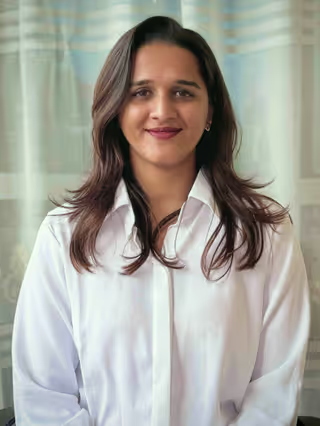
Smriti Simkhada
90/90 Perfect Scorer
Updated September 2026 · Reviewed by Smriti Simkhada (90/90)
Introduction
If you are a Nepali accounting graduate planning to migrate to Australia, your PTE score sits at the centre of two separate immigration gates. PTE for accountants Australia PR is not a single hurdle — you need one score for your CPA Australia skills assessment and a different score for the Department of Home Affairs (DHA) visa points. Most Nepali candidates we coach in Bharatpur and Kathmandu underestimate how strict the assessing authorities have become, especially after CPA Australia revised its English thresholds in August 2025.
This guide covers exactly what score you need, what changed in 2025, how your Nepali credentials (BBS, BBA, ACCA, CA Nepal) map to CPA Australia recognition, and a realistic 6-week preparation plan. We focus on ANZSCO codes 221111 (Accountant General), 221112 (Management Accountant), and 221113 (Taxation Accountant) — the three codes most Nepali accountants pursue for Subclass 189, 190, and 491 visas. By the end, you will know whether to target Proficient (10 points) or Superior (20 points) English, and how to get there from Nepal.
Stuck below your target? The 79+ Sprint
Private 1-on-1 coaching, from US$99: pick 7 days, 17 days or 1 month, one live session a day on your time zone (Sydney · Melbourne · Toronto · London · Doha), a demo session included, and Coach-Until-Target on the longer plans.
What CPA Australia Changed on 7 August 2025
On 7 August 2025, CPA Australia updated the minimum PTE Academic scores accepted for its skills assessment. The new thresholds are not aligned to a flat 65 across all bands — each section now has its own floor. This caught a lot of Nepali applicants off guard because older blog posts and migration agent PDFs still quote the previous numbers.
(As of writing — verify current figures with CPA Australia before you book your test.)
CPA Australia Minimum PTE Scores (Aug 2025 update)
| Skill | Minimum PTE Academic Score |
|---|---|
| Listening | 58 |
| Reading | 59 |
| Writing | 69 |
| Speaking | 76 |
Notice the asymmetry: Speaking demands a 76, which corresponds roughly to IELTS Speaking 7.5 (not 7.0+; PTE 76 sits between the IELTS 7.5 equivalent of PTE 71 and the IELTS 8.0 equivalent of PTE 79), while Listening sits at 58 (IELTS ~6.5). For most Nepali test-takers, Speaking and Writing are the choke points — exactly the two sections we will spend the most time on later in this article.
ANZSCO Codes Covered for Nepali Accountants
CPA Australia assesses three primary occupations for skilled migration. Choose the one that best matches your Nepali work experience and academic background:
- 221111 Accountant (General) — broad accounting roles, audit assistants, junior CAs, BBS/BBA grads in general practice
- 221112 Management Accountant — costing, budgeting, FP&A, internal management reporting roles
- 221113 Taxation Accountant — tax preparation, tax advisory, IRD-related roles in Nepal
All three codes appear on Australia's Medium and Long-term Strategic Skills List (MLTSSL), which determines eligibility for Subclass 189 (independent), 190 (state-nominated), and 491 (regional). The English requirements from CPA Australia are identical across the three — the difference shows up in state nomination criteria, not in the assessment.
The Two Gates: CPA Assessment vs DHA Visa Points
This is where most Nepali candidates get confused. You actually need to think about CPA Australia PTE score Nepal requirements as two separate decisions:
Gate 1 — CPA Australia Skills Assessment
CPA Australia must issue a positive skills assessment before you can submit an Expression of Interest (EOI). For this, you need the section minimums above (L58 / R59 / W69 / S76). This is a pass/fail gate — meeting these scores does not earn PR points, it just unlocks the assessment.
Gate 2 — DHA Visa Points (Subclass 189/190/491)
Separately, the Department of Home Affairs awards points based on overall English proficiency:
- Competent English — PTE Listening 47, Reading 48, Writing 51, Speaking 54 → 0 points (just meets visa eligibility)
- Proficient English — PTE Listening 58, Reading 59, Writing 69, Speaking 76 → 10 PR points
- Superior English — PTE Listening 69, Reading 70, Writing 85, Speaking 88 → 20 PR points
- Note: thresholds above are the post-7-Aug-2025 DHA component-specific bands. The legacy uniform 50/65/79 rule applies only to tests taken on or before 6 Aug 2025. Source: Pearson DHA update.
Here is the trap: CPA Australia's Aug 2025 minimums (Speaking 76, Writing 69) sit between Proficient and Superior. So if you only target the CPA minimums, you will get the assessment but earn just 10 points from DHA. To bank the full 20 points, you must hit the Superior English component-specific bands — Listening 69, Reading 70, Writing 85, Speaking 88 (effective 7 August 2025) — that is the real target for serious Nepali applicants chasing competitive cut-offs.
Score Map: Functional → Proficient → Superior
Use this as your goal-setting framework before you book your first test:
- Tier 1 — CPA Australia minimum (= DHA Proficient post-7-Aug-2025): L58 / R59 / W69 / S76 (per-component) — unlocks the CPA skills assessment and earns 10 DHA points
- Tier 2 — Proficient (10 PR points): L58, R59, W69, S76 (per-component, post-7-Aug-2025) — note this is the same per-component requirement as the CPA minimum above
- Tier 3 — Superior (20 PR points): L69, R70, W85, S88 (per-component, post-7-Aug-2025) — the realistic target if you want a competitive 189/190 invitation
For ANZSCO 221111/221112/221113, the November 2025 SkillSelect invitation round (the most recent canonical data) showed a benchmark of approximately 85 points for most professional occupations — verify the latest round data at the DHA SkillSelect invitations page as cut-offs vary by round. Most successful Nepali applicants are aiming for Superior English (20 points) plus other point boosters like Australian study, NAATI, or partner skills.
Mapping Nepali Credentials to CPA Australia Recognition
CPA Australia assesses your qualification against the Australian Qualifications Framework (AQF). Here is how common Nepali accounting credentials typically map (always verify with a CPA Australia migration assessment — this is indicative):
Bachelor of Business Studies (BBS) — TU
A 4-year BBS from Tribhuvan University with an accounting major is generally assessed as comparable to an Australian bachelor's degree. Coverage of the nine CPA core knowledge areas is the deciding factor — gaps (typically in audit, taxation, or business law) may require bridging units.
BBA / BBA-Finance
BBA programs from Pokhara University, Kathmandu University, or Purbanchal University are similarly assessed. Accounting major and unit-by-unit syllabus mapping matter more than the degree title.
ACCA (Association of Chartered Certified Accountants)
ACCA-qualified members hold a globally recognised credential. CPA Australia has historically had Mutual Recognition Agreements (MRA) with ACCA — confirm current MRA status, but ACCA Affiliate or Member status often eases the assessment significantly.
CA Nepal (ICAN)
Chartered Accountants from the Institute of Chartered Accountants of Nepal are typically assessed favourably for ANZSCO 221111. The depth of CA training in audit, tax, and financial reporting usually maps well to CPA core areas, though English score remains the constraint.
Regardless of credential, the English score is the gate that fails most Nepali applicants — not the academic mapping.
Why Nepali Accountants Struggle on Speaking and Writing
In our 1-on-1 mentorship sessions with accounting candidates, we see consistent patterns:
Speaking (target 76+ for CPA, 88 for Superior)
- Read Aloud — Nepali speakers often soften consonants and stress the wrong syllables in technical English ("aˈccount" vs "ˈaccount"). The PTE AI scorer is unforgiving on word stress.
- Repeat Sentence — short-term memory of unfamiliar accents (Australian, British) is a real weakness if you only listened to American content during your degree.
- Describe Image — accountants love numbers but freeze on graphs. The 25-second prep window is too short if you have not drilled a fixed template.
Writing (target 69+ for CPA, 85 for Superior)
- Summarize Written Text — the 1-sentence, 75-word constraint trips up writers used to long Nepali-English business reports.
- Essay — 200-300 words, formal register, clear thesis. Accountants often write conversationally or stuff in jargon without explaining it.
- Grammar and spelling carry heavy weight — small errors compound fast.
6-Week Preparation Plan for Nepali Accountants
Week 1 — Diagnostic and Foundation
- Take one full PTE mock test (free or paid). Identify your weakest section.
- Drill pronunciation: 20 minutes/day on Read Aloud with recording playback.
- Build a 200-word business/finance vocabulary list from official PTE practice material.
Week 2 — Speaking Intensive
- Daily 30-minute Read Aloud + Repeat Sentence drills.
- Master Describe Image with a 4-part template: overview → highest → lowest → trend.
- Record yourself daily, compare against native audio.
Week 3 — Writing Intensive
- Write 1 Summarize Written Text + 1 Essay daily, timed.
- Use a fixed 4-paragraph essay template (intro, two body paragraphs, conclusion).
- Get external feedback — self-grading misses grammar errors.
Week 4 — Reading and Listening
- 30 minutes/day on Reading Fill-in-the-Blanks (collocations matter).
- 30 minutes/day on Write from Dictation — the highest-leverage Listening task.
- Listen to Australian podcasts (ABC News) for accent exposure.
Week 5 — Full Mocks
- Two full mock tests this week, simulated test conditions.
- Review each section, build an error log.
- Re-drill weakest task type for 2 hours.
Week 6 — Polish and Test
- One final mock at the start of the week.
- Light revision only — avoid burnout 48 hours before the test.
- Book your real test at the Pearson centre in Kathmandu or Bharatpur.
See our dedicated PTE coaching for accountants page for the CPA Australia and CA ANZ English requirements and a tailored strategy.
Tips for Nepali Accounting Graduates
- Technical vocabulary is a double-edged sword — your accounting English helps in Reading and Listening but tempts you to overcomplicate Writing. Keep essays simple and clear.
- Time management is your edge — accountants are trained for time discipline. Use that. Practice with a stopwatch from day one.
- Test centre logistics — Pearson centres operate in Kathmandu (multiple) and Bharatpur. Book 2-3 weeks ahead. The PTE Academic list price in Nepal is USD 220 (since March 2026), which comes to roughly NPR 32,000-33,000 at checkout depending on the exchange rate — confirm the exact amount at booking.
- Pick your test window carefully — avoid the audit busy season (Asar end / mid-July in Nepal). Schedule your prep when your client load is lighter.
- Do not skip Speaking practice because you "speak English at work" — workplace English is not PTE English. The AI scorer rewards clarity, fluency, and pronunciation, not vocabulary depth.
- Get structured 1-on-1 feedback — for accountants targeting 79+, our 1-on-1 mentorship includes scored mock essays and pronunciation diagnostics that group classes cannot match.
See our PTE coaching for accountants (CPA) page for the CPA / CA ANZ English requirement and strategy.
Frequently Asked Questions
Q: Does CPA Australia accept PTE Core for skills assessment?
A: As of writing, CPA Australia accepts PTE Academic, not PTE Core. PTE Core is primarily for Canadian immigration. For Australian skills assessment and PR, you need PTE Academic. Always verify on the CPA Australia website before booking.
Q: What if my Bachelor's degree is from a Nepali university — will CPA Australia accept it?
A: Yes, CPA Australia assesses Nepali bachelor's degrees (BBS, BBA) on a unit-by-unit basis against the nine core knowledge areas. The degree itself is generally recognised — gaps in specific subjects (audit, taxation, commercial law) may require bridging units after migration.
Q: How long does the CPA Australia skills assessment take?
A: Standard processing is typically 8-12 weeks once all documents (transcripts, English score, work experience) are submitted. Expedited processing is available at extra cost. Book your PTE Academic test early so the score is ready when you submit.
Q: PTE vs IELTS for CPA Australia — which is better for Nepali candidates?
A: PTE Academic is generally faster (results in 2 business days vs IELTS 3-13 days), AI-scored (less subjective), and many Nepali test-takers find Speaking easier because there is no human examiner. IELTS suits candidates strong in handwritten Writing. CPA accepts both — pick the one that matches your strengths.
Q: Do I need Superior English (79+) or is Proficient (65+) enough?
A: For ANZSCO 221111/221112/221113, the November 2025 SkillSelect round showed a benchmark of approximately 85 points for most professional occupations (verify the latest round data at immi.homeaffairs.gov.au as cut-offs vary). Proficient (10 points) is rarely enough — most successful Nepali applicants target Superior English (20 points) to stay competitive. If you have a state nomination (190) or regional offer (491), Proficient may suffice.
Q: I scored 70 in Writing but 75 in Speaking — does CPA accept this?
A: Writing 70 is above the CPA minimum of 69, but Speaking 75 is below the minimum of 76. CPA Australia requires all four sections to meet the minimum simultaneously. You would need to retake until Speaking hits 76+. Each section is gated independently.
Q: Can I use older PTE results from before August 2025?
A: Pearson's score-report access window is 2 years from the test date. For Australian visa and immigration purposes, DHA/Home Affairs accepts PTE Academic results for approximately 3 years from the test date — so a valid test taken in 2023 or 2024 may still be accepted for PR purposes even after Pearson's own 2-year report-access window. However, if you book your CPA assessment after 7 August 2025, the new section minimums apply regardless of when you took the test. Always verify current validity rules with DHA or a registered migration agent.
Q: Where can Nepali accountants take the PTE Academic test?
A: Pearson VUE test centres in Nepal include locations in Kathmandu and Bharatpur. The test is computer-based and runs roughly 2 hours. Booking is done through the official Pearson PTE website. The test fee in Nepal is USD 220 list price — approximately NPR 32,000-33,000 at checkout (verify current pricing at the time of booking).
Conclusion
For Nepali accountants serious about CPA Australia and Australian PR, PTE for accountants Australia PR is a two-gate problem: the CPA assessment minimum (L58/R59/W69/S76 as of Aug 2025) and the DHA Superior English target (L69/R70/W85/S88 post-7-Aug-2025). Aim for the higher target from day one. Treating the CPA minimum as your goal will leave you 10 PR points short and uncompetitive in the EOI pool.
If you are an ICAN-qualified CA, ACCA member, or BBS/BBA graduate planning your move from Nepal, structured preparation makes the difference between a 65 and a 79. Our 1-on-1 mentorship is built for working professionals who need flexible Sydney/Melbourne-friendly time slots and section-specific drills. Explore our PTE Academic guide, Australia PTE coaching page, or read more about your instructor to start your CPA Australia journey from Nepal.
Continue on PTE Nepal: CPA section on Australia hub, Subclass 189 PR pillar, and Sydney 1-on-1 coaching.
Last fact-checked on 2026-05-08 against official sources (Pearson PTE, Australia Department of Home Affairs, AHPRA, IRCC, GOV.UK, INZ). Test fees, score requirements, and visa rules can change at any time — always verify the latest details on the relevant official website before booking or applying.
About Smriti Simkhada
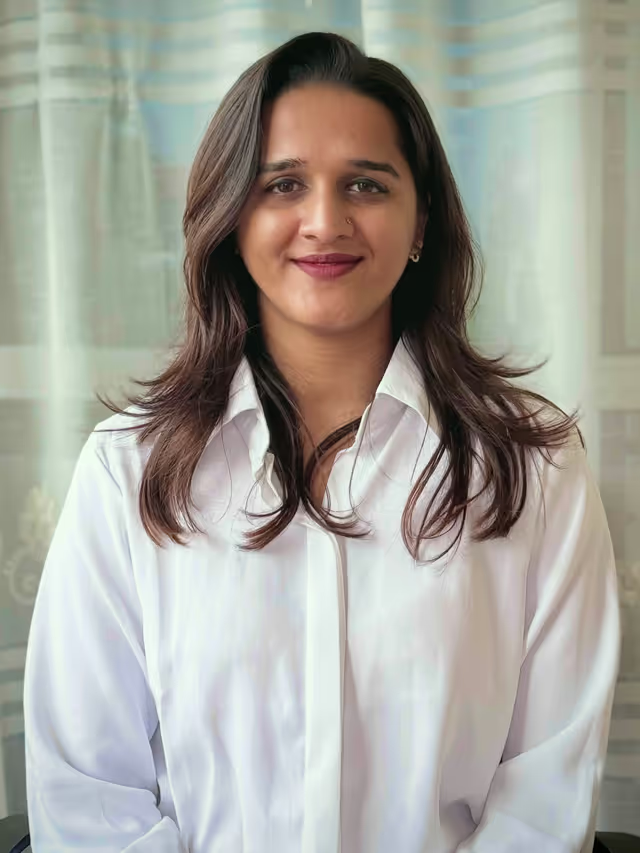
Smriti Simkhada is a PTE Academic perfect scorer (90/90) providing structured PTE coaching for Nepali students. She has helped over 1,000 students prepare for Australia PR and Canada immigration through structured, criteria-aligned coaching.
