PTE Score for ACS Skills Assessment: Software Developers Australia 2026

By Smriti Simkhada (90/90) · Updated
⚡ Quick answer
The ACS skills assessment requires no PTE or English test score at all. ACS does not ask for PTE Academic results. You need PTE later, at the Department of Home Affairs (DHA) visa stage, to claim English points: Proficient (10 points) needs L58 R59 W69 S76, and Superior (20 points) needs L69 R70 W85 S88.
— Verified by Smriti Simkhada, PTE Academic 90/90 (PTE Nepal).
Introduction
If you're a software developer, web developer, or IT professional from Nepal planning to migrate to Australia, you'll need an ACS (Australian Computer Society) Skills Assessment — not Engineers Australia. Unlike traditional engineering roles that require CDR reports through Engineers Australia, IT professionals must go through ACS, which has completely different documentation requirements.
This guide covers ACS assessment pathways, occupation codes for ICT professionals, PTE Academic score targets for Australian visa points, and the migration strategy that works for Nepali BCA/BIT graduates, diploma holders, and non-engineering tech workers targeting Australia Subclass 189/190/491 visas in 2026.
Whether you studied computer science at Kathmandu University, completed a BIT program, graduated from a coding bootcamp, or are entirely self-taught with strong GitHub portfolios, this article explains how ACS assessment works and what PTE Academic scores you need for maximum migration points.
Always confirm the latest requirements on the official Department of Home Affairs (DHA) and ACS websites before applying, as thresholds and policies change.
Stuck below your target? The 79+ Sprint
Private 1-on-1 coaching, from US$99: pick 7 days, 17 days or 1 month, one live session a day at a time that suits you, a demo session included, and Coach-Until-Target on the longer plans.
What Is ACS Skills Assessment?
ACS (Australian Computer Society) is the designated assessing authority for ICT (Information and Communication Technology) professionals applying for Australian skilled migration. If your occupation falls under ANZSCO Division 2 ICT categories (261xxx, 262xxx, 263xxx), you must obtain ACS Skills Assessment before lodging your Expression of Interest (EOI) for PR.
ACS vs Engineers Australia (EA)
Many Nepali students confuse ACS with Engineers Australia. Here's the critical difference:
- Engineers Australia (EA): Assesses traditional engineering disciplines (Civil, Mechanical, Electrical, Chemical, etc.). Requires CDR (Competency Demonstration Report) with 3 Career Episodes.
- ACS (Australian Computer Society): Assesses ICT professionals (Software Engineers, Developers, System Analysts, Cybersecurity Specialists, ICT Managers). Requires Project Report or RPL documentation, not CDR.
- Important distinction on English requirements: ACS does not require English language test results (such as PTE Academic) for its skills assessment. Your PTE Academic score is needed separately for Australian visa purposes — to claim English proficiency points and meet DHA's visa English requirements. These are two separate stages in your migration process. See the ACS website for current application requirements.
Who Needs ACS Assessment?
You need ACS if your occupation code is:
- 261313 - Software Engineer: Most common for general software developers (highest competition, capped occupation)
- 261312 - Developer Programmer: Application developers, full-stack developers, mobile app developers
- 262112 - ICT Security Specialist: Cybersecurity professionals, penetration testers, security analysts
- 261311 - Analyst Programmer: Business analysts with coding responsibilities
- 135111 - Chief Information Officer (CIO): Senior ICT management (requires extensive leadership experience)
- 263111 - Computer Network and Systems Engineer: DevOps, cloud engineers, network architects
If you're working as a web developer, backend engineer, frontend developer, mobile app developer, or DevOps engineer in Nepal, you'll likely apply under 261313 (Software Engineer) or 261312 (Developer Programmer).
PTE Academic Score Requirements for Australian Visa (After ACS Assessment)
Remember: ACS does not require PTE or any English test for its skills assessment. However, once your ACS assessment is complete, your PTE Academic score matters significantly for Australian visa purposes — specifically for claiming English proficiency points in the points test and meeting visa English requirements.
Important 2025 Update — New PTE Score Thresholds: For PTE Academic tests taken on or after 7 August 2025, the Department of Home Affairs uses new per-skill score thresholds rather than a single uniform score across all bands. Always check the DHA English language requirements page for the thresholds applicable to your visa subclass and test date.
English Level Thresholds and Migration Points (Post-7 August 2025)
For tests taken on or after 7 August 2025:
- Competent English — 0 points, meets minimum visa requirement. Thresholds: Listening 47, Reading 48, Writing 51, Speaking 54 (minimum in each component). Older tests taken on or before 6 Aug 2025 may be assessed under transition rules — confirm with your immigration agent.
- Proficient English — 10 points. Thresholds: Listening 58, Reading 59, Writing 69, Speaking 76 (minimum in each component).
- Superior English — 20 points. Thresholds: Listening 69, Reading 70, Writing 85, Speaking 88 (minimum in each component).
These thresholds apply to tests taken on or after 7 August 2025. If you sat the test before this date, confirm the applicable thresholds with your immigration agent or check the DHA website.
Competitive PTE Score for Software Engineers (261313) in 2026
Here's the reality: 261313 Software Engineer is a capped occupation with extremely high competition. Recent invitation rounds for Subclass 189 have hovered around the 85-90 points range, and most invited candidates meet Superior English thresholds (Listening 69, Reading 70, Writing 85, Speaking 88) or achieve even higher scores.
| English Level | PTE Thresholds (Post-7 Aug 2025, Each Component) | Migration Points | Competitive for 261313? |
|---|---|---|---|
| Competent | L47, R48, W51, S54 | 0 points | ❌ Not competitive |
| Proficient | L58, R59, W69, S76 | 10 points | ⚠️ Unlikely (need state nomination) |
| Superior | L69, R70, W85, S88 | 20 points | ✓ Competitive (combined with age/experience) |
| Above Superior thresholds | Higher scores across all components | 20 points | ✓ Highly competitive |
Check the DHA English language requirements page for your visa subclass before booking or lodging your application.
Target PTE Score for Software Developers (Nepal Context)
Based on 2026 invitation trends and occupation ceilings, Nepali software developers should target:
- Subclass 189 (Independent): No mandatory English minimum above Competent at grant stage — English bands are points-test components, not visa-grant minimums. Competent (0 pts) meets the grant requirement; Superior (L69, R70, W85, S88 = +20 pts) is strongly recommended competitively. You're competing against developers from many countries with similar profiles.
- Subclass 190 (State Nomination): No DHA-mandated Proficient English floor for grant — English bands are points components. Proficient adds +10 pts; Superior is highly preferred. States may set their own nomination criteria separately. States like Victoria, NSW, South Australia prioritize higher English scores for nomination.
- Subclass 491 (Regional): No mandatory English minimum above Competent at DHA grant stage. Proficient adds +10 pts; 8+ years overseas skilled employment adds +15 pts; regional nomination adds +15 pts. Aim for Proficient or Superior for a competitive profile targeting regional areas with ICT demand (Tasmania, NT, SA regional).
Bottom line: If you want a realistic chance at PR as a software developer, aim to meet or exceed the Superior English thresholds. This gives you 20 English points and puts you in the competitive pool for quarterly invitations.
ACS Assessment Pathways for Nepali IT Professionals
ACS offers multiple pathways depending on your educational background. Unlike Engineers Australia's rigid CDR format, ACS is more flexible but requires careful documentation of your ICT qualifications and work experience. Note that English test results are not part of the ACS skills assessment documentation — they are submitted separately when you apply for your visa or lodge your EOI.
Pathway 1: ICT Major Qualification (Standard Route)
If you have a Bachelor's or Master's degree in Computer Science, Software Engineering, IT, Information Systems, or related ICT fields from a recognized university, you qualify for the standard pathway.
Eligible degrees for Nepali students:
- BE Computer Engineering (IOE, Kathmandu University)
- BSc Computer Science and Information Technology (CSIT) - Tribhuvan University
- Bachelor of Information Technology (BIT) - KU
- Bachelor of Computer Application (BCA) - TU
- MSc IT, MSc Computer Science from recognized universities
Work experience required after qualification:
- Bachelor's in ICT: 2 years relevant work experience required
- Master's in ICT: No work experience required if Master's closely relates to nominated occupation
ACS will assess your degree and deduct 2-4 years from your total work experience depending on how closely your degree matches your nominated occupation. For example, if you have a BCA degree and 5 years as a software developer, ACS might recognize only 3 years of skilled employment after deducting the "learning period."
Pathway 2: ICT Minor Qualification
If your degree is partially related to ICT (e.g., Bachelor's in Electronics with minor in programming, or MBS with IT electives), ACS requires:
- 4 years of relevant ICT work experience after graduation
- Detailed Project Report showing how you transitioned into ICT roles
This pathway works for Nepali students who completed BE Electronics, BE Electrical, or even some business degrees (BBS, MBS) but moved into software development or IT roles post-graduation.
Pathway 3: RPL (Recognition of Prior Learning) — For Non-Degree Holders
This is the pathway for bootcamp graduates, diploma holders, self-taught developers, and career switchers without a formal ICT degree. RPL is the most documentation-intensive but opens migration pathways for non-traditional tech workers.
Who qualifies for RPL?
- Coding bootcamp graduates
- Diploma in IT/Software (CTEVT diploma in Nepal, or international diplomas)
- Self-taught developers with strong GitHub portfolios and 6+ years of verifiable employment
- Career switchers from non-ICT degrees who worked as developers for 6+ years
RPL Requirements:
- 6 years of relevant ICT work experience in the last 10 years (closely related to nominated occupation)
- Two detailed Project Reports (each 2,000+ words) documenting your ICT skills and responsibilities
- Vendor certifications (AWS Certified Solutions Architect, Microsoft Azure certifications, CISSP, etc.) strengthen your case but are not mandatory
- Portfolio documentation: GitHub repositories, live project URLs, client testimonials, code samples
- Employment references: Statutory declarations from supervisors confirming your ICT duties
Example RPL candidate profile (Nepal):
Ramesh completed BBS (Bachelor of Business Studies) from TU in 2016, then joined a coding bootcamp in Kathmandu. He worked as a junior web developer from 2017-2019, then moved to a Nepali software company as a full-stack developer (2019-2023). In 2024, he became a senior developer at a fintech startup. Total ICT experience: 7 years. He applies via RPL pathway, submits two Project Reports detailing his MERN stack projects, includes GitHub links to 15+ repositories, and gets ACS approval under 261312 (Developer Programmer).
ACS Project Report vs Engineers Australia CDR
Many Nepali students preparing for EA CDR think ACS requires the same format. It doesn't. Here's the difference:
| Aspect | EA CDR (Engineering) | ACS Project Report (ICT) |
|---|---|---|
| Format | 3 Career Episodes (1,000 words each) | 2 Project Reports (2,000+ words each for RPL) |
| Focus | Engineering competencies (EA Stage 1 & 2) | ICT skills application, problem-solving, technical depth |
| Documentation | Highly structured (Introduction, Background, Personal Engineering Activity, Summary) | Flexible structure: Project overview, your role, technologies, challenges, outcomes |
| Plagiarism Check | Strict Turnitin checks | Strict plagiarism checks, must be original |
| Evidence | Employment references, degree transcripts | Employment references, degree (or RPL portfolio), vendor certs (optional) |
What to Include in ACS Project Reports
For each project, address:
- Project Title and Duration: "E-commerce Platform Development (Jan 2022 - Aug 2022)"
- Organization Name: Employer or client name, location
- Your Role and Responsibilities: "Senior Full-Stack Developer responsible for backend API design, database architecture, and deployment automation"
- Technologies Used: List programming languages, frameworks, databases, cloud services (e.g., "Node.js, Express, MongoDB, React, AWS EC2, Docker, Jenkins CI/CD")
- Problem Statement: What business/technical problem did the project solve?
- Your Technical Contributions: Describe your code, design decisions, optimizations (be specific: "Implemented Redis caching reducing API response time from 800ms to 120ms")
- Challenges and Solutions: Technical obstacles you overcame
- Outcome and Impact: Business results, user metrics, performance improvements
PTE Academic Preparation Strategy for Software Developers
Software developers from Nepal often have an advantage in PTE Academic due to strong vocabulary exposure from reading documentation, Stack Overflow, and technical blogs. However, many struggle with Speaking fluency and Writing essay structure.
PTE Academic is primarily scored by Pearson's AI system. Since the 2025 update, some response types may also be part-scored or reviewed by human experts, though pronunciation and oral fluency are not assessed by human examiners. These strategies can improve consistency, but your score depends on your English ability, task performance, and official scoring criteria.
Leverage Your Tech Background in PTE
- Reading: Technical developers are used to parsing complex documentation, API references, and research papers. This translates directly to PTE Reading Fill in the Blanks (collocations) and multiple-choice questions. Use your analytical mindset to eliminate wrong options.
- Writing: Treat PTE essays like technical documentation. Use clear structure (Introduction → Body Paragraphs → Conclusion), just like you'd structure a README file or technical proposal. Avoid overly creative language; prioritize clarity and grammar accuracy.
- Listening: PTE Listening rewards note-taking skills. Use the same shorthand you'd use in sprint planning meetings or client calls. Practice Write From Dictation by listening to tech podcasts at 1.5x speed and typing out sentences verbatim.
- Speaking: This is where Nepali developers often struggle most. The AI scoring system prioritizes fluency and pronunciation. Practice Read Aloud daily using technical articles. Record yourself and focus on clarity and smooth delivery.
3-Month PTE Study Plan for Working Developers
Month 1: Foundation (Target: Proficient English level)
- Week 1-2: Take a scored mock test (use Pearson's official scored practice tests for the most accurate score prediction) to identify weak areas
- Week 3-4: Focus on structured responses for Speaking (Describe Image, Retell Lecture) and Writing (SWT one-sentence rule, Essay structured template)
- Daily: 30 minutes Read Aloud practice (fluency over perfection), 30 minutes Write From Dictation
Month 2: Skill Refinement (Target: Superior English level)
- Week 5-6: Master Reading Fill in the Blanks (practice collocations), target 50 questions daily
- Week 7-8: Listening deep dive (Summarize Spoken Text note-taking, Highlight Correct Summary elimination strategy)
- Daily: 2 hours practice (1 hour Speaking/Writing, 1 hour Reading/Listening drills)
Month 3: Mock Tests and Fine-Tuning (Target: Consistently above Superior thresholds)
- Week 9-10: Full scored mock tests every 3 days, analyze score reports, fix mistakes
- Week 11-12: Focus on weak task types, practice under timed conditions, use cross-module tasks (Read Aloud boosts Reading score, Summarize Spoken Text boosts Writing)
- Book PTE exam when consistently achieving Superior thresholds or above in practice mocks
Check Pearson's official website for current test fees and available dates in Nepal. Fees and seat availability can change; confirm in your myPTE account before payment.
Common Mistakes Nepali Software Developers Make in ACS Applications
- Submitting EA CDR format for ACS: ACS does not accept Career Episodes. Use Project Reports or standard ACS application format based on your pathway.
- Claiming work experience during university: ACS deducts "learning period" from your work history. If you worked part-time as a developer during your BCA/CSIT degree, that experience might not count toward skilled employment.
- Choosing wrong occupation code: Many applicants choose 261313 (Software Engineer) because it sounds prestigious, but if your actual role is more aligned with 261312 (Developer Programmer) or 262112 (ICT Security Specialist), choose the code that matches your duties. Wrong code = ACS rejection.
- Underestimating PTE preparation: Developers often assume their English is "good enough" because they read documentation daily. PTE requires specific task strategies and structured practice. Don't rely on general English proficiency alone.
- Weak employment references for RPL: RPL pathway requires detailed statutory declarations from supervisors. Generic HR letters won't cut it. You need detailed role descriptions, technologies used, and specific projects.
- Ignoring vendor certifications: While not mandatory, AWS/Azure/CISSP certifications significantly strengthen RPL applications. If you're self-taught, investing in 1-2 industry certifications before applying can help.
Step-by-Step Migration Strategy for Nepali Software Developers
- Identify Your Occupation Code: Review ANZSCO descriptions for 261313, 261312, 262112, and choose the one matching your current job duties. Don't pick based on job title; focus on actual responsibilities.
- Prepare for PTE Academic: Start PTE prep 4-6 months before submitting your ACS application. Target Superior English thresholds (post-7 Aug 2025: L69, R70, W85, S88) for competitive EOI ranking.
- Gather Employment Evidence: Collect offer letters, pay slips, tax returns, employment references, and project documentation for the last 6-8 years. ACS will verify everything.
- Choose ACS Pathway: Standard (if you have ICT degree), ICT Minor (if partially related degree), or RPL (if bootcamp/self-taught). Check the ACS website for specific requirements.
- Draft Project Reports (if RPL): Write 2 detailed reports (2,000+ words each) covering recent projects. Be specific about your technical contributions.
- Submit ACS Application: Check the ACS website for current application fees and processing times, as these change. Submit your application with degree transcripts, employment references, and project reports (English test results are not required by ACS at this stage).
- Receive ACS Outcome: If positive, ACS will confirm your occupation, recognize your skilled employment period (after deductions), and provide an assessment letter valid for 3 years (check ACS website for current validity period).
- Lodge EOI via SkillSelect: Create Expression of Interest for Subclass 189/190/491. Calculate your points (age, English, work experience, education). Include your PTE Academic score to claim the appropriate English proficiency level. For 261313, expect 85-90 points minimum for invitation in 2026 rounds.
- State Nomination Strategy (if below 189 cutoff): If your points are 75-80, target state-sponsored streams (Subclass 190). Victoria, NSW, and South Australia have dedicated ICT streams. Check each state's migration website for current requirements.
- Invitation and Visa Lodge: When invited, you have 60 days to lodge your visa application. Prepare police clearance, medicals, and final documents. Check the DHA website for current processing times and application fees.
Alternative Pathways if 261313 Is Too Competitive
Software Engineer (261313) has a pro-rata ceiling (limited invitations per month) due to overwhelming demand. If you're not competitive at 85-90 points, consider:
Option 1: Study Pathway (Master's in Australia)
- Enroll in Master of IT or Master of Computer Science at Australian universities
- Gain post-study work visa experience
- Work as a developer in Australia for 1-2 years, then apply for PR with Australian work experience points and no ACS deduction
- PTE requirement for student visa: Check current university-specific requirements on each institution's website, as thresholds vary
Option 2: Employer Sponsorship (Subclass 482 to 186)
- Apply to Australian tech companies for sponsorship (Skills in Demand, subclass 482 — formerly TSS, renamed 7 Dec 2024)
- Work for 3 years, then transition to Employer Nomination Scheme (Subclass 186) for permanent residency
- Check current English requirements on the DHA website for each visa subclass
- Challenge: Hard to get sponsorship without Australian work experience or advanced skills
Option 3: Target Regional Visa (491) with Lower Cutoffs
- Subclass 491 (Regional Skilled) has lower cutoffs but requires living/working in regional Australia for 3 years before transitioning to Subclass 191 (permanent)
- Regional areas include South Australia (Adelaide is classified regional), Tasmania, Northern Territory
- If you're willing to live outside Sydney/Melbourne for 3 years, this may be more achievable
See our dedicated PTE coaching for engineers and IT professionals page for ACS-specific Speaking and Writing strategy.
Tips for Nepali BCA, BIT, and Bootcamp Graduates
- BCA graduates from Tribhuvan University: Your degree qualifies for ACS standard pathway if you have 2+ years post-graduation work experience as a developer. Emphasize project-based coursework and final-year projects in your ACS application.
- BIT graduates from Kathmandu University: KU's Bachelor of Information Technology is generally well-regarded by ACS. If you worked during your degree, note that ACS may deduct those years. Wait until you have 2-3 years full-time post-graduation experience before applying.
- Bootcamp graduates (e.g., Skill Academy, Broadway Infosys, SANN Technology): You must apply via RPL pathway. Focus on building 6+ years of verifiable employment as a developer. Keep detailed records of projects, code repositories, and client testimonials. Check the ACS RPL requirements before applying, as requirements may vary by occupation.
- Self-taught developers with no formal degree: RPL is your pathway. Document everything: GitHub contributions, open-source projects, freelance work, full-time employment. ACS wants to see progression from junior to senior roles. If you've been a solo freelancer for 6 years, that's harder to verify than 6 years at registered companies.
- Switching from QA/Support to Development: If you started as a QA engineer or IT support and transitioned to development, ACS will only count years where your primary duties were ICT-related (coding, system design). Make this clear in your Project Reports and employment references.
PTE Resources for Software Developers
- Pearson PTE Academic Official Practice: Start here to understand the official test format and get the most accurate score prediction. Available at pearsonpte.com
- APEUni: Practice platform for Write From Dictation and Reading Fill in the Blanks (free tier available)
- E2Language: Comprehensive course with Speaking templates and live classes
- PTE Magic: Question bank with AI scoring for Speaking (good for daily practice)
- YouTube channels and online communities: Free strategies and tips popular among Nepali students
These resources can help you practice, but your score depends on your English ability and task performance on the official test. Results from third-party practice platforms are estimates only.
Cost Breakdown for ACS + PTE + EOI (Nepal Context)
| Expense | Notes |
|---|---|
| PTE Academic Exam Fee | Check current Nepal fees at pearsonpte.com — fees vary by country and date |
| PTE Preparation Course (optional) | Varies by provider and format |
| ACS Skills Assessment (Standard or RPL) | Check current fees at acs.org.au/msa |
| Document Translation/Notarization | Varies by language and volume |
| EOI Lodgement | Free |
| Subclass 189 Visa Application | Check current fees at immi.homeaffairs.gov.au — government fees change periodically |
All fees are subject to change. Always confirm current costs on official websites before planning your budget.
See our PTE coaching for engineers & IT professionals page for ACS-specific Speaking and Writing strategy.
Frequently Asked Questions
Q: Can I use PTE Core for ACS Skills Assessment?
A: No. ACS uses PTE Academic for English proficiency evidence where applicable. However, as noted above, ACS does not require English test results for its skills assessment — your PTE Academic score is relevant for Australian visa purposes after ACS. PTE Core is designed for Canadian permanent residency and economic immigration (IRCC) and is not used for Australian skilled migration. Book PTE Academic at Pearson test centers in Kathmandu or Chitwan.
Q: Do I need PTE 79+ for ACS approval or just for PR visa?
A: ACS does not require any specific PTE score — or any English test at all — to process your Skills Assessment. Your PTE Academic score matters for Australian visa purposes after ACS is complete. For competitive EOI invitations (especially 261313 Software Engineer), you need to meet Superior English thresholds (post-7 Aug 2025: Listening 69, Reading 70, Writing 85, Speaking 88) to claim 20 English points and compete effectively.
Q: How long does ACS assessment take in 2026?
A: Processing times change. Check the ACS website for current processing times and any available expedited options.
Q: Can I apply for ACS before completing my PTE?
A: ACS does not require English test results for its skills assessment, so you can submit your ACS application without a PTE score. However, you will need your PTE Academic score when you lodge your EOI or visa application. Plan your PTE preparation so your score is ready by the time your ACS assessment is complete.
Q: Will ACS accept my BCA degree from Tribhuvan University?
A: BCA from TU is generally recognized by ACS as an ICT major qualification. You'll typically need 2 years of post-graduation work experience in a closely related ICT role. ACS will assess your degree and deduct years from your total work experience as a "learning period." Check the ACS website for current requirements and assessment criteria.
Q: I'm self-taught with 5 years of freelance development experience. Can I apply via RPL?
A: RPL requires 6 years minimum, and freelance work is harder to verify than employment at registered companies. If you have strong client testimonials, contracts, invoices, and a detailed portfolio (GitHub, live projects), you may qualify. Consider getting 1 more year of employment at a registered company to strengthen your application. Always confirm current RPL requirements on the ACS website before applying.
Q: What's the difference between 261313 Software Engineer and 261312 Developer Programmer?
A: Both are ICT roles, but 261313 is broader (system design, architecture, full SDLC) while 261312 focuses more on application development and programming. Choose based on your actual job duties, not job title. 261313 is capped (limited invitations), so some migration agents recommend 261312 if your role fits, as it may have lower cutoffs in certain state nomination rounds.
Q: Can I improve my PTE score after ACS approval?
A: Yes. ACS assessment is valid for several years (check current validity on the ACS website). If you initially got your ACS assessment with a lower English level, you can retake PTE later to achieve Superior English thresholds for higher EOI points. Update your EOI with the new PTE score without re-doing ACS.
Q: Do I need vendor certifications (AWS, Azure) for ACS approval?
A: Not mandatory for standard pathway. However, for RPL pathway (bootcamp/self-taught), vendor certifications (AWS Certified Developer, Microsoft Azure certifications, CISSP) can significantly strengthen your application and demonstrate formal ICT competency beyond self-study.
Q: How much does it cost to migrate to Australia as a software developer from Nepal?
A: Total costs vary and change regularly. Key expenses include PTE exam fee(s), ACS skills assessment fee, visa application fee, document translation, police clearance, and medicals. Check all fees on their respective official websites before planning your budget. If you include a spouse or partner, additional fees apply. Migration agent fees are optional but may be worthwhile for complex cases.
Conclusion
Migrating to Australia as a software developer from Nepal is highly competitive but achievable with the right strategy. Focus on three pillars: (1) Meeting Superior English thresholds in PTE Academic (post-7 Aug 2025: Listening 69, Reading 70, Writing 85, Speaking 88), (2) Properly documented ACS Skills Assessment (choose the correct pathway and occupation code), and (3) Maximum EOI points through age, work experience, and English proficiency.
If you're a BCA/BIT graduate with 2-3 years of experience, aim for standard ACS pathway and target Superior English within 3-4 months of focused preparation. If you're a bootcamp graduate or self-taught developer, invest time in building verifiable work history (6+ years), document your projects meticulously, and consider vendor certifications before applying via RPL.
Remember: 261313 (Software Engineer) is a capped occupation with cutoffs at 85-90 points in 2026. If you're at 75-80 points, explore state nomination (Subclass 190) or regional pathways (Subclass 491) instead of waiting indefinitely for Subclass 189 invitations.
Need personalized PTE coaching for ACS migration? Book a free consultation with PTE Nepal expert Smriti Simkhada to create your custom study plan. We specialize in helping Nepali IT professionals achieve Superior English thresholds for competitive Australia PR applications. Contact us via WhatsApp at +977 982-523-5082 or visit ptenepal.com.
Continue Your PTE Preparation
Related guides for Nepali students preparing for PTE Academic and PTE Core:
- PTE score for Australia PR points
- How to score superior english
- Superior English 85-88 for PR
- PTE 79 vs IELTS 8 for Australia
- PTE vs IELTS for Australia and Canada
- Free score assessment
Continue on PTE Nepal: ACS section on Australia hub, Subclass 189 PR pillar, and 1-on-1 mentorship from Smriti Didi.
Last fact-checked on 2026-05-08 against official sources (Pearson PTE, Australia Department of Home Affairs, AHPRA, IRCC, GOV.UK, INZ). Test fees, score requirements, and visa rules can change at any time — always verify the latest details on the relevant official website before booking or applying.
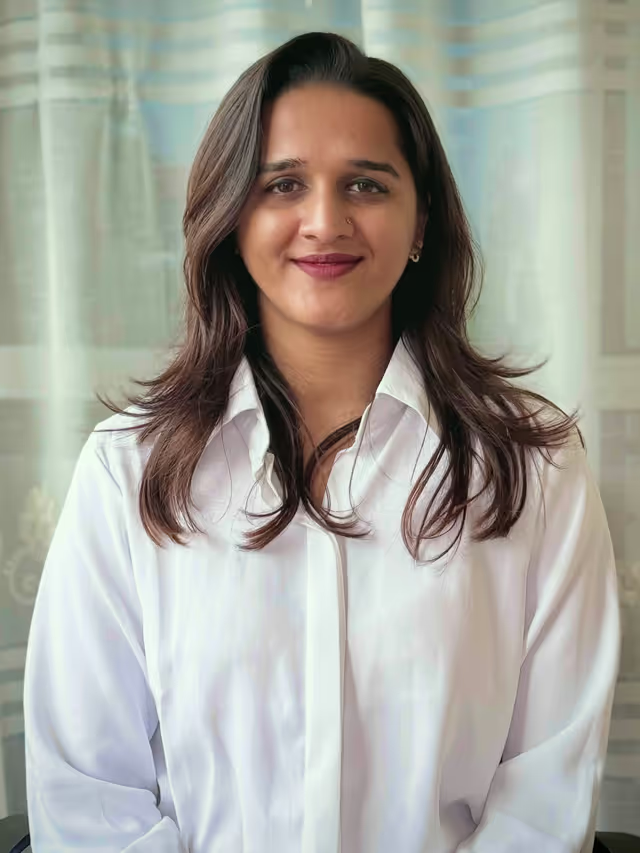
About Smriti Simkhada
Smriti Simkhada is a PTE Academic perfect scorer (90/90) providing structured PTE coaching for Nepali students. She and her team have helped 1,500+ students prepare for Australia PR and Canada immigration through structured, criteria-aligned coaching.