PTE Retake Strategy for Nepali Students Already in Australia (2026)
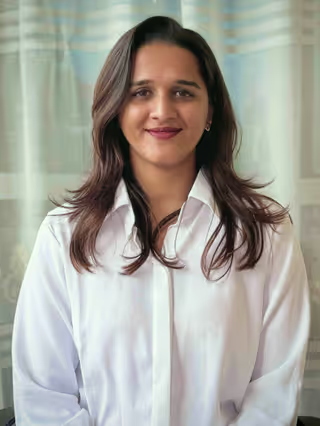
Smriti Simkhada
90/90 Perfect Scorer
Updated June 2026 · Reviewed by Smriti Simkhada (90/90)
Why Nepali Students Already in Australia Still Struggle with PTE
You expected Australia to make PTE easier. You are speaking English every day, understanding your colleagues, watching Australian TV, sending emails in English at work. Surely the score will come now.
Then you get your result back. 72 in Listening, 68 in Reading, 61 in Writing, 74 in Speaking. Not the 79+ you needed. Not even close to the DHA Superior threshold that would give you 20 extra points toward Australia PR.
Stuck below your target? The 79+ Sprint
Private 1-on-1 coaching, from US$99: pick 7 days, 17 days or 1 month, one live session a day on your time zone (Sydney · Melbourne · Toronto · London · Doha), a demo session included, and Coach-Until-Target on the longer plans.
This is the most common situation for Nepali students, workers, and nurses who are already in Australia and attempting a PTE retake. Being immersed in Australian English improves your conversational ability — it does not automatically improve your PTE task performance. These are different skills, measured in completely different ways.
This guide is for the PTE retake Australia Nepali students face after arriving — not for students in Nepal preparing to apply. It covers the retake strategy for three use cases: PR points, AHPRA nursing registration, and university admission, plus exactly why diaspora students plateau and what breaks the stall.
Understanding Your Score Report Before You Rebook
How to Read Your PTE Score Report Analytically
The most common retake mistake is rebooking without diagnosing what went wrong. Your score report tells you exactly which tasks are suppressing which skill scores — but only if you read it the right way.
Every PTE score report shows two layers: your four skill scores (Listening, Reading, Writing, Speaking) and your enabling skills (Pronunciation, Oral Fluency, Grammar, Vocabulary, Spelling, Written Discourse). Most students only look at the skill scores and miss the diagnostic layer.
- Identify which skill score is below your target threshold. A score two points below threshold is a different problem than ten points below.
- Check enabling skills for the same skill. If your Speaking is 68 and your Oral Fluency is in the yellow band, the problem is hesitation or pacing — not accent or vocabulary.
- Look for cross-module patterns. Low Written Discourse suppresses both Writing and Reading simultaneously. A low Grammar score affects Speaking, Writing, and Reading Fill-in-the-Blanks at once.
- Enabling skills give strong task-level diagnostic signals. A coach can map enabling skill gaps to specific tasks in a single session.
Do not rebook until you can answer: which two tasks, if improved, would move my weakest skill score above the threshold? If you cannot answer it, you need a diagnostic session before preparation.
What Distracts Diaspora Students from Effective Preparation
Being in Australia creates specific preparation challenges that students in Nepal do not face. If you have been in Australia for six months or more and your PTE score has not improved despite your improved English, one or more of these patterns is almost certainly the reason.
English immersion without PTE preparation. Daily Australian life exposes you to natural, conversational English. PTE Academic tests a very specific register: formal, academic, task-bounded. You are getting better at the wrong type of English. A warehouse supervisor who speaks fluent workplace English still needs to know how to construct a coherent Summarize Written Text in 45–75 words — those are different skills.
False confidence after months in Australia. Many Nepali workers and students underestimate how much task-specific preparation PTE requires because their general English feels stronger. They attempt a retake without adequate preparation and are surprised when the score is lower than their mock test suggested.
No accountability structure. In Nepal, group batches and coaching classes create external deadlines and accountability. In Australia — especially if you are in a share house, working shifts, and preparing alone — there is nothing to push you through the hard parts. Most self-prepared diaspora students stop actively studying within two weeks of booking their test.
Outdated template reliance. Many diaspora students learned templates from online communities or friends who took PTE years ago. Pearson's AI scoring engine now flags heavily templated responses in Describe Image, Summarize Written Text, and essay writing. Templates that scored well in 2022 are now actively penalised in 2025 and 2026. If you are still using a fixed 35-word Describe Image template, this is likely suppressing your Speaking score.
Not adjusting preparation around shift patterns. If you are working evening or night shifts in AEST, studying between 10pm and midnight after a shift is not effective preparation. Most Nepali coaches in Nepal operate during Nepal daytime — which is afternoon to evening in Australia — but early morning slots (6–8am AEST) align with Nepal evening times and are productive study periods before a day shift.
The Right Retake Strategy for Each Use Case
Retaking for PR Points (DHA Thresholds)
Australia's Department of Home Affairs uses PTE to determine English proficiency levels for skilled migration points. After the August 7, 2025 changes, the thresholds are component-specific — not a single number across all skills.
The current DHA PTE thresholds are:
- Superior English (+20 points): Listening 69 / Reading 70 / Writing 85 / Speaking 88
- Proficient English (+10 points): Listening 58 / Reading 59 / Writing 69 / Speaking 76
- Competent English (0 points, minimum for many visas): Listening 47 / Reading 48 / Writing 51 / Speaking 54
Notice that Writing (85) and Speaking (88) thresholds for Superior are significantly higher than Listening (69) and Reading (70). This means most Nepali students working toward Superior English need to focus their retake preparation almost entirely on Writing and Speaking — not on the test as a whole.
For a full breakdown of how these thresholds interact with your Subclass 189, 190, or 491 points calculation, see the detailed guide on PTE score requirements for Australia PR points (2026).
Retake strategy for PR:
- Identify your current gap to the Proficient threshold first (not Superior). Proficient is a more achievable intermediate target for most students.
- Focus 60% of your preparation on your two weakest components from the score report.
- For Writing 69: practise Summarize Written Text (one-sentence structure) and essay writing with current, non-templated structures reviewed for grammar and discourse quality.
- For Speaking 76: concentrate on Describe Image and Retell Lecture, where task-specific strategies have the highest per-task score impact.
- Book one diagnostic mock test on PTE's official platform (not a third-party app) three weeks before your retake date to calibrate your current score accurately.
Retaking for AHPRA Nursing Registration
AHPRA updated its English proficiency thresholds effective 23 April 2026. The current PTE Academic thresholds for AHPRA registration are:
- Overall: 63
- Listening: 58
- Reading: 59
- Writing: 60
- Speaking: 76
Speaking 76 is the most demanding component for most Nepali nurses. The gap between the overall threshold (63) and Speaking (76) means a student who hits 63 in every other skill still needs an additional 13 points in Speaking specifically.
AHPRA also allows a two-test combination: scores from two PTE Academic sittings within a 12-month window can be combined (same provider only — IELTS + PTE is not allowed), provided each sitting meets the per-component floor scores AHPRA publishes — Listening 53, Reading 54, Writing 60, Speaking 66 — and the overall combined result meets the 63 / 58 / 59 / 60 / 76 standard. Verify the current floors on ahpra.gov.au before relying on this. This creates a strategic option: if you scored Speaking 72 in one sitting and Speaking 74 in another, neither sitting qualifies on its own — but if your second attempt produces Speaking 76 while maintaining the other component thresholds, that sitting is sufficient on its own.
For detailed guidance on the two-test combination strategy, see the AHPRA PTE requirements guide.
Retake strategy for AHPRA:
- If your Speaking is the only component below threshold, treat this as a Speaking-only retake and allocate 70% of preparation time to Speaking tasks.
- Prioritise Describe Image (highest weight in Speaking) and Answer Short Question (high accuracy task where errors cost disproportionately).
- If Writing 60 is also below threshold, practise Summarize Written Text one-sentence structure — it is the fastest Writing task to improve with targeted practice.
- Maintain your other components while fixing Speaking. Neglecting Listening and Reading preparation can drop those scores below threshold on the retake, disqualifying the sitting even if Speaking improves.
Retaking for University Admission
Australian university PTE requirements range from 50 overall to 65 each component, depending on the institution and course. For university retakes, the strategy is simpler: identify the one or two skills below your institution's minimum band and prepare specifically for those. Focus narrowly — do not attempt a general score improvement.
Practical Preparation Around an Australian Work Schedule
The biggest logistics challenge for diaspora students is not motivation — it is finding preparation time that fits around shift work, overtime, and family responsibilities.
If you work day shifts (AEST): Your most effective study window is early morning (6–8am) before the shift. This aligns with Nepal's evening time (11:30pm–1:30am NPT), meaning a Nepali tutor can hold live sessions with you in your morning, which is a productive study period rather than the end of a tiring day.
If you work evening or night shifts (AEST): Late morning to early afternoon (10am–1pm AEST) is your best window, after adequate sleep. This corresponds to Nepal's late afternoon (4:30pm–7:30pm NPT), which is standard business hours in Nepal — so booking afternoon coaching slots in Nepal time aligns with your post-sleep window in Australia.
If your schedule rotates: You need asynchronous preparation resources (recorded sessions, review materials) that supplement live coaching rather than replace it. A coaching arrangement where sessions are recorded lets you review task-specific feedback in your own time, which is more sustainable than fixed weekly slots.
Test centre booking in Australia: PTE Academic test centres include Sydney, Melbourne, Brisbane, Perth, Adelaide, and Canberra. Unlike Nepal, where slots fill weeks in advance, most Australian centres have availability within one to two weeks. There is no mandatory waiting period between attempts. All bookings go through pearsonpte.com.
Test cost in Australia: PTE Academic in Australia costs AUD 490 (including 10% GST) per attempt at Australian Pearson VUE test centres (2026 standard price; always confirm at pearsonpte.com at time of booking). At current exchange rates, this is significantly more expensive per attempt than booking in Nepal. Adequate preparation before each retake is not just about passing — it is about avoiding a costly failed attempt that delays your visa or registration timeline by months.
Common Mistakes to Avoid
- Retaking immediately after a failed attempt without diagnostic work. Booking within a week of a failed test without analysing the score report is the single most expensive retake mistake. You will repeat the same patterns and get a similar score.
- Using free third-party mock test apps as your benchmark. Many apps available on the Australian App Store are not accurately calibrated to PTE's AI scoring algorithm. Always benchmark with Pearson's official scored practice test — the AUD cost is worth it for an accurate baseline.
- Studying alone after long shifts. Fatigue degrades speaking quality and writing precision. A 30-minute focused morning session before a shift produces better results than a 90-minute exhausted session at midnight.
- Over-relying on English immersion. Hearing Australian English all day does not replace deliberate PTE task practice. You need to produce — Write From Dictation, Repeat Sentence, Read Aloud, Summarize Written Text — under timed conditions, regularly.
- Neglecting the score report between attempts. Your score report is specific feedback from the PTE AI. Not using it to guide the next preparation cycle wastes the most precise diagnostic tool available.
- Ignoring template risk. If you are using a fixed Describe Image template from an online community, test it on a scored official mock first. Many widely shared templates now trigger lower scores from Pearson's algorithm. Task-specific strategies that adapt to content outperform rigid structural templates.
Tips for Nepali Students in Australia Specifically
- Your accent is not the obstacle. Pearson's AI scoring evaluates Oral Fluency and Pronunciation on whether your speech is clear and consistent — not whether it matches an Australian or British accent. Nepali students in Australia who are immersed in English often develop more natural pacing, which benefits these scores. The problem is more often in task structure than accent.
- Book your test when you are genuinely ready, not when your lease is ending or your visa needs renewing. Time pressure is the enemy of effective preparation. If you book a test three weeks out because you feel urgency, you will get a three-week preparation result. Pearson score reports are valid for 2 years from the test date; DHA accepts PTE Academic results for approximately 3 years for skilled-migration applications (a separate DHA rule, not a Pearson rule) — use that window strategically rather than testing repeatedly under pressure.
- A Nepali tutor understands what you are carrying. An Australian English tutor will not know why you hesitate on Read Aloud after conjunctions, why your essay conclusions tend to generalise, or why your Describe Image responses trail off. A Nepali coach who has worked with diaspora students understands these specific patterns and can fix them directly rather than spending sessions on general English correction.
- Online coaching with AEST timezone accommodation is now viable. Smriti Simkhada at PTE Nepal offers 1-on-1 online sessions with early morning AEST slots, removing the timezone barrier that used to make Nepal-based coaching impractical for diaspora students.
- Plan your test timing around score validity. Pearson score reports are valid for 2 years from the test date. Separately, Australia's DHA accepts PTE Academic results for approximately 3 years for skilled-migration applications — these are two different rules. If you achieve your target, confirm the score will still be valid (under whichever rule applies) when your visa application is lodged — especially on a Points Test pathway where nomination or invitation can take 12–18 months.
Frequently Asked Questions
How soon can I retake PTE Academic in Australia?
Pearson requires a minimum 5-calendar-day gap between consecutive PTE Academic attempts (verify the latest scheduling rule on pearsonpte.com). You can rebook as soon as your previous result is released, but the next sitting must be at least 5 days after the previous test date. In practice, most test centres in Australia have availability within one to two weeks. You will need adequate preparation time, not a waiting period, before rebooking.
Can I use PTE scores from Australia and Nepal in the same AHPRA two-test combination?
Yes. The AHPRA two-test combination allows scores from any two PTE Academic sittings within the 12-month window, regardless of where the tests were taken. A sitting in Nepal followed by a sitting in Melbourne is valid for combination purposes, as long as both are within 12 months and the overall threshold (63) is met in each.
Is it worth booking a PTE coaching session in Australia or should I use an online Nepali coach?
In-person Australian PTE coaching is available but expensive — typically AUD 80–150 per hour — and tutors are often not familiar with Nepali-specific scoring patterns. Online coaching with a Nepali tutor who understands the diaspora context is significantly more cost-effective and, for most Nepali students, more targeted. The cultural and linguistic context a Nepali coach provides translates directly to session efficiency.
I have been in Australia for 18 months and my English feels much stronger. Why did my PTE score drop compared to Nepal?
This is a very common diaspora experience. Your conversational and workplace English has genuinely improved — but PTE Academic measures academic English production under timed, structured conditions. Australian workplace English is informal, conversational, and context-supported. PTE Writing and Speaking tasks require formal, task-specific performance. The two registers diverge after immersion, and without deliberate PTE practice during your time in Australia, your task-specific skills rust even while your general English improves.
My DHA PR application needs Superior English. Is it realistic to reach L69/R70/W85/S88 from Australia?
Yes, but it requires task-specific preparation — not just general English improvement. Writing 85 and Speaking 88 are high thresholds that require precise techniques: structured essay writing reviewed for discourse quality, and fluent, coherent spoken responses with strong task coverage. Most students who achieve Superior English from Australia do so with targeted coaching on their two weakest components rather than a broad study approach. The timeline is typically four to eight weeks of focused preparation after a diagnostic session.
Conclusion
Being in Australia gives you advantages — better English exposure, more flexible test centre availability, and deeper context for the Australian pathways you are pursuing. It does not, by itself, give you a higher PTE score.
Nepali students in Australia who improve their PTE score treat the retake as a precision task: they analyse the score report first, fix the specific issues behind the gap, prepare around their shift schedule, and get expert feedback on what the PTE AI is penalising. If your score has stalled despite being in Australia, the gap is almost certainly technical — task-specific habits, not general English. That is fixable.
If you want a structured retake plan built around your AEST schedule, the 1-on-1 online coaching programme offers targeted sessions accommodating Australian shift patterns — early morning AEST sessions with Smriti Simkhada, available for Nepali students across Sydney, Melbourne, Brisbane, and beyond.
Continue on PTE Nepal: PTE for Australia hub, Sydney 1-on-1 coaching, and Melbourne 1-on-1 coaching.
Verify before relying on these figures: AHPRA, the Australia Department of Home Affairs, and IRCC update score thresholds, fees, and policies regularly. Cross-check the latest requirements on ahpra.gov.au, immi.homeaffairs.gov.au, and canada.ca/express-entry before booking your test or applying. Last fact-checked 2026-05-08.
Last fact-checked on 2026-05-08 against official sources (Pearson PTE, Australia Department of Home Affairs, AHPRA, IRCC, GOV.UK, INZ). Test fees, score requirements, and visa rules can change at any time — always verify the latest details on the relevant official website before booking or applying.
About Smriti Simkhada
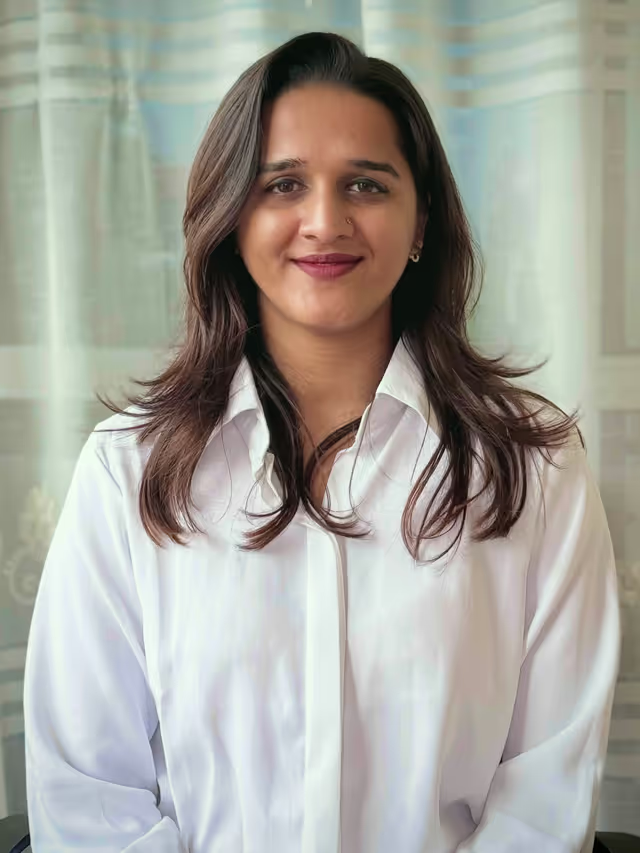
Smriti Simkhada is a PTE Academic perfect scorer (90/90) providing structured PTE coaching for Nepali students. She has helped over 1,000 students prepare for Australia PR and Canada immigration through structured, criteria-aligned coaching.
