PTE Retell Lecture Template 2026 + Every Speaking Task (Nepal)
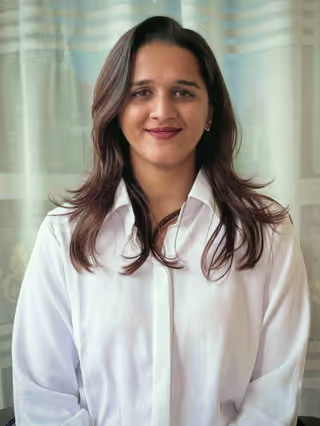
Smriti Simkhada
90/90 Perfect Scorer
Updated August 2026 · Reviewed by Smriti Simkhada (90/90)
Speaking is the highest-leverage section in PTE Academic for Nepali students. Most other sections improve through vocabulary and reading practice, but Speaking is where 4-7 score points hinge on whether you have a clean, repeatable template for each task type. This guide gives you task-specific templates for the five Speaking task types in PTE Academic 2026 — built around the criteria the AI actually scores, not generic ESL exercises. The Retell Lecture template gets the deepest treatment on this page: a main frame, a backup frame for partial notes, and a worked 40-second answer. Pair this with the broader stuck-at-75-to-79 Speaking strategy for the full picture.
The five task types covered: Read Aloud, Repeat Sentence, Describe Image, Retell Lecture, Answer Short Question. Each one has a distinct scoring profile, and using a single generic "speaking template" across them all is one of the most common reasons Nepali students stall at 72-77 in Speaking. Different tasks reward different speaking patterns.
Stuck below your target? The 79+ Sprint
Private 1-on-1 mentorship (Rs. 15,000) with Sydney/Melbourne/Toronto/Singapore/Doha-friendly slots — coach-until-target.
Short answer: Four of PTE Academic's five Speaking tasks use a copy-ready frame — the ones that matter most are Describe Image, Retell Lecture and Read Aloud (Repeat Sentence needs only a light approach). Answer Short Question is the one task with no template — it's a one-word or one-phrase answer.
The catch: Pearson's AI rewards natural, content-rich speech and flags over-rehearsed openers, so a "safe frame" has to sound spontaneous — never memorised word-for-word. Below are the exact copy-ready templates for each task, the filler phrases that get penalised, and the fluency habits that push your overall score toward 79+. Jump to the Retell Lecture template.
Quick Comparison: Speaking Tasks at a Glance
| Task | Duration | Items | Primary scoring | Cross-module impact |
|---|---|---|---|---|
| Read Aloud | 30-40s prep + varies by item (speak) | 6-7 | Pronunciation, Oral Fluency | Reading + Reading enabling skills |
| Repeat Sentence | 3-9s audio + 15s speak | 10-12 | Oral Fluency, Pronunciation, Listening accuracy | Listening |
| Describe Image | 25s prep + 40s speak | 3-4 | Content, Oral Fluency, Pronunciation | None directly |
| Retell Lecture | up to 90s audio + 10s prep + 40s speak | 3-4 | Content, Oral Fluency, Pronunciation | Listening |
| Answer Short Question | 3-9s audio + 10s speak | 10-12 | Vocabulary (correct answer), Pronunciation | Listening |
Update note: For tests taken after 7 August 2025, Pearson's Speaking & Writing section also includes two additional scored task types: Summarize Group Discussion and Respond to a Situation. The five tasks below are the original templates; for the new tasks, see our dedicated guides on Respond to a Situation and Summarize Group Discussion strategy. Always verify the current task set on the official Pearson Speaking & Writing page.
Download All 7 Speaking Templates (2026 PDF) — every template on this page plus the two new task types, in one printable file in our free study materials library.
1. Read Aloud Template
Read Aloud is the most frequent Speaking task and contributes to your Reading score through enabling skills. The template is not what you say — the words are given — it is how you say them.
The chunking template
Mentally split the passage into chunks of 3-5 words during the 30-second prep:
- Chunk by meaning, not punctuation — Natural phrase boundaries beat comma-by-comma reading.
- Mark the 2-3 hardest words — Multi-syllable academic terms get word stress wrong if rushed.
- Identify the main verb in each sentence — Light stress on content words (nouns, verbs) and weak stress on function words (articles, prepositions).
Delivery rule
Even pacing, no stops, no self-corrections. The flow-over-correction rule matters more here than anywhere else. A small slip mid-passage costs less than stopping to fix it. Read Aloud also boosts Reading — practising it daily lifts both Speaking and Reading enabling skills.
2. Repeat Sentence Template
Repeat Sentence has the highest items count of any Speaking task (10-12 per exam) and contributes to both Speaking and Listening. The "template" here is a memory-and-execution discipline.
The 3-step memory pattern
- Listen for the spine — Subject + main verb + object. These three words anchor everything else.
- Note adjectives and adverbs as modifiers — They attach to the spine but are not the structural backbone.
- Speak immediately after the beep — Pause longer than 1-2 seconds and Oral Fluency drops. Even partial sentences start with steady delivery beat hesitant complete ones.
Common Nepali-student mistake: trying to memorise word-for-word instead of reconstructing from the spine. Repeat Sentence memory tricks covers more recall patterns.
3. Describe Image Template
Describe Image gets the most attention in coaching and the most over-templated responses. The AI penalises memorised content patterns, so the template should give you structure but force fresh content per image.
The 5-part structure
"This image presents [type — graph / chart / map / diagram] showing [topic]. The most striking feature is [highest or most distinctive data point]. Additionally, [second observation, often a comparison or trend]. The image also indicates [a third detail or context]. Overall, this suggests [implication or conclusion]."
Substitute brackets with image-specific content. Avoid memorised opening phrases ("In today's data-driven world…") — these are detected and penalised. The full Describe Image formula walks through the 35-second timing.
Common mistakes
- Reading numbers without explaining what they mean.
- Skipping the conclusion sentence (loses Content score).
- Hesitating mid-response trying to find the "right" word.
4. Retell Lecture Template 2026
Retell Lecture is the task most readers came for. You hear an academic lecture of up to 90 seconds, get 10 seconds to organise your notes, then speak for 40 seconds. The scoring engine wants two things at once: content words that match the lecture, and speech that never stalls. A good Retell Lecture template holds both together under pressure, because the shape of your answer is decided before the microphone opens.
During the audio, capture notes in the 5-box structure: TOPIC | P1 | P2 | P3 | CONCL. The noun-verb note-taking strategy explains what goes in each box: nouns and verbs only, never full sentences.
The main template (five sentences, 40 seconds)
"The lecture is about [TOPIC]. The speaker explains that [P1]. Furthermore, [P2]. The lecturer also points out [P3]. In conclusion, the lecture highlights that [CONCL]."
Each box becomes one sentence. Five sentences across 40 seconds is a sustainable pace, roughly seven seconds per sentence. Vary the connectors between attempts ("moreover", "in addition", "the speaker then argues") so no two answers sound recited.
The backup template: when you caught only two details
Every test-taker eventually meets a lecture they barely follow. A fast speaker, an unfamiliar topic, a noisy test centre. Do not go silent. A fluent 35-second answer built on two correct details scores better than a halting attempt at five. Use this reduced frame:
"The lecture focused on [TOPIC]. One key point the speaker made was [DETAIL 1]. The speaker also mentioned [DETAIL 2]. Taken together, these points suggest that [a careful conclusion drawn from the two details]."
Expand each detail with a phrase you actually heard. Content credit comes largely from keyword overlap with the lecture, so even an isolated technical term from your notes is worth speaking aloud inside a natural sentence.
How to spend the 40 seconds
- Seconds 0-5: the topic sentence. Start the moment the microphone opens; a long initial pause costs Oral Fluency before you have said anything.
- Seconds 5-32: one sentence per point, about seven seconds each.
- Seconds 32-40: the conclusion sentence. Aim to finish naturally around second 38 rather than getting cut off mid-word.
Worked sample answer
Imagine a 70-second lecture on urban heat islands: cities are hotter than surrounding rural areas; causes are dark surfaces and reduced vegetation; consequences include higher energy use; the speaker recommends green roofs. Your 5-box notes might read: urban heat islands | dark surfaces absorb heat | less vegetation, less cooling | higher energy demand | green roofs help. The spoken response:
"The lecture is about urban heat islands, where cities become significantly warmer than nearby rural areas. The speaker explains that dark surfaces such as roads and rooftops absorb and store heat throughout the day. Furthermore, reduced vegetation in cities removes the natural cooling effect of plants. The lecturer also points out that this leads to higher energy demand for air conditioning. In conclusion, the lecture highlights that green roofs and urban planting can reduce the problem."
Five sentences, one per box, delivered evenly across the 40 seconds — content coverage plus steady Oral Fluency, with no memorised filler the AI can flag.
Why memorised Retell Lecture answers score lower
Templates leak. The same opening lines circulate through TikTok clips and coaching PDFs, and an answer built from stock phrases with no lecture content scores poorly however fluent it sounds. The frames above survive because they are nearly all placeholder: most of every sentence must come from the lecture itself. That is also why practising with real questions beats polishing the template one more time.
Practise with this week's real Retell Lecture questions
Our weekly PTE prediction file carries a full Retell Lecture set, usually 60 to 70 items, refreshed every week and free to use. Work through five a day with the 5-box notes and the main template, recording yourself each time. Students in Kathmandu and students working in Sydney use the same file; Pearson's question pool does not change by country.
5. Answer Short Question Template
Answer Short Question is the only Speaking task where Vocabulary (correct factual word) outweighs Oral Fluency. There is no template — the answer is one word or one short phrase. The "template" is preparation: study common ASQ topics (everyday objects, weather, geography, time, body parts).
Speaking pattern: state the answer immediately, optionally repeat it for clarity. Example prompt: "What do you call a doctor who treats animals?" → "A veterinarian. Veterinarian." Confidence and clarity matter more than fluency padding. Answer Short Question tips cover the topic categories worth memorising.
Common Mistakes Nepali Students Make Across Speaking Tasks
- Self-correcting mid-response — Costs Oral Fluency in Read Aloud, Repeat Sentence, Describe Image, and Retell Lecture. The flow-over-correction rule applies universally.
- Using the same template across all tasks — A Describe Image template forced onto Retell Lecture sounds artificial and scores poorly on Content.
- Memorising opening phrases — "In today's modern world…" is detected and penalised across all tasks. Vary your openings.
- Hesitating before the beep — Speaking immediately after the beep on Repeat Sentence and Retell Lecture preserves Oral Fluency.
- Imitating an Australian accent — The AI does not score accent character. Clarity and pronunciation accuracy of difficult consonants matter; the underlying accent does not.
Step-by-Step Practice Method (4-Week Plan)
- Week 1 — Read Aloud + Repeat Sentence: Daily 15 minutes Read Aloud (recorded, reviewed) + 20 Repeat Sentence items.
- Week 2 — Describe Image: Daily 5 images using the 5-part structure. Record and self-review for hesitations and content coverage.
- Week 3 — Retell Lecture: Daily 3 lectures with 5-box notes and recorded responses. Build the note-to-speech bridge.
- Week 4 — Answer Short Question + integration: 30 ASQ items daily; full mock Speaking sections twice in the week.
Tips for Nepali Students
- Practise in English-only mode — Translation delay shows up as Oral Fluency hesitations. Internal monologue should be in English during exam.
- Record on your phone, review daily — Self-review catches stress errors and pause patterns that you cannot hear in real time.
- Drill difficult consonants — v/w distinction, th sounds, p/f distinction. These cost Pronunciation across multiple tasks.
- Use Pearson official practice as the benchmark — Third-party Speaking mocks often inflate scores by 4-8 points.
- Don't try to sound American or Australian — Smriti Simkhada scored 90/90 with a Nepali accent. Clarity and fluency are what the AI measures.
What Students Have Found
"Switching from one generic template to task-specific templates was the unlock for Speaking. Read Aloud chunking and Describe Image structure are different muscles." — Bipin K., Bharatpur
"The 5-box notes for Retell Lecture and the spine-first approach for Repeat Sentence both lifted my Speaking from 75 to 82 in the next attempt." — Sandhya R., Pokhara
Results reflect individual student preparation experience. Scores depend on personal effort, starting ability, and test conditions. No specific outcome is guaranteed.
Frequently Asked Questions
Should I memorise these templates word-for-word?
The structures yes — the content no. Memorising the structural pattern (e.g., 5-part Describe Image) is fine and helps under time pressure. Memorising literal opening sentences is detected and penalised. Vary connectors and verbs across attempts.
Is it safe to use a Retell Lecture template in 2026?
Yes, if the template is structural. The frames on this page are connector skeletons; the substance of every sentence comes from the lecture you just heard. What gets flagged is reciting memorised sentences that could fit any lecture, because they add fluent-sounding audio with no matching content.
What if I understand almost nothing of the lecture?
Speak anyway. Switch to the backup template, name the topic, and build sentences around the two or three nouns you caught. Silence scores zero on the item; a steady partial answer keeps both Content and Oral Fluency alive.
How long should my Retell Lecture answer be?
Use most of the 40 seconds. Finishing at 15 seconds gives the scoring engine little to work with; being cut off mid-sentence is an untidy ending. Train yourself to land the conclusion at around second 38.
Which Speaking task is most important for 79+?
Read Aloud (highest item count + cross-module benefit to Reading) and Repeat Sentence (highest item count, dual-skill scoring with Listening). Improving these two lifts Speaking, Reading, and Listening simultaneously.
Does the AI penalise the Nepali accent?
No. The scoring engine evaluates phoneme accuracy, intelligibility, and fluency markers — not accent character. Nepali, Indian, and other South Asian accents are well-represented in training data. Clarity matters more than accent imitation.
How many weeks of practice do I need to reach 79+ in Speaking?
Most Nepali students with conversational English need 4-6 weeks of focused, recorded daily practice to push from 72-75 to 79+ in Speaking. The exact timeline depends on your starting Oral Fluency and Pronunciation enabling skills.
Should I practise with the official Pearson scored mocks or third-party platforms?
Use Pearson official practice as the benchmark. Third-party mocks tend to overestimate Speaking scores by 4-8 points. Book the real exam only when your official Pearson practice score shows 80+ in Speaking.
Build Your Speaking Score
Task-specific Speaking templates are one part of strong preparation. If you are stuck below target, from Nepal or around an Australian work roster, the fastest route is 1-on-1 coaching with Smriti Simkhada: your recordings reviewed, your blocking task diagnosed, sessions scheduled around Sydney and Melbourne shifts. Prefer to start smaller? Book a free score assessment call or join the next 15-day group batch (Rs. 2,500).
Conclusion
A template is scaffolding, not a script. The frames on this page exist so you never freeze in the first three seconds — but the marks come from what you put inside them: real content words from the lecture or image, said clearly, at a steady pace, for the full response window.
Start with one task. Take the Retell Lecture frame, run it against this week’s prediction questions until the 5-box note system feels automatic, then move to Describe Image. Trying to memorise every template at once is how students end up sounding rehearsed, which is exactly what the scorer marks down.
If your Speaking score has stalled in the 65–78 band, the fix is almost never a better template — it is feedback on your actual recordings. That is what the free score assessment is for.
Last fact-checked on 2026-05-08 against official sources (Pearson PTE, Australia Department of Home Affairs, AHPRA, IRCC, GOV.UK, INZ). Test fees, score requirements, and visa rules can change at any time — always verify the latest details on the relevant official website before booking or applying.
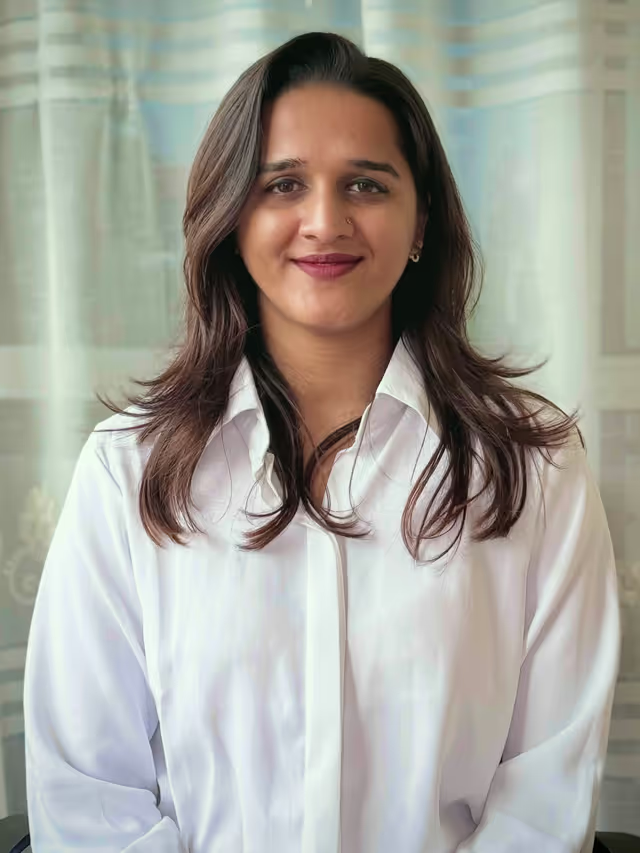
About Smriti Simkhada
Smriti is a PTE Academic perfect scorer (90/90) providing structured PTE coaching for Nepali students. She has helped over 1,000 students prepare for Australia PR and Canada immigration through structured, criteria-aligned coaching.
