PTE Core Speaking Tips for Nepali Students: CLB 9 Strategy (2026)
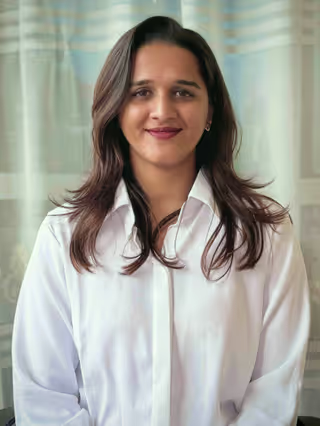
By Smriti Simkhada (90/90) · Updated
PTE Core Speaking uses the same AI scoring engine as PTE Academic, and scores are reported on Pearson's 10–90 scale (the same numeric scale as PTE Academic). IRCC then converts those per-skill scores to CLB levels using its official concordance table. For Canadian Express Entry, you need CLB 9 in each skill (verify the current Pearson PTE Core to CLB mapping on pearsonpte.com/pte-core; PTE Academic and PTE Core use the same 10–90 scale but have different CLB concordance mappings). Reaching CLB 9 in Speaking is the skill most Nepali students lose points on, because it combines oral fluency, pronunciation, content accuracy, and discourse management in a single response.
This guide covers task-level strategy for every PTE Core Speaking task, with templates, common Nepali-accent pitfalls, and the structured delivery approach that works on Pearson's current scoring model.
The PTE Core Speaking Task List
PTE Core Speaking includes these tasks (mostly shared with PTE Academic). Item counts vary per test version — verify on pearsonpte.com/pte-core:
- Read Aloud — short passages; 35-40 second speaking window
- Repeat Sentence — sentence repetition; 15 second response
- Describe Image — image description; 40 second response
- Answer Short Question — general-knowledge questions; 10 second response
- Respond to a Situation — scenario prompts; ~20s prep + 40s response (this task is in BOTH PTE Academic and PTE Core — PTE Academic added it on 7 August 2025. Note the prep window differs: 20 seconds in PTE Core, 10 seconds in PTE Academic)
Retell Lecture is not in PTE Core. This is one notable scoring difference on the Speaking side compared with PTE Academic.
Stuck below your target? The 79+ Sprint
Private 1-on-1 coaching, from US$99: pick 7 days, 17 days or 1 month, one live session a day at a time that suits you, a demo session included, and Coach-Until-Target on the longer plans.
Task 1: Read Aloud
Read Aloud contributes to both Speaking and Reading scores. For CLB 9, focus on three things:
- Flow over accuracy. If you mispronounce a word, do not correct it. Self-correction ("sorry, I meant...") breaks fluency continuity, which is what Oral Fluency measures. Keep moving.
- Chunk at punctuation. The AI rewards natural phrase grouping. Break at commas, colons, and periods — not between every word.
- Stress content words. Nouns, main verbs, adjectives get slight emphasis. Articles, prepositions, auxiliaries stay soft. This is the single biggest fix for Nepali-accented Read Aloud.
Speaking strategy: read the passage silently in the 30-40 second preparation window, mark chunks mentally at punctuation, then deliver at 150-160 words per minute. Slower sounds hesitant. Faster kills clarity.
Task 2: Repeat Sentence
Repeat Sentence rewards exact content match more heavily than perfect pronunciation. The scoring system compares your output against the expected text using acoustic similarity.
- Memorize the sentence structure, not each word. Focus on the subject, main verb, object, and any numbers. These are the content anchors.
- Speak immediately. Long pauses before starting (>2 seconds) flag the response as hesitant and reduce fluency scoring.
- If you miss a word, substitute a plausible alternative. Silence is worse than a near-miss. "The conference was scheduled for Tuesday" and "The conference is scheduled on Tuesday" score similarly — the content is preserved.
Task 3: Describe Image
Describe Image is the most template-compatible task in PTE Core Speaking. Use the 35-second formula:
- 4-5 sec: Identify image type. "The [bar chart / line graph / process diagram / map] illustrates [topic]."
- 10-12 sec: State the single most dominant feature. Highest bar, steepest rise, largest share.
- 10 sec: One supporting data point or secondary observation.
- 5-6 sec: Conclusion. "Overall, the data suggests..."
End at 35 seconds — do not try to fill all 40. A clean early finish signals control; a forced over-run triggers the mid-sentence cutoff.
For a full worked example with 8 sample answers across image types, see our Describe Image sample answers PDF.
Task 4: Answer Short Question
Answer Short Question is general-knowledge vocabulary. The AI rewards one-word or very short answers, not full sentences.
- Question: "What do we call a baby dog?"
- Best answer: "A puppy." Not "I think it is a puppy" — extra words dilute the content score.
Prep strategy: review the top 300 general-knowledge ASQ topics (animals, weather, food, body parts, professions, geography) during your 2-week prep window. These recycle heavily across test administrations.
Task 5: Respond to a Situation
Respond to a Situation is in both PTE Academic and PTE Core; PTE Academic added it on 7 August 2025. You hear a scenario (e.g., "You are late to a meeting because of a traffic jam. Call your colleague and explain.") and have approximately 20 seconds to prepare and 40 seconds to respond as if actually in the situation. Verify timings on pearsonpte.com/pte-core.
CLB 9 framework — use this structure every time:
- Greeting + context (5-8 sec): "Hi [colleague's name], it's [your name]. I'm calling because..."
- Explain the situation (10-12 sec): Reason + impact. "I'm stuck in heavy traffic on the highway and it looks like I'll be about 20 minutes late."
- Propose a solution (10-12 sec): What you want them to do. "Could you let the team know I'll join as soon as I arrive? If possible, could you cover the first agenda item?"
- Close (5-8 sec): Acknowledgement + thanks. "Thanks so much for handling this — I really appreciate it."
The AI rewards natural conversational register, clear problem-solution structure, and appropriate politeness markers. Do not over-formalise ("I would like to humbly inform you...") — it sounds non-native. Use contractions, direct phrasing, and a warm tone.
We have a full set of 10 Respond to a Situation sample answers (PDF) covering apology, request, negotiation, and follow-up scenarios.
Common Nepali-Accent Issues and How to Fix Them
- /v/ vs /w/ confusion: "very" often becomes "wery". Practice minimal pairs: vine/wine, vest/west, veil/wail.
- /θ/ as /t/: "think" becomes "tink". The AI does not heavily penalise this, but Inconsistent use (sometimes /θ/, sometimes /t/) confuses the acoustic model. Pick one and stay consistent.
- Retroflex /t/ and /d/: Nepali retroflex consonants sound harsh to the AI's English model. Soften them — tip of the tongue on the alveolar ridge, not the hard palate.
- Falling intonation on questions: "Are you coming?" said with Nepali declarative intonation reads as a statement. Raise the pitch on the final syllable.
- Word stress on compound nouns: "blackboard" stresses the first syllable; "black board" stresses the second. Get this right or context collapses.
Preparation Plan for CLB 9 in 15 Days
- Day 1-2: Diagnostic mock test. Identify which of the 5 tasks lose the most points.
- Day 3-5: Read Aloud + Repeat Sentence daily drills. 20 passages + 30 sentences per day.
- Day 6-8: Describe Image with 35-second formula. 10 images per day, recorded and reviewed.
- Day 9-11: Respond to a Situation. 5 scenarios daily, with the 4-part structure.
- Day 12-13: ASQ vocabulary review + timed full-section mock.
- Day 14: Rest day or light review.
- Day 15: Test day.
Need Personalised Feedback?
Record yourself doing a Respond to a Situation task and send it to me on WhatsApp (+977 9825235082). I will give you specific feedback on oral fluency, content coverage, and any Nepali-accent patterns holding your score back.
Or enroll in the next PTE Core batch — dedicated Core coaching with CLB 9 focus.
Continue Your PTE Preparation
Related guides for Nepali students preparing for PTE Academic and PTE Core:
- PTE score requirements guide
- PTE Core complete guide for Nepal
- PTE Core to CLB conversion
- PTE Core CLB score guide
- PTE Core vs PTE Academic for Canada PR
- PTE Core vs PTE Academic differences
Always verify: IRCC scoring tables, CLB-to-PTE Core conversions and program-specific minimums can change. Confirm the latest values on the IRCC Express Entry language test page before submitting any application.
Last fact-checked on 2026-05-08 against official sources (Pearson PTE, Australia Department of Home Affairs, AHPRA, IRCC, GOV.UK, INZ). Test fees, score requirements, and visa rules can change at any time — always verify the latest details on the relevant official website before booking or applying.
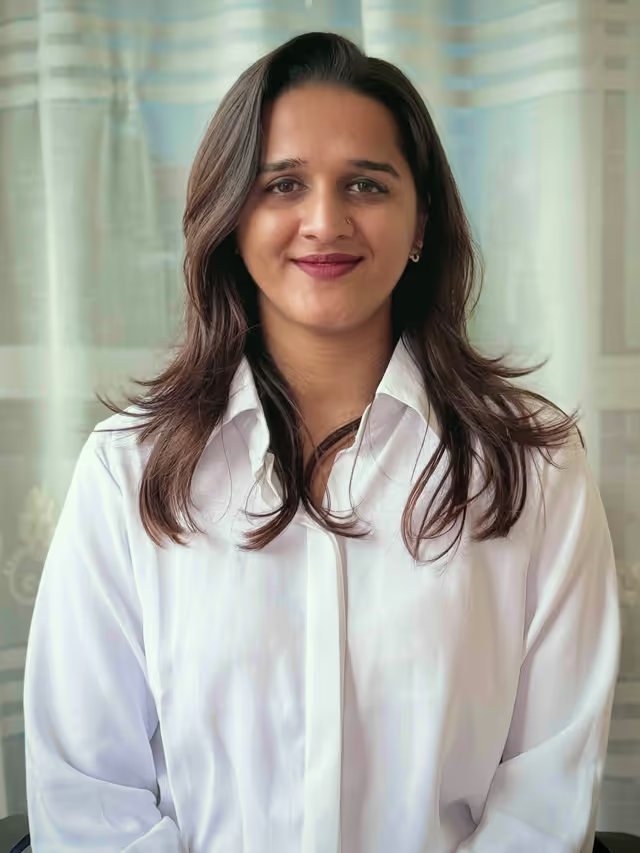
About Smriti Simkhada
Smriti Simkhada is a PTE Academic perfect scorer (90/90) providing structured PTE coaching for Nepali students. She and her team have helped 1,500+ students prepare for Australia PR and Canada immigration through structured, criteria-aligned coaching.