PTE Core vs PTE Academic: Key Differences Every Nepal Student Must Know
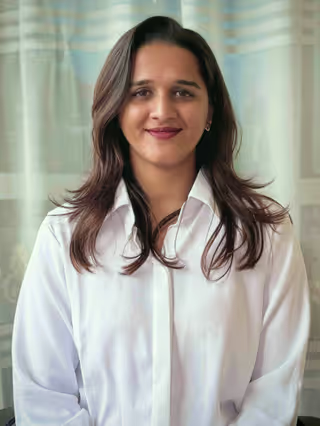
By Smriti Simkhada (90/90) · Updated
PTE Core vs PTE Academic: Not the Same Test
This is one of the most common and most costly mistakes Nepali students make: booking PTE Academic when they need PTE Core for Canada immigration.
Both tests are made by Pearson. Both use similar computer-based tasks. Both are AI-scored. But they serve completely different purposes—and for immigration, using the wrong one means your result is invalid and you need to retake from scratch.
Stuck below your target? The 79+ Sprint
Private 1-on-1 coaching, from US$99: pick 7 days, 17 days or 1 month, one live session a day at a time that suits you, a demo session included, and Coach-Until-Target on the longer plans.
The One-Sentence Difference
- PTE Academic: For university admissions (worldwide) and Australian immigration (student visas, PR)
- PTE Core: For Canadian immigration only (Express Entry, PNP, and IRCC-managed streams)
If your goal is Australia—student visa, skilled migration, 189/190/491 visa—you need PTE Academic.
If your goal is Canada—Express Entry, PNP, or any IRCC stream—you need PTE Core.
Full Comparison Table
| Feature | PTE Core | PTE Academic |
|---|---|---|
| Purpose | Canadian immigration (IRCC) | University admissions + Australian immigration |
| Accepted by | IRCC Canada (immigration only) | 3,500+ universities worldwide; Australia DHA (Home Affairs); UK visas |
| Score system | Reports numeric scores 10–90 per skill (CLB equivalency is a lookup table — not printed on the score report) | Reports scores 10–90 (per skill + overall) |
| Score validity | 2 years | 2 years |
| Test duration | ~2 hours | ~2 hours (2025 enhanced format) |
| Scoring engine | Pearson AI (same as PTE Academic) | Pearson AI |
| Results turnaround | Typically within two business days, up to five | Pearson emails you when scores are ready |
| Test fee (Nepal 2026) | USD 248.60 (Pearson's listed Nepal price; confirm in your Pearson account) | USD 248.60 (Pearson's listed Nepal price; confirm in your Pearson account) |
| Australia immigration | Not accepted | Accepted (preferred) |
| Canada immigration | Accepted (IRCC designated) | Not accepted by IRCC for PR |
| University admissions | Not used | Accepted by 3,500+ universities |
How the Scoring Systems Differ
PTE Academic Scoring
PTE Academic scores each skill on a scale of 10–90 and provides an overall score. Common targets for Nepali students:
- Superior English (post-7-Aug-2025: L69/R70/W85/S88): Required for maximum immigration points (+20) in Australian skilled migration
- Competent English (L47/R48/W51/S54): Required minimum for skilled migration (189/190/491/186/482)
- 47 overall, no per-skill minimum: Australian student visa (subclass 500) DHA floor for tests taken on or after 7 August 2025 (older valid tests assessed at 50)
PTE Core Scoring
PTE Core reports numeric scores of 10–90 for each of the four skills; you then convert them to Canadian Language Benchmark (CLB) levels using IRCC's lookup table (CLB is not printed on the score report). Common targets:
- CLB 9 all skills: Competitive Express Entry profile (maximizes CRS language points)
- CLB 7 all skills: Minimum for Federal Skilled Worker Express Entry
How the Task Format Compares
PTE Core is a 2-hour test with 19 question types across Speaking & Writing (46-67 minutes), Reading (27-37 minutes), and Listening (30-37 minutes).
PTE Core Task Types (Official)
Speaking & Writing section includes:
- Personal Introduction (unscored — also in PTE Academic)
- Read Aloud
- Repeat Sentence
- Describe Image
- Re-tell Lecture (shared with PTE Academic — present in PTE Core too)
- Respond to a Situation (PTE Core specific — added; does NOT replace Re-tell Lecture)
- Answer Short Question
- Summarize Written Text
- Write Email (PTE Core specific — replaces Essay; 80-120 words in ~9 minutes)
Reading section includes:
- Multiple Choice (Single/Multiple Answers)
- Re-order Paragraphs
- Reading: Fill in the Blanks (R-FIB — drag-and-drop word bank; Reading score only)
- Reading & Writing: Fill in the Blanks (RW-FIB — per-blank dropdown menus; cross-skill, scored under both Reading and Writing)
Listening section includes:
- Summarize Spoken Text
- Multiple Choice (Single/Multiple Answers)
- Fill in the Blanks
- Highlight Correct Summary
- Select Missing Word
- Highlight Incorrect Words
- Write from Dictation
Source: PTE Core Teacher Guide (PDF)
Key Differences from PTE Academic
- Respond to a Situation is added in PTE Core (it does NOT replace Re-tell Lecture — both tasks coexist in PTE Core)
- Write Email in PTE Core (80-120 words, ~9 minutes) replaces Write Essay (200-300 words) from PTE Academic
- Personal Introduction (unscored) appears in both tests as the first task — it is not unique to PTE Core
- PTE Core uses workplace / community / everyday English topics; PTE Academic uses academic English
Can You Prepare for Both at the Same Time?
Yes—with important adjustments. Because the task formats overlap significantly, preparing for one builds skills for the other. The main adjustments when shifting from PTE Academic to PTE Core preparation:
- Learn the CLB equivalency table so you know what per-skill scores you're targeting
- Practice Respond to a Situation and Write Email specifically for PTE Core
- Do PTE Core-specific mock tests to familiarize yourself with the exact format
The core scoring principles remain the same: fluency, pronunciation, spelling, grammar, vocabulary, and content accuracy all matter in both tests.
Common Booking Mistake: Wrong Test
Before paying for your test, confirm:
- Your booking confirmation says "PTE Core" explicitly (not PTE Academic)
- Check with your immigration consultant that PTE Core is accepted for your specific stream
- Verify at canada.ca
Frequently Asked Questions
Can I use PTE Academic results for Canada immigration?
No. PTE Academic is not designated by IRCC for immigration purposes. IRCC only accepts PTE Core for Express Entry, Provincial Nominee Programs, and permanent residency applications. PTE Academic is accepted for Canadian study permits and university admissions.
Is the preparation strategy the same for both tests?
Mostly similar. Both tests use Pearson's AI scoring engine and share many task types. The main difference is the score target framing: for PTE Academic you target numeric scores (e.g., 79+); for PTE Core you target CLB levels (e.g., CLB 9 per skill). These strategies can improve consistency, but your score depends on English ability, task performance, and official scoring criteria.
Will PTE Core results be accepted by Australian universities?
No. PTE Core is designed specifically for Canadian immigration and is not recognized by universities or Australian immigration authorities.
Preparing for PTE Core in Nepal
PTE Core test centers are now available in Nepal at the same locations as PTE Academic. The preparation approach is similar, with adjustments for the CLB scoring framework and Core-specific tasks.
Read more: PTE Core Nepal Complete Guide | How to Target High Scores in PTE Academic
Continue Your PTE Preparation
Related guides for Nepali students preparing for PTE Academic and PTE Core:
- PTE score requirements guide
- PTE Core complete guide for Nepal
- PTE Core to CLB conversion
- PTE Core CLB score guide
- PTE Core vs PTE Academic for Canada PR
- PTE Academic mistakes (also relevant to Core)
Verify before booking: Pearson lists the PTE fee in Nepal in USD, so the rupee amount depends on your bank's rate. PTE Core and PTE Academic carry the same USD 248.60 price. Always confirm the current fee on the official Pearson PTE Core booking page in your Pearson account before payment.
Not for Australia: PTE Core is approved by IRCC for Canada only. Australia's Department of Home Affairs and AHPRA accept PTE Academic — not PTE Core — for skilled-migration visas (189 / 190 / 491 / 482 / 186) and professional registration. Verify on immi.homeaffairs.gov.au.
Always verify: IRCC scoring tables, CLB-to-PTE Core conversions and program-specific minimums can change. Confirm the latest values on the IRCC Express Entry language test page before submitting any application.
Last fact-checked on 2026-05-08 against official sources (Pearson PTE, Australia Department of Home Affairs, AHPRA, IRCC, GOV.UK, INZ). Test fees, score requirements, and visa rules can change at any time — always verify the latest details on the relevant official website before booking or applying.
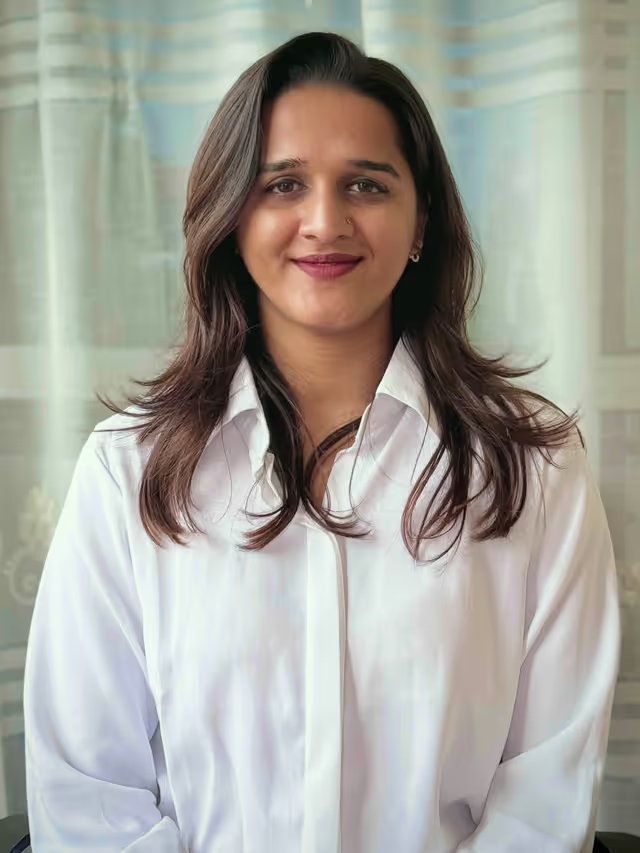
About Smriti Simkhada
Smriti Simkhada is a PTE Academic perfect scorer (90/90) providing structured PTE coaching for Nepali students. She and her team have helped 1,500+ students prepare for Australia PR and Canada immigration through structured, criteria-aligned coaching.