PTE Academic Common Mistakes Nepal 2026: 4-Module Score Killers
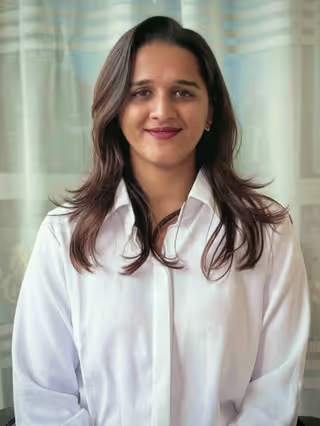
Smriti Simkhada
90/90 Perfect Scorer
Updated June 2026 · Reviewed by Smriti Simkhada (90/90)
Most Nepali students preparing for PTE Academic in 2026 lose 4-7 points not from weak English, but from a small number of recurring mistakes that the automated scoring engine penalises consistently. This guide catalogues the highest-cost mistakes across all four communicative skills — Speaking, Writing, Reading, Listening — with before/after examples and the exact fix for each. Pair this with the 2026 PTE Academic overview for the broader scoring picture.
Every mistake below is something the scoring engine can detect and penalise repeatably. None of them require advanced English; they require awareness and discipline. Fix two or three of these and your next exam score moves measurably without any additional vocabulary or grammar work.
Stuck below your target? The 79+ Sprint
Private 1-on-1 mentorship (Rs. 15,000) with Sydney/Melbourne/Toronto/Singapore/Doha-friendly slots — coach-until-target.
Speaking — Top 4 Mistakes That Cost Marks
Mistake 1: Self-correcting mid-response
Before: "The graph shows the population... uh, the population growth... I mean, increase in population from 2010 to..." (3 self-corrections, Oral Fluency drops 4-6 points)
After: "The graph shows the population growth from 2010 to 2020." (steady, no self-correction)
Fix: Apply the flow-over-correction rule. A small slip mid-response costs less than stopping to fix it. Keep moving.
Mistake 2: Memorised opening phrases in Describe Image
Before: "In today's modern world, this graph clearly demonstrates that…" (detected as memorised template, Content + Linguistic Range hit)
After: "This image presents a bar graph showing population growth across five regions." (image-specific opening)
Fix: Use task structure (5-part Describe Image template) but vary your actual sentences per image.
Mistake 3: Hesitating before the beep on Repeat Sentence
Before: [2-3 second pause after beep] "The researchers found..." (lost Oral Fluency seconds)
After: [immediate start] "The researchers found..." (continuous from the beep)
Fix: Speak within 0.5 seconds of the beep. Even partial sentences with smooth delivery beat complete sentences with delayed start.
Mistake 4: Trying to sound Australian/American
Before: Forced "r" sounds, exaggerated vowel shifts (sounds artificial, Pronunciation hit)
After: Clear, intelligible Nepali-accented English with correct word stress
Fix: The AI scores intelligibility, not accent character. Focus on word stress and difficult consonants (v/w, th, p/f), not accent imitation.
Writing — Top 4 Mistakes That Cost Marks
Mistake 1: Two-sentence Summarise Written Text
Before: "Climate change damages ecosystems. Governments must respond urgently." (Two sentences. Form 0.)
After: "Climate change damages ecosystems, which requires urgent government response through coordinated policy reform." (One sentence.)
Fix: Apply the one-sentence rule ruthlessly. Use relative clauses and subordinating conjunctions to keep one sentence.
Mistake 2: Misspelling repeated keywords in essays
Before: "Envoirnment", "tecnology", "developement" (one error per word; if word repeats 4 times, 4 errors)
After: "Environment", "technology", "development"
Fix: Identify your top-misspelled words from past attempts. Drill those daily before booking the test. Spelling is a binary check per word — repeats compound the loss.
Mistake 3: Memorised essay openings
Before: "Nowadays, in this fast-paced world, technology has become an essential part of our daily lives." (detected, penalised)
After: "Online learning has expanded rapidly across both school and university education in the past decade." (prompt-specific opening)
Fix: Use the flexible essay framework — structure memorised, content adapted to the prompt.
Mistake 4: Going over or under word limits
Before: 320-word essay (over the 200-300 cap, Form penalty); two-sentence SWT response (Form score = 0 regardless of word count)
After: 250-word essay; one-sentence SWT of 60 words
Fix: Build word-count awareness into proofreading. For Writing SWT (Summarise Written Text), the word range is 5–75 words in a single sentence — a 45-word single-sentence response has no Form penalty. The Form penalty on SWT is for writing two or more sentences, not for word count. For Listening SST (Summarise Spoken Text), the zero-score cliff is at 40 words (not 50). Word-limit penalties apply to every Writing task.
Reading — Top 4 Mistakes That Cost Marks
Mistake 1: Selecting too many options on Multiple Choice Multiple Answer
Before: Selects 4 of 5 options on MCMA hoping for partial credit. Wrong selections deduct -1 each. Floors at 0.
After: Selects only 1-2 options that can be defended with specific evidence from the passage.
Fix: MCMA has negative marking. MCSA does not. Use conservative selection on MCMA.
Mistake 2: Reading the passage before the question
Before: Reads full passage in detail, then evaluates options. Spends 90 seconds on a single MC item.
After: Reads question first, scans passage for relevant section, evaluates options. 60 seconds per item.
Fix: Question-first approach saves 30 seconds per Multiple Choice item. Reading time management covers full pacing.
Mistake 3: Translating word meanings instead of using grammar signals on Fill in the Blanks
Before: Tries to remember every word's translation. Misses that the blank requires a noun (after "the") and quickly eliminates verb-form options.
After: Identifies the required word form first (noun/verb/adj/adv), then narrows by collocation.
Fix: Word form + preposition + collocation eliminates 70% of options without translation. FIB grammar shortcuts cover the patterns.
Mistake 4: Leaving Multiple Choice Single Answer blank when uncertain
Before: Leaves MCSA item unanswered when torn between two options.
After: Picks the more likely option. MCSA has no negative marking — leaving blank is guaranteed 0.
Fix: Always attempt MCSA. Even a 50/50 guess has expected value 0.5, better than 0.
Listening — Top 4 Mistakes That Cost Marks
Mistake 1: Spelling errors on Write From Dictation
Before: Writes "phenominon" instead of "phenomenon." Word counted as wrong.
After: Drills high-frequency academic words for spelling daily before the test.
Fix: WFD spelling is binary — each word is correct or wrong. A misspelled word counts as a missed word in the dictation. Spelling practice transfers across Listening + Writing scores.
Mistake 2: Trying to write full sentences during audio in Summarise Spoken Text
Before: Stops listening to write a sentence. Misses subsequent content.
After: Captures nouns and verbs only as keywords. Writes the summary during the writing window using notes.
Fix: Note-taking is keyword-only. Full sentences come during the 10-minute writing window.
Mistake 3: Selecting too many options on Listening Multiple Choice Multiple Answer
Before: Same MCMA mistake as Reading — clicks more than supportable.
After: Conservative selection based on what the audio explicitly stated.
Fix: Same negative marking applies — L-MCMA penalises wrong selections at -1 per click.
Mistake 4: Not using the cursor method on Highlight Incorrect Words
Before: Tries to read the passage and listen at the same time. Misses 30% of HIW errors.
After: Cursor follows the audio word-by-word; clicks any visible word that does not match the audio.
Fix: The cursor method is the standard approach for HIW. Hand-eye coordination on the cursor is the discipline, not English ability.
Cross-Module Mistakes
- Skipping cross-module tasks — Read Aloud (Speaking → Reading), Summarise Spoken Text (Listening → Writing), and Write From Dictation (Listening → Writing) lift two skills with one practice block. Cross-module scoring explains the dynamics.
- Practising on third-party mocks only — Inflated scores. Calibrate against Pearson official scored practice.
- Booking the exam before the official mock confirms readiness — Real-exam scores match Pearson official practice. Aim for 80+ in official mock before booking.
What to Do Instead — Priority Fixes
- Fix the two-sentence SWT mistake — biggest single point gain in Writing.
- Fix the MCMA over-selection mistake — biggest single point gain in Reading.
- Drill WFD spelling — biggest single point gain in Listening.
- Apply the flow-over-correction rule — biggest single point gain in Speaking.
Tips for Nepali Students
- Audit your last attempt — Identify which mistakes cost you the most. Most Nepali students lose to 2-3 specific mistakes, not all 16.
- Use Pearson official practice — The only mock test calibrated to the real scoring engine.
- Don't add new content; fix existing patterns — Most students plateau because they keep practising mistakes. Awareness fixes more than additional drills.
"I had been retaking with the same mistakes — two-sentence SWT and MCMA over-selection. Once I fixed those two, my Writing went from 70 to 78 and Reading from 73 to 79." — Anjali T., Kathmandu
"The flow-over-correction rule was the unlock. I stopped trying to fix slips mid-Read Aloud and Speaking moved from 74 to 81." — Pawan R., Bharatpur
Results reflect individual student preparation experience. Scores depend on personal effort, starting ability, and test conditions. No specific outcome is guaranteed.
Frequently Asked Questions
Which mistake costs the most points?
The two-sentence SWT mistake is the most expensive single mistake — Form scoring on SWT is binary, and a two-sentence response loses the full Form score on that task. MCMA over-selection on Reading is a close second.
Are these mistakes the same for PTE Core?
Most apply to PTE Core too, with one major difference: PTE Core uses Write Email instead of an academic essay, so the essay-specific mistakes (memorised openings, word limits) shift to email-specific equivalents.
How long does it take to fix these mistakes?
Awareness alone fixes some mistakes immediately (e.g., always-attempt MCSA, conservative MCMA). Habit-based mistakes (self-correction in Speaking, two-sentence SWT) take 2-3 weeks of conscious practice to fix permanently.
Will fixing these mistakes alone get me to 79?
Probably not by themselves if your underlying English skills are below C1, but they will move you 4-7 points closer. Pair mistake-fixing with targeted enabling-skill work for the full lift.
Where should I start?
Identify your two most expensive mistakes from your last score report. If you don't have a score report yet, the diagnostic call below maps them quickly.
Plan Your Mistake-Fix Sprint
For a structured 4-week plan that targets your specific mistakes, book a free score assessment call or join the next 15-day batch (Rs. 2,500). The 1-on-1 mentorship reviews your past attempts to identify the exact mistakes pulling your score down.
Mock-test scores are not Pearson scores: Mock-test platforms use their own AI scoring engines, which are calibrated independently from Pearson. Treat mock results as directional indicators, not score predictions. Real-test scoring can differ in either direction, particularly for Speaking and Writing tasks.
Verify current fees: Pearson does not publish a Nepal-specific NPR fee. Test fees vary by test centre, currency, and date. Always confirm the current fee on pearsonpte.com or in your Pearson VUE booking flow before paying.
Last fact-checked on 2026-05-08 against official sources (Pearson PTE, Australia Department of Home Affairs, AHPRA, IRCC, GOV.UK, INZ). Test fees, score requirements, and visa rules can change at any time — always verify the latest details on the relevant official website before booking or applying.
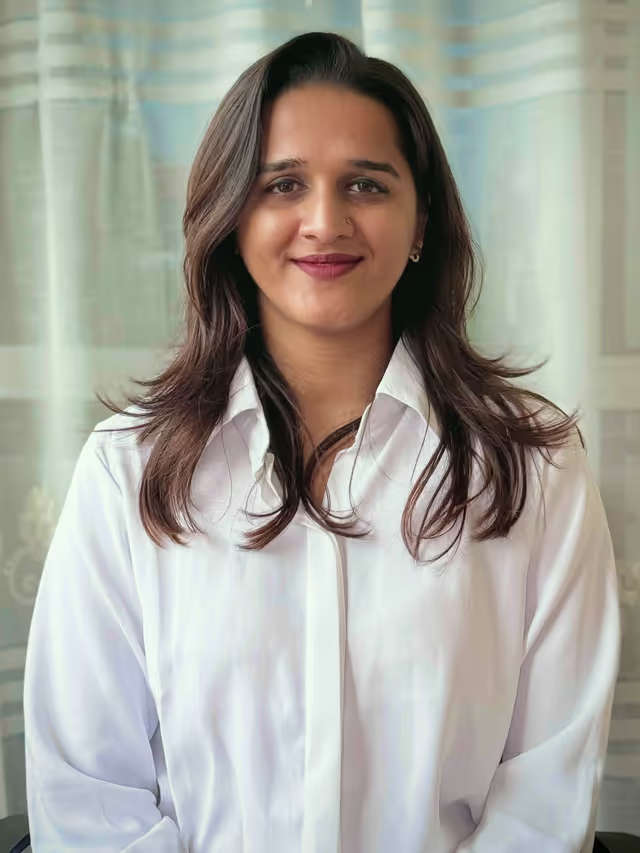
About Smriti Simkhada
Smriti is a PTE Academic perfect scorer (90/90) providing structured PTE coaching for Nepali students. She has helped over 1,000 students prepare for Australia PR and Canada immigration through structured, criteria-aligned coaching.
