17 Grammar Rules You MUST Know to Score 90 in PTE Reading
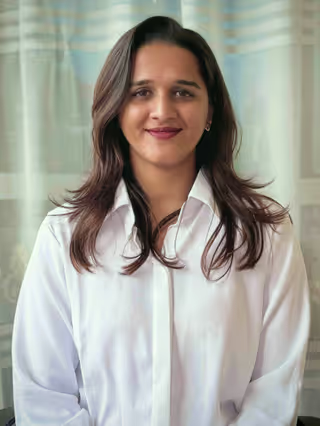
Smriti Simkhada
90/90 Perfect Scorer
Updated May 2026 · Reviewed by Smriti Simkhada (90/90)
PTE Fill in the Blanks Grammar Shortcuts 2026 — Quick Reference
Grammar rules in PTE Reading Fill in the Blanks (FIB) tasks function as rapid elimination tools. Knowing the most reliable grammar signals lets you eliminate 2-3 options in the first 5 seconds of looking at a blank — before even applying collocation knowledge. These are the highest-ROI grammar shortcuts for Nepali students.
For broader context, see the PTE score requirements guide.
Stuck below your target? The 79+ Sprint
Private 1-on-1 mentorship (Rs. 15,000) with Sydney/Melbourne/Toronto/Singapore/Doha-friendly slots — coach-until-target.
Shortcut 1 — Article + Blank = NOUN
If the blank appears immediately after "the", "a", or "an", the blank must be a noun (or an adjective modifying the subsequent noun, but try noun first).
Examples: "the [blank] of the study" → noun; "a [blank] approach" → adjective before "approach" (but "approach" is already there, so blank = adjective)
Verify the latest official format on pearsonpte.com/pte-academic/test-format before relying on task counts, timings, or scoring rules — Pearson updates these without site-wide announcements.
Shortcut 2 — Subject + Blank = VERB
If the blank appears after a subject noun and before an object or complement: "Researchers [blank] the results" → verb in past or present tense.
Shortcut 3 — "Significantly", "Highly", "Rapidly" + Blank = ADJECTIVE or VERB
Adverbs modify adjectives or verbs. "The process was significantly [blank]" → adjective (describing the process). "The rate [blank] significantly" → verb.
Shortcut 4 — Preposition Lock
"impact [blank] the environment" — the preposition "on" should follow "impact" (impact on). If the blank contains the word before a preposition: "have an [blank] on" → "effect" (have an effect on), not "affect" (verb, not used after "an").
Shortcut 5 — "Have/Has/Had" + Blank = Past Participle
Perfect aspect (have/has/had) is always followed by a past participle: "has [blank] significantly" → "increased", "declined", "improved" (past participles, not base form "increase").
Practical Application
For each blank: (1) check article/subject/auxiliary → determine word class needed → eliminate wrong word class options → (2) apply collocation to remaining options → (3) use context meaning to finalise.
This three-step approach takes about 20 seconds per blank and resolves most items. Only truly ambiguous blanks require the full 30-second collocation analysis.
Frequently Asked Questions
Does RW-FIB use the same grammar rules?
Yes. RW-FIB (drag-and-drop) uses the same grammar and collocation signals as R-FIB (dropdown). The word bank in RW-FIB often contains obvious wrong word classes as distractors — eliminate these first.
FIB strategy is part of the 15-day group batch Reading sessions. For vocabulary building including collocation practice, browse free study materials. Read the full PTE Academic guide or book the 1-on-1 mentorship.
Continue Your PTE Preparation
Related guides for Nepali students preparing for PTE Academic and PTE Core:
- Reading time management
- Reading collocations list
- Reorder Paragraphs 2-minute trick
- Multiple Choice strategy
- Read Aloud and Reading score
- Free score assessment
Last fact-checked on 2026-05-08 against official sources (Pearson PTE, Australia Department of Home Affairs, AHPRA, IRCC, GOV.UK, INZ). Test fees, score requirements, and visa rules can change at any time — always verify the latest details on the relevant official website before booking or applying.
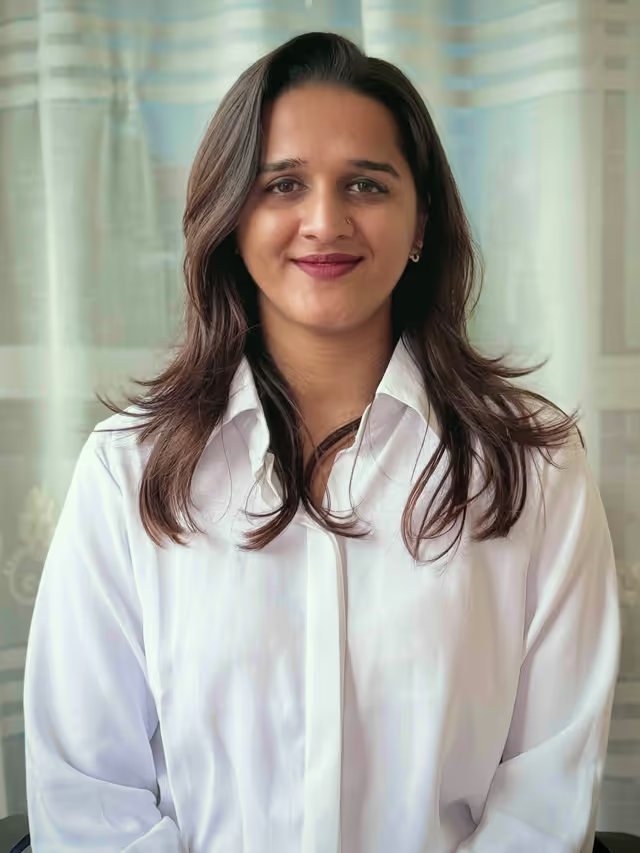
About Smriti Simkhada
Smriti is a PTE Academic perfect scorer (90/90) providing structured PTE coaching for Nepali students. She has helped over 1,000 students prepare for Australia PR and Canada immigration through structured, criteria-aligned coaching.
