PTE Academic 2026: Everything You Need to Know About the New Scoring
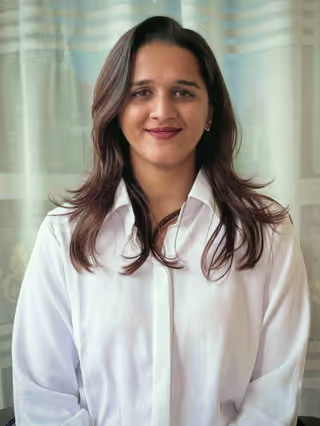
Smriti Simkhada
90/90 Perfect Scorer
Updated June 2026 · Reviewed by Smriti Simkhada (90/90)
If you are preparing for PTE Academic in 2026, the most useful thing to know is what has actually changed and what has stayed exactly the same. The exam still uses Pearson's automated scoring engine, the score scale is still 10-90, and around 20 task types appear across Speaking, Writing, Reading, and Listening (Pearson groups Speaking & Writing with 9 scored task types, Listening with 8, and Reading with 5). What has shifted is how students should approach preparation now that integrated and cross-module scoring is better understood.
This guide is written specifically for Nepali students preparing from Kathmandu, Chitwan, Bharatpur, and other cities — students aiming for 79+ for Australia PR, 65 each for student visas, or competitive scores for university admission abroad. Skip the rumours and focus on what is documented and consistent across recent score reports.
Stuck below your target? The 79+ Sprint
Private 1-on-1 mentorship (Rs. 15,000) with Sydney/Melbourne/Toronto/Singapore/Doha-friendly slots — coach-until-target.
What Has Stayed the Same in 2026
The PTE Academic structure has not changed in 2026. You still have one continuous test session of about two hours, no separate Speaking interview, no human examiner, and around 20 scored task types grouped into three parts: Speaking and Writing combined, Reading, and Listening.
- Score scale: 10 to 90 in each communicative skill (Speaking, Writing, Reading, Listening) and overall.
- Validity: Score reports remain valid for 2 years for general use; the Department of Home Affairs may, in some skilled-migration scenarios, accept PTE results up to 3 years old — verify on the Department of Home Affairs page for your visa subclass.
- Acceptance: Australia, Canada (PTE Core), UK, New Zealand, Ireland, and US universities continue to accept PTE.
- Result delivery: Most candidates receive scores within 48 hours.
What 2026 Has Made Clearer About Scoring
The mechanics of automated scoring have not changed, but the way preparation experts and Pearson's own materials describe cross-module contribution has become more transparent. Two things stand out for 2026:
1. Cross-module scoring is real and worth optimising for
Many Speaking and Listening tasks contribute to other communicative skills. Read Aloud and Repeat Sentence contribute to your Reading and Listening scores. Summarize Spoken Text and Write From Dictation feed both Listening and Writing. Cross-module scoring is why a strong Speaking performance can lift your Reading score even if you finish the reading section uncertain.
2. Enabling skills decide the ceiling
Each communicative skill is built from enabling skills like Oral Fluency, Pronunciation, Grammar, Vocabulary, Spelling, and Written Discourse. Your enabling skill scores explain why a candidate with strong Speaking task accuracy might still score 76 — Oral Fluency is dragging the score down.
What Nepali Students Should Focus on in 2026
Across hundreds of student score reports from Bharatpur, Kathmandu, and Pokhara, three patterns repeat. If your goal is 79+ in 2026, these are the levers that move the score:
- Oral Fluency over pronunciation — Speaking scores get stuck at 75-78 because of hesitations, restarts, and self-corrections, not because of the Nepali accent. Consistent pacing matters more than accent neutralisation.
- Spelling accuracy in Write From Dictation — A single misspelled word in WFD can shave 4-6 points from your Listening score. Daily WFD practice with fresh sentences is the highest ROI activity for Listening.
- Sentence-level grammar in Writing — Subject-verb agreement, articles, and tense consistency matter more than vocabulary range. Common grammar mistakes account for most stuck-at-77 Writing scores.
Does the AI Penalise the Nepali Accent?
This is the question every Nepali test-taker asks, so it deserves a direct answer. The automated scoring engine is not designed to penalise regional accents. It evaluates speech against intelligibility and fluency criteria, not native-speaker comparison. Students from Bharatpur and Kathmandu regularly score 79+ in Speaking. The block is almost always fluency hesitations or pronunciation of specific consonants (v/w, th sounds), not the underlying accent.
Which Resources Actually Reflect 2026 Scoring
Use Pearson's official PTE Practice platform as your benchmark. Third-party mock platforms in Nepal often report scores 4-8 points higher than the actual exam, particularly in Speaking. If your official Pearson practice score shows 80+ in all four skills, you are ready to book. A comparison of mock platforms helps you choose calibrated tools.
2026 Preparation Plan for Nepali Students
- Weeks 1-2: Diagnostic. Take one official Pearson scored practice. Identify the blocking skill (the lowest of the four communicative scores).
- Weeks 3-5: Targeted task practice on the blocking skill. Daily Read Aloud (10 passages), daily WFD (15 sentences), 3 essays per week.
- Weeks 6-7: Full mocks. Two scored mocks per week to build stamina and refine timing.
- Week 8: Light revision, one final mock, then book the real exam.
Common Misunderstandings About 2026 PTE
- "The AI is harder in 2026" — There is no public evidence the scoring threshold has shifted. Most candidates seeing lower scores are using third-party prep that overestimates baseline.
- "Templates no longer work" — Templates still help with task framing and timing. Memorised content scored against generic prompts has always been penalised. A flexible template adapted to the prompt is the working approach.
- "Speaking needs an Australian accent" — No. Clarity, pacing, and pronunciation accuracy of difficult consonants matter; the underlying accent does not.
What Students Say About Structured 2026 Preparation
"I had taken PTE three times before reaching out. The structured plan during the 15-day batch helped me identify that Oral Fluency was my real block, not the accent." — Sandesh K., Kathmandu
"The diagnostic call alone changed my preparation direction. I stopped wasting time on tasks that were already strong and focused on Write From Dictation for two weeks." — Priya M., Pokhara
Results reflect individual student preparation experience. Scores depend on personal effort, starting ability, and test conditions. No specific outcome is guaranteed.
Frequently Asked Questions
Has the PTE Academic format changed in 2026?
No. The format, task types, scoring scale, and timing remain the same. What is different is how preparation strategies emphasise enabling skills and cross-module scoring more explicitly.
Does the 2026 exam use stricter AI scoring?
There is no public Pearson announcement of stricter scoring. The same automated scoring engine is in use. Score variation between practice platforms is usually a calibration issue, not a scoring change.
How do I know which skill to focus on first?
Take one official Pearson scored practice test. Identify the lowest of the four communicative scores. That is your "blocking skill." Spend 70% of your preparation time on the tasks that feed it.
Is PTE Academic still accepted for Australia PR in 2026?
Yes. PTE Academic remains accepted by Australian Department of Home Affairs for skilled migration, student visas, and partner visas. Current PTE score requirements for Australia PR are unchanged for 2026.
Plan Your 2026 PTE Preparation
If you are preparing for PTE Academic in 2026, start with a clear diagnosis. Book a free score assessment call to identify your blocking skill before you spend weeks on the wrong tasks. The 1-on-1 mentorship begins with a score-report review and a targeted prep plan. The 15-day group batch (Rs. 2,500) covers the highest-impact tasks for Nepali students. For the full preparation pathway, see how to score 79+ in PTE Academic from Nepal.
Last fact-checked: 2026-05-08 against official sources (Pearson PTE, Australia Department of Home Affairs, AHPRA, IRCC Canada, GOV.UK, INZ). Test fees, score requirements, and visa rules can change at any time. Always verify the latest details on the relevant official website before booking or applying.
Last fact-checked on 2026-05-08 against official sources (Pearson PTE, Australia Department of Home Affairs, AHPRA, IRCC, GOV.UK, INZ). Test fees, score requirements, and visa rules can change at any time — always verify the latest details on the relevant official website before booking or applying.
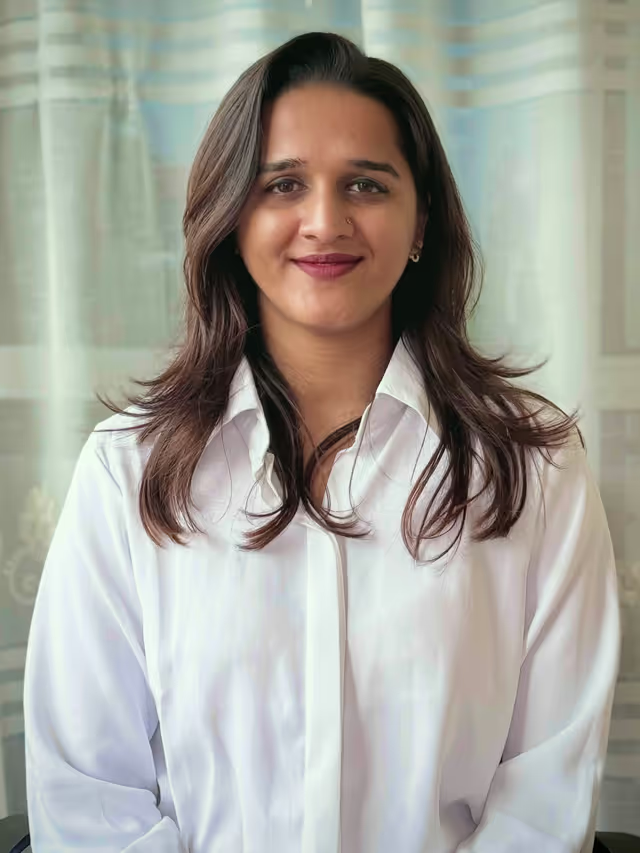
About Smriti Simkhada
Smriti is a PTE Academic perfect scorer (90/90) providing structured PTE coaching for Nepali students. She has helped over 1,000 students prepare for Australia PR and Canada immigration through structured, criteria-aligned coaching.
