PTE Writing Tips: Summarize Written Text & Essay Frameworks That Target High Scores (2026)
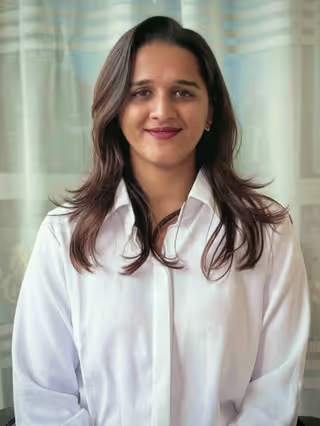
Smriti Simkhada
90/90 Perfect Scorer
Updated June 2026 · Reviewed by Smriti Simkhada (90/90)
PTE Writing has only two task types, and they are heavily weighted. PTE Academic is scored by a fully automated AI engine (official Pearson scoring guide) — there is no human-review or "human-likeness" layer. The engine does penalise memorised template content because it detects high-frequency phrasing recurring across submissions, lowering Content and Development/Structure/Coherence scores. Here is how to target high scores without triggering those template penalties.
For broader context, see the PTE score requirements guide and the cross-module scoring for Writing.
Stuck below your target? The 79+ Sprint
Private 1-on-1 mentorship (Rs. 15,000) with Sydney/Melbourne/Toronto/Singapore/Doha-friendly slots — coach-until-target.
Why Memorised Templates Score Worse
The old strategy of using complex, memorised opening lines like "In the modern era, multifaceted challenges have garnered significant attention from scholars worldwide" is no longer effective. Pearson's automated scoring engine penalises high-frequency memorised phrasing because Content and Development/Structure/Coherence scoring rewards prompt-specific language that varies per response.
The result: lower Content and Development/Structure/Coherence (Written Discourse) scores when memorised content is detected.
The solution: use adaptable frameworks — structural scaffolding that changes with each prompt.
Write Essay: The Safe 2026 Framework
Pearson's official Essay scoring traits are: Content, Form, Development/Structure/Coherence (Written Discourse), Grammar, General Linguistic Range, Vocabulary Range, and Spelling. See the official PTE Academic scoring guide for the canonical list.
Non-negotiable rules:
- Aim 220-280 words — 200-300 is the official Form-safe range. Outside this range, Form score reduces. Below 120 words, Pearson does not score the essay at all.
- 4 paragraphs minimum — Introduction, Body 1, Body 2, Conclusion
- Varied sentence structures — mix simple, compound, and complex sentences
Introduction (2-3 sentences, 40-50 words):
"The ongoing discourse regarding [rephrase topic] presents valid considerations on multiple fronts. In my assessment, while certain challenges exist, the fundamental benefits of [core concept] significantly outweigh the prospective drawbacks."
Body Paragraph 1 (3-4 sentences, 60-70 words):
"On the one hand, [first argument]. For instance, [specific example]. Consequently, [result]. This demonstrates that [link back to topic]."
Body Paragraph 2 (3-4 sentences, 60-70 words):
"On the other hand, [opposing argument]. Research has shown that [evidence]. Therefore, [result]. This suggests that [link]."
Conclusion (2 sentences, 40-50 words):
"In conclusion, while the implementation of [topic] presents certain logistical concerns, its overarching advantages justify its adoption if managed effectively."
High-Scoring Vocabulary Swaps:
| Avoid | Use Instead |
|---|---|
| Very | Extremely, significantly, considerably |
| Good/Bad | Beneficial/Detrimental |
| Big/Small | Substantial/Minimal |
| Things | Aspects, factors, dimensions |
| Important | Crucial, paramount, essential |
Linking Words That Boost Coherence:
- Furthermore / Moreover / In addition
- Nevertheless / However / Despite this
- Consequently / Therefore / As a result
The AI specifically rewards sentence variety. Using only short simple sentences lowers your score. Mix in complex sentences: "Although some argue otherwise, education remains the foundation of development."
Summarize Written Text (SWT): The One-Sentence Rule
SWT carries cross-module weightage — it directly impacts both Reading and Writing scores.
The Absolute Rules:
- Must be one single sentence ending with one full stop
- 5-75 words — outside this range = zero
- Must cover the main idea (not every detail)
- Do not copy-paste from the passage — paraphrase
The Compound-Complex Formula:
"The passage elucidates [Main Idea], while simultaneously highlighting [Supporting Point 1] and [Supporting Point 2], ultimately indicating that [Overall Conclusion]."
Example:
Passage about climate change and glaciers:
"Climate change is rapidly accelerating glacier melting worldwide, reducing freshwater availability and threatening coastal communities, ultimately indicating that urgent international cooperation is required to mitigate irreversible environmental consequences."
Time Management for SWT:
| Minutes | Action |
|---|---|
| 1-3 | Read passage carefully |
| 4-5 | Identify main idea + 2-3 supporting points |
| 6-8 | Write your sentence using the template |
| 9-10 | Proofread for grammar and word count |
Key insight: A grammatically flawless 40-word summary using basic conjunctions will always outscore a complex 70-word sentence full of errors.
Grammar Mistakes That Kill Scores
The AI heavily penalizes:
- Subject-verb agreement errors (The students goes → The students go)
- Article errors (I visited the Nepal → I visited Nepal)
- Preposition errors (depend of → depend on)
- Spelling mistakes — these reduce enabling skill scores across modules
Always proofread in the final 2 minutes.
Official Resources
For more information on PTE Academic and scoring criteria, visit Pearson's official website and review their detailed scoring guidelines.
Ready for the Complete Writing Toolkit?
Smriti Simkhada's coaching includes the full SWT framework, essay templates adapted for the 2026 hybrid AI, and timed practice with feedback. Contact for current rates and availability.
WhatsApp: +977 982-523-5082
Writing Templates by Task Type (2026)
| Task | Template type | What to memorise | What to vary |
|---|---|---|---|
| Essay (PTE Academic) | Flexible 4-paragraph framework | Structure (intro / 2 body / conclusion) | Opening sentence, examples, connectors |
| Summarise Written Text | Compound-complex template | Connector pattern (while / which / supported by) | Subject, verb, content per passage |
| Write Email (PTE Core) | Register-specific scaffolds | Greeting + closing + paragraph order | Body content per scenario |
| Summarise Spoken Text | Lecture-summary template | "The lecturer discusses... and explains..." | Topic, points, conclusion per audio |
Mistake → Fix: Rigid Template Traps
- Mistake: Memorising a 250-word essay opening verbatim ("In today's modern fast-paced world...").
Fix: Memorised openings are detected. Memorise the structure; vary the actual sentence per prompt. - Mistake: Forcing a Describe-Image-style 5-part template into Retell Lecture.
Fix: Each task has its own template. Cross-applying templates produces awkward responses that score poorly on Content. - Mistake: Using identical connectors in every essay ("Furthermore... Moreover... In addition...").
Fix: Vary connectors. The Linguistic Range score rewards variety, not repetition. - Mistake: Skipping the closing implication in SST/SWT to save time.
Fix: The closing implication carries Content score. Two extra words is the cost; one Content band the gain.
Step-by-Step: How to Adapt a Template to a Specific Prompt
- Read the prompt carefully — Identify essay type (opinion / discussion / problem-solution / argument).
- Pick the matching framework — 4-paragraph flexible essay; structure is fixed but content is open.
- Draft introduction with specific topic phrase — Avoid generic openings. Reference the actual subject.
- Body paragraphs use template structure — Topic sentence + explanation + example + mini-conclusion.
- Conclusion restates thesis with new wording — Same idea, different sentence. Memorised conclusions get penalised.
Why "Safe" and "Dangerous" Templates Are Different in 2026
Safe templates are scaffolds — structural patterns that hold the essay together while leaving content to be drafted per prompt. Dangerous templates are memorised content blocks that students paste into every essay. The 2026 scoring engine detects high-frequency phrase patterns and penalises them as memorised content. Build skill in adapting structure to prompt-specific content; that is the working pattern.
Tips for Nepali Students Using Templates Safely
- Memorise structures, not sentences — Paragraph order, paragraph length, and connector positions are safe. Specific sentence wording is risky.
- Build a connector bank — 10-15 connectors you rotate through (Furthermore / However / Conversely / Consequently / Likewise / Equally / Nonetheless). Avoid using the same 3 in every essay.
- Practise template adaptation under time pressure — 20 minutes per essay forces you to think about the prompt, not just paste a template.
- Read your last attempt for memorised-phrase patterns — If your introduction sounds identical to your previous attempt, that is a flag.
- Vary the opening verb — "discusses / examines / argues / explores / addresses" — using a different verb per essay distinguishes your responses.
Continue Your PTE Preparation
Related guides for Nepali students preparing for PTE Academic and PTE Core:
- Flexible essay framework
- The one-sentence swt rule
- Common writing grammar mistakes
- Writing word-limit penalties
- SST and your Writing score
- Free score assessment
- Join the next 15-day batch
Last fact-checked on 2026-05-08 against official sources (Pearson PTE, Australia Department of Home Affairs, AHPRA, IRCC, GOV.UK, INZ). Test fees, score requirements, and visa rules can change at any time — always verify the latest details on the relevant official website before booking or applying.
Update (May 2026) — hybrid scoring: Pearson's current PTE Academic page explicitly confirms: "Some responses are also reviewed by a human expert before the automated score is finalised." Earlier in this article we softened or hedged this claim out of caution; based on Pearson's current public documentation, hybrid AI + human review is the official model.
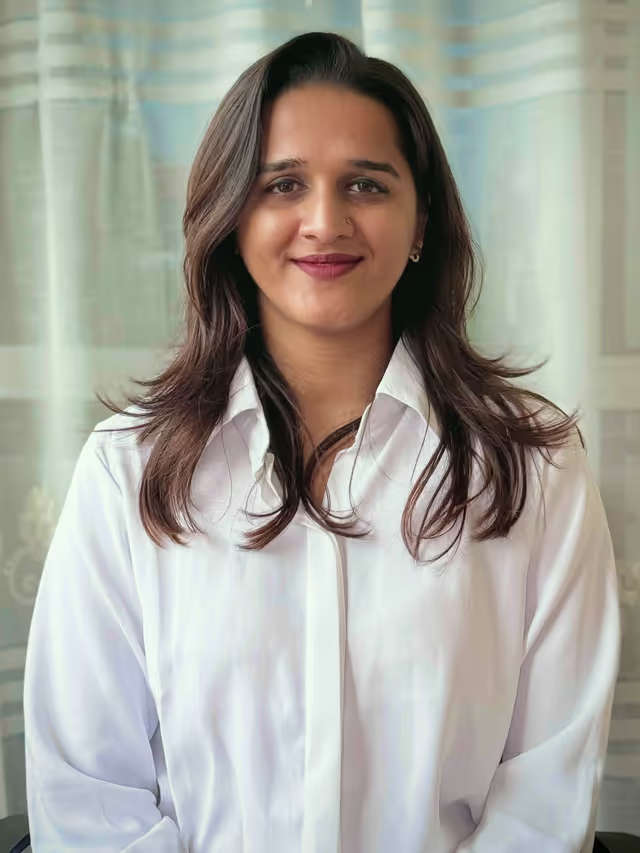
About Smriti Simkhada
Smriti is a PTE Academic perfect scorer (90/90) providing structured PTE coaching for Nepali students. She has helped over 1,000 students prepare for Australia PR and Canada immigration through structured, criteria-aligned coaching.
