Most Important PTE Tasks for Australia PR: Where 79+ Is Actually Scored (2026)

Smriti Simkhada
90/90 Perfect Scorer
Updated October 2026 · Reviewed by Smriti Simkhada (90/90)
Updated thresholds (post 7 August 2025): Department of Home Affairs now uses component-specific thresholds for English brackets. Competent (0 PR points): L47 / R48 / W51 / S54. Proficient (10 PR points): L58 / R59 / W69 / S76. Superior (20 PR points): L69 / R70 / W85 / S88. Pre-7-Aug-2025 the brackets used uniform 50 / 65 / 79 each. Verify the latest at immi.homeaffairs.gov.au.
Priority shift: under the new asymmetric thresholds, Speaking (S88) and Writing (W85) tasks carry higher weight for Superior English than Listening (L69) and Reading (R70). The task priorities below reflect this re-ranking — Read Aloud, Repeat Sentence, Describe Image, Essay, and Summarise Written Text are the highest-leverage tasks for the Superior English bar.
Stuck below your target? The 79+ Sprint
Private 1-on-1 coaching, from US$99: pick 7 days, 17 days or 1 month, one live session a day on your time zone (Sydney · Melbourne · Toronto · London · Doha), a demo session included, and Coach-Until-Target on the longer plans.
Most Important PTE Tasks for Scoring 79+ in 2026
With 20 different task types spread across PTE Academic's four sections, knowing which tasks to prioritise is the difference between scattered preparation and a targeted strategy. Not all tasks carry equal weight. Some tasks contribute to multiple communicative skills simultaneously. Some have the highest score-per-minute-of-practice return. This guide identifies the most important PTE Academic tasks for scoring 79+ in each skill, based on their scoring weight and the score impact they have for Nepali students.
How PTE Academic Scoring Works (Quick Overview)
PTE Academic scores each communicative skill (Speaking, Writing, Reading, Listening) based on performance across all relevant tasks in that section — plus some cross-skill contributions from tasks in other sections. This means improving one task can lift multiple communicative skill scores simultaneously.
Understanding which tasks are "cross-skill" — contributing to more than one communicative skill — is the key to efficient preparation.
Most Important Tasks for Speaking (79+ Target)
1. Read Aloud — Highest Impact Speaking Task
Read Aloud is the single most important Speaking task in PTE Academic. It contributes to both Speaking (Oral Fluency, Pronunciation) and Reading (Reading comprehension through enabling skills). There are typically 6-7 Read Aloud items per exam.
Why it matters most: Oral Fluency, the enabling skill most responsible for Speaking score gaps for Nepali students, is primarily shaped by Read Aloud performance. Students with weak Oral Fluency but strong Pronunciation still score below 79 in Speaking. Read Aloud practice directly builds Oral Fluency through pacing, chunking, and connected speech.
Practice target: Read one academic text aloud daily, recording yourself and checking for hesitations and unnatural pauses.
2. Repeat Sentence — Fastest Fluency Builder
Repeat Sentence is high-frequency (10-12 items per exam) and contributes heavily to both Oral Fluency and Pronunciation. Because each item is only 3-9 seconds, you can practice many items in a short session. Students who consistently score above 85% accuracy on Repeat Sentence typically achieve 75+ in Speaking.
Practice target: 20 Repeat Sentence items daily during the 2 weeks before your exam.
3. Describe Image — Content + Fluency Combined
Describe Image (6-7 items per exam) tests both content accuracy and Oral Fluency. The template-based approach (Introduction → Main trend → Comparison → Conclusion) allows students to achieve consistent fluency even when the image is complex. Strong Describe Image performance often pushes Speaking over 79 for students who are stuck at 75-78.
Most Important Tasks for Writing (79+ Target)
1. Summarise Written Text — Cross-Skill Powerhouse
Summarise Written Text (SWT) is the most important Writing task because it contributes to BOTH Writing and Reading scores. It tests Grammar, Vocabulary, and Written Discourse simultaneously. There are typically 2-3 SWT items per exam.
A well-crafted SWT response (one accurate sentence of 5-75 words that captures the main idea and key supporting details) can lift both your Writing and Reading communicative skill scores. Students who struggle with Writing below 79 often find that fixing SWT accuracy moves their score the most.
2. Essay (Discuss Both Views / Agree or Disagree)
The Essay is the most heavily-weighted individual Writing task. It is scored on Content, Form, Grammar, Vocabulary, and Written Discourse. An essay that is well-structured, avoids memorised templates, and demonstrates vocabulary range scores significantly higher than a template-filled essay with correct grammar.
Key insight for Nepali students: PTE's AI system now identifies heavily-used templates (especially openers like "In this modern era" and "Owing to this"). Students who continue using these templates find their Writing score stays flat at 70-73. Moving to topic-specific, flexible structures unlocks the higher score.
Most Important Tasks for Reading (79+ Target)
1. Reading: Fill in the Blanks (R-FIB) — Highest Volume, High Impact
Reading FIB (4-5 items per exam) tests vocabulary in context — specifically collocation knowledge, word form, and grammar signals. It is the Reading task that offers the most practice efficiency because each blank is an independent question. Strong collocation knowledge (knowing which words naturally follow others) is the key skill.
2. Reorder Paragraphs — Discourse Structure
Reorder Paragraphs tests discourse coherence — the ability to understand how ideas connect in academic text. Students who use the 4-step strategy (find the topic sentence, find the conclusion, use discourse markers, check pronouns) consistently score higher than students who approach it by trial and error.
3. Reading/Writing: Fill in the Blanks (RW-FIB) — Cross-Skill
RW-FIB contributes to both Reading and Writing scores. It appears 5-6 times per exam and tests grammar, collocation, and vocabulary. Improving RW-FIB accuracy through collocation practice lifts both Reading and Writing, making it one of the most efficient tasks to master.
Most Important Tasks for Listening (79+ Target)
1. Write From Dictation — Single Highest Score Impact
Write From Dictation (WFD) is the most important Listening task in PTE Academic. It contributes heavily to both Listening and Writing scores through the enabling skill of Spelling. There are typically 4-5 WFD items per exam, and each correctly-typed word earns a partial credit point.
Why it dominates: Students who miss an average of 2-3 words per WFD item (across 4-5 items) lose 8-15 potential points in Listening. Students who achieve near-perfect accuracy on WFD typically score 75+ in Listening even if they struggle with other Listening tasks.
Practice target: 20 minutes of WFD practice daily, focusing on the exact wording of each audio snippet.
2. Highlight Incorrect Words — Fast Points
Highlight Incorrect Words is lower-pressure than WFD (no typing required — just clicking) and appears 2-3 times per exam. Students who practice the cursor-following method (scroll through the transcript while listening and click deviations immediately) score consistently high on this task with minimal preparation time investment.
Priority Practice Schedule Based on Your Weak Skill
| Weak Skill | Primary Task to Fix | Secondary Task | Cross-Skill Benefit |
|---|---|---|---|
| Speaking below 79 | Read Aloud (daily) | Repeat Sentence | Also lifts Reading |
| Writing below 79 | Summarise Written Text | Essay structure | Also lifts Reading |
| Reading below 79 | R-FIB collocation | SWT (cross-skill) | SWT also lifts Writing |
| Listening below 79 | Write From Dictation | Highlight Incorrect Words | WFD also lifts Writing |
Common Mistakes Nepali Students Make When Choosing What to Practice
- Practising what they are good at — Students often gravitate to tasks they already score well on because they feel productive. The highest score gains come from fixing your weakest tasks, not reinforcing strong ones.
- Treating all tasks equally — Spending equal time on Select Missing Word (low impact) and Write From Dictation (high impact) is an inefficient use of preparation time.
- Not checking enabling skills — Knowing your communicative skill scores is not enough. Knowing that Speaking is 74 because Oral Fluency is 60 (not Pronunciation) tells you to practice Read Aloud, not pronunciation drills.
Frequently Asked Questions
Which single task, if improved, is most likely to push me from 78 to 79 in Speaking?
For most Nepali students, Read Aloud is the answer. Oral Fluency (which Read Aloud most directly trains) is the most common bottleneck for Speaking scores in the 74-78 range. 3-4 weeks of daily Read Aloud practice with self-recording typically produces a measurable improvement in Oral Fluency scores.
Is Write From Dictation really worth spending so much time on?
Yes — for most students, WFD is the highest-value time investment in the Listening section. Getting all words correct in 4-5 WFD items can add 10-15 Listening points for students who are currently missing several words per item.
Can I reach 79 in Speaking if my Pronunciation is low?
Yes, but it is harder. Pronunciation is one of two Speaking enabling skills (the other being Oral Fluency). If Pronunciation is below 70, you should work on clarity of speech in high-frequency problem sounds for Nepali speakers (v/w distinction, th sounds, word stress). However, raising Oral Fluency from 60 to 75+ usually has a larger score impact than improving Pronunciation from 70 to 80.
Structured Practice for High-Impact Tasks
If you want to build expertise in the tasks that matter most — Read Aloud, Write From Dictation, Summarise Written Text, and Reading FIB — a 1-on-1 plan of 7 days, 17 days or 1 month structures your preparation around these high-impact tasks daily. The 1-on-1 mentorship begins with a score report review to identify exactly which tasks to prioritise. Browse free study materials or explore the full PTE Academic guide.
Continue Your PTE Preparation
Related guides for Nepali students preparing for PTE Academic and PTE Core:
- How to score 79+ from nepal
- PTE 79+ timeline
- Retake strategy for 79+
- How many attempts most need
- PTE vs IELTS for PR
- Free score assessment
More on PTE Nepal: PTE for Australia hub and Subclass 189 PR pillar.
Verify current fees: Pearson lists the PTE fee in Nepal in USD, so the rupee amount depends on your bank's rate. Pearson can change its prices, so always confirm the current fee on pearsonpte.com or in your Pearson VUE booking flow before paying.
Last fact-checked on 2026-05-08 against official sources (Pearson PTE, Australia Department of Home Affairs, AHPRA, IRCC, GOV.UK, INZ). Test fees, score requirements, and visa rules can change at any time — always verify the latest details on the relevant official website before booking or applying.
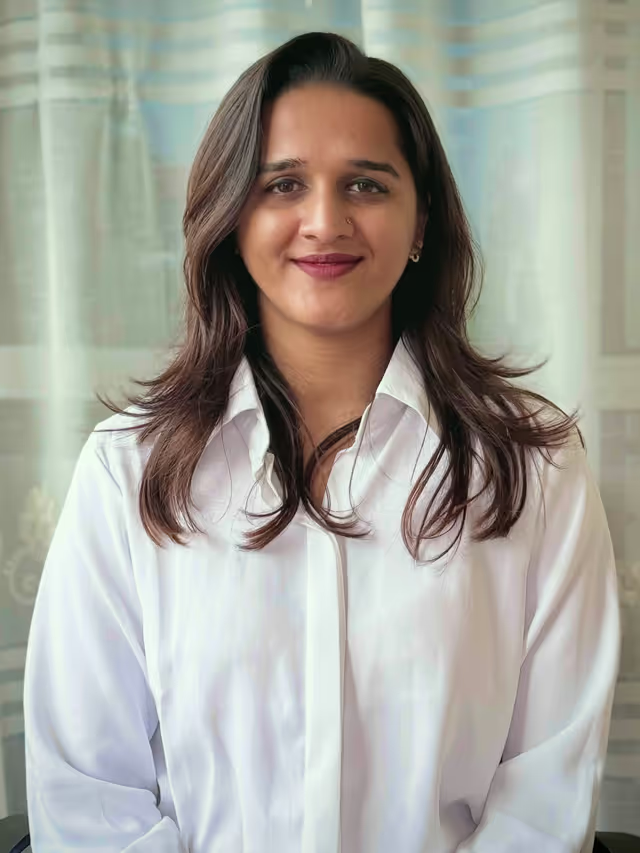
About Smriti Simkhada
Smriti Simkhada is a PTE Academic perfect scorer (90/90) providing structured PTE coaching for Nepali students. She has helped over 1,000 students prepare for Australia PR and Canada immigration through structured, criteria-aligned coaching.
