AHPRA Internationally Qualified Nurses (IQN): Step-by-Step PTE Pathway (2026)
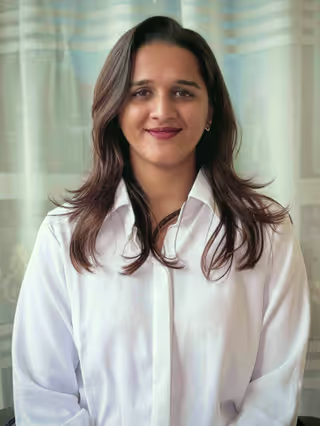
Smriti Simkhada
90/90 Perfect Scorer
Updated October 2026 · Reviewed by Smriti Simkhada (90/90)
Introduction
Most Nepali nurses considering Australia want to know two things: what tests do I need to pass, and how long will it take? The answer is the AHPRA IQN pathway — a structured assessment process for Internationally Qualified Nurses (and Midwives) that includes qualification verification, English language proficiency (where PTE comes in), and the Outcomes-Based Assessment (OBA).
This article walks through every step of the IQN pathway for Nepali nurses in 2026, explains how the AHPRA PTE requirements (23 April 2026) apply, where PTE Academic fits, and what realistic timelines look like from "I am thinking of moving to Australia" to "I am working as a registered nurse in Sydney."
Stuck below your target? The 79+ Sprint
Private 1-on-1 coaching, from US$99: pick 7 days, 17 days or 1 month, one live session a day on your time zone (Sydney · Melbourne · Toronto · London · Doha), a demo session included, and Coach-Until-Target on the longer plans.
What Is the IQN Pathway?
The AHPRA IQN pathway is the structured process that the Nursing and Midwifery Board of Australia (NMBA) uses to assess foreign-trained nurses against Australian standards. It is the only route for a nurse trained outside Australia to register and work in the Australian public or private healthcare system.
The Three IQN Pathways
- Self-Check Tool / Stream A: For nurses whose qualifications are deemed substantially equivalent to Australian standards. Direct registration after English + criminal history checks.
- Stream B (Outcomes-Based Assessment / OBA): Most common pathway. Two-step assessment: Multiple Choice Questionnaire (MCQ) and Objective Structured Clinical Examination (OSCE).
- Stream C (Bridging Programs): For nurses whose qualifications need supplementation through an accredited Australian bridging program (typically 3–12 months).
Most Nepali-trained nurses fall into Stream B (OBA pathway) or Stream C (Bridging) depending on their qualification level and training depth.
The Five-Phase IQN Pathway
Phase 1 — Self-Check and Qualification Recognition
- Use AHPRA's online self-check tool to assess where your qualification fits
- Submit detailed transcript, course content, clinical hours, qualification level (Bachelor's of Nursing minimum)
- NMBA reviews and assigns you to Stream A, B, or C
- Typical timeline: 4–8 weeks for review
Phase 2 — English Language Proficiency
This is where PTE Academic enters. Per AHPRA's English language standard (effective 23 April 2026):
- PTE Academic Overall: 63 minimum
- Listening: 58 minimum
- Reading: 59 minimum
- Writing: 60 minimum
- Speaking: 76 minimum
The Two-Test Combination Provision
Since April 2026, AHPRA accepts scores combined across up to two test sittings within a 12-month window. The overall required minimums (L58/R59/W60/S76) must be met across the two combined sittings, AND no skill in either individual sitting may fall below the per-sitting sub-floors: Listening 53, Reading 54, Writing 60, Speaking 66. Both thresholds must be satisfied — the per-sitting floors are lower than the overall required minimums. This is significant for Nepali nurses who plateau in one band.
Phase 3 — Multiple Choice Questionnaire (MCQ)
- Computer-based test of nursing theory and clinical knowledge
- 150 questions, 3 hours
- Tests Australian standards of nursing practice, ethics, legal frameworks
- Held at testing centres globally including major cities (none in Nepal as of 2026 — typically India, Singapore, or Australia)
Phase 4 — Objective Structured Clinical Examination (OSCE)
- Practical clinical assessment held at AHPRA-approved testing centres in Australia
- 10 stations covering common clinical scenarios
- Each station 8–15 minutes
- Tests practical clinical skills, communication, decision-making
- Must be completed in Australia — requires a temporary visa (usually 408 or visitor visa)
Phase 5 — Registration and Job Search
- After passing both MCQ and OSCE, apply for AHPRA registration
- Complete criminal history check, AHPRA English self-declaration
- Once registered, apply for jobs in Australian public health (NSW Health, Victoria Health, Queensland Health, etc.) or private aged-care/hospitals
- Most nurses apply for Subclass 482 (employer-sponsored) or 186 (PR) once they have a job offer
Why Speaking 76 Is the Hardest AHPRA Threshold
Speaking 76 is the most demanding band in the AHPRA threshold set. For most Nepali nurses, Listening 58, Reading 59, and Writing 60 are achievable with 4–8 weeks of focused prep. Speaking 76 typically requires 8–16 weeks of pronunciation, fluency, and oral structure work.
What Drives Speaking 76
- Pronunciation accuracy (specific phonemes, not generic "clear speech")
- Oral Fluency (pace, pause patterns, stress, intonation)
- Vocabulary range used naturally in Speaking tasks
- Strong performance across all 7 Speaking tasks (RA, RS, DI, RL, ASQ, RtaS, SGD)
The Two-Test Combination Strategy
Given Speaking 76 difficulty, many Nepali nurses use the two-test combination: take the test, hit Listening 58 / Reading 59 / Writing 60 / Speaking 70 (clearing the per-sitting sub-floor of L53/R54/W60/S66 in the first sitting), then retake within 12 months targeting Speaking 76 only. The overall required minimums (L58/R59/W60/S76) must be met across the two combined sittings. In each individual sitting, no skill may fall below the per-sitting sub-floors: L53/R54/W60/S66. This is documented in the AHPRA two-test combination article.
Realistic Timeline for Nepali Nurses
Optimistic Timeline (12–18 Months)
- Months 1–2: Self-check and qualification recognition
- Months 3–6: PTE prep and first attempt
- Months 7–8: PTE retake (if needed) for Speaking 76
- Months 9–10: MCQ preparation and exam
- Months 11–13: Travel to Australia for OSCE
- Months 14–16: Job search and visa application
- Month 17–18: Start work in Australia as registered nurse
Realistic Timeline (18–30 Months)
- Most Nepali nurses take longer due to PTE Speaking 76 plateau, OSCE timing constraints, and visa processing delays
- Plan for 24 months from "starting AHPRA self-check" to "first nursing shift in Australia"
Common Mistakes Nepali Nurses Make
- Taking PTE before qualification assessment. Some qualifications fall to Stream C (bridging required). Confirm Stream B/A first, then invest in PTE.
- Targeting AHPRA Speaking 70 to "see if it's enough." Speaking 76 is the threshold. Anything below means retake.
- Booking OSCE before the MCQ is passed. Both must be passed; OSCE is fee-heavy and Australia-based.
- Assuming Australian university bridging is faster than OBA. Bridging programs are 6–12 months; OBA is faster if you can pass the practical exams.
- Confusing AHPRA registration with visa. AHPRA registration ≠ Australian work visa. You need both. Plan visa pathway (482 / 186) in parallel with registration.
Step-by-Step IQN Strategy for Nepali Nurses
- Begin AHPRA self-check tool. Submit qualification documents.
- While waiting for stream assignment, begin PTE prep targeting AHPRA thresholds.
- Take PTE Academic. Aim for Overall 63, all bands at threshold, Speaking ideally 70+ on first attempt.
- If Speaking is below 76, retake within 12 months for two-test combination.
- Once stream is assigned and PTE thresholds met, prepare for MCQ.
- Pass MCQ at the nearest test centre (typically India/Singapore for Nepali candidates).
- Travel to Australia for OSCE on a 408 or visitor visa.
- Apply for AHPRA registration once OSCE is passed.
- Begin job search in Australian healthcare system.
- Apply for 482 (employer-sponsored) or pursue 186 ENS direct PR.
Tips for Nepali Nurses
- Bachelor's of Nursing (BNS / BNS Hons) graduates from Nepal universities like Tribhuvan, Pokhara, or KU typically fall into Stream B (OBA pathway). Verify your specific institution.
- For Speaking 76 prep, focus on pronunciation drills before fluency practice. Most Nepali nurses can speak quickly but lose marks on phoneme accuracy.
- The AHPRA Speaking 76 threshold combined with the two-test 12-month window is favourable — the previous fixed Overall 65 with no flexibility was harder.
- Diaspora candidates already in Australia (on visitor visa or other) can do everything from there. Diaspora candidates in Sydney/Melbourne/Brisbane have local OSCE access.
- Coordinate with a recruitment agency for Australian healthcare jobs in parallel with OSCE prep. NSW Health, Victoria Health, and several private aged-care chains actively recruit Nepali nurses.
Frequently Asked Questions
Q: Can I do AHPRA registration entirely from Nepal without going to Australia?
A: No. The OSCE must be done in Australia. You need a temporary visa for that travel.
Q: How long is my PTE score valid for AHPRA?
A: 2 years from test date. The two-test combination must be within 12 months of each other. Plan timelines to avoid score expiry.
Q: Are bridging programs faster than OBA?
A: Generally no. Bridging is 6–12 months; OBA can be done in 4–8 months if you pass MCQ and OSCE on first attempt.
Q: My nursing qualification is from a Nepali institute — will Stream A apply?
A: Unlikely. Most Nepali Bachelor's of Nursing programs fall into Stream B. Use the AHPRA self-check tool to confirm your specific case.
Q: How much does the entire IQN pathway cost?
A: Approximate budget: AHPRA fees (~AUD 1,500), PTE Academic (USD 248.60 per attempt, Pearson's listed Nepal price), MCQ (~AUD 500), OSCE (~AUD 4,000), travel and accommodation (~AUD 5,000), visa (~AUD 700). Total: roughly AUD 11,700 for the AUD items, plus USD 248.60 for each PTE attempt. Excluding bridging program costs if Stream C.
Conclusion
For Nepali nurses, the AHPRA IQN pathway is structured, well-defined, and achievable — but takes 12–24 months minimum and requires meeting Speaking 76 on PTE Academic. Plan deliberately: stream first, PTE second (with retake budget for Speaking), then MCQ and OSCE, then registration and visa.
If you are an experienced Nepali nurse with Bachelor's of Nursing and 2+ years of clinical experience, this is a real pathway. If you are a recent graduate, plan for additional clinical experience in Nepal before starting AHPRA — strengthens your OSCE readiness.
For 1-on-1 PTE Academic coaching specifically targeting AHPRA thresholds (Overall 63, Speaking 76), book a session at ptenepal.com or WhatsApp +977 982-523-5082. Smriti's 1-on-1 mentorship is built around the AHPRA Speaking 76 protocols and delivered from Nepal with timezone flexibility for diaspora candidates.
Continue on PTE Nepal: Australia PTE Pathway Hub · AHPRA Nursing Registration · Speaking 76 8-Week Plan · Two-Test Combination Strategy
Verify on the official source: AHPRA's English Language Skills Registration Standard changed on 23 April 2026 and may be updated again. Always confirm current minimum scores, accepted tests, and combining rules on the AHPRA registration standard page and the relevant National Board page (e.g., NMBA for nursing) before booking a test or lodging an application.
Fee disclaimer: AHPRA, NMBA, and Pearson revise their fee schedules periodically. Always confirm current fees on nursingmidwiferyboard.gov.au, ahpra.gov.au, and pearsonpte.com before budgeting for the IQN pathway.
Last fact-checked on 2026-07-03 against official sources (Pearson PTE, Australia Department of Home Affairs, AHPRA, IRCC, GOV.UK, INZ). Test fees, score requirements, and visa rules can change at any time — always verify the latest details on the relevant official website before booking or applying.
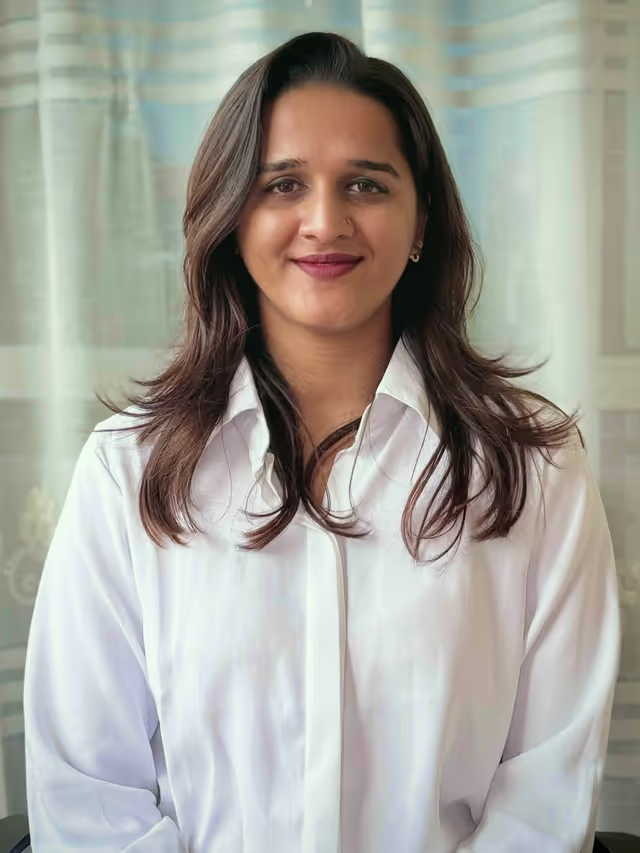
About Smriti Simkhada
Smriti Simkhada is a PTE Academic perfect scorer (90/90) providing structured PTE coaching for Nepali students. She has helped over 1,000 students prepare for Australia PR and Canada immigration through structured, criteria-aligned coaching.
