PTE Academic March 2026 Content Update: What Changed for Nepal
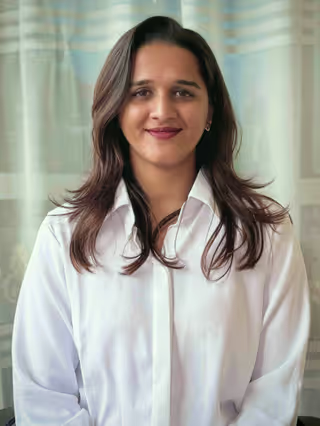
Smriti Simkhada
90/90 Perfect Scorer
Updated October 2026 · Reviewed by Smriti Simkhada (90/90)
Introduction
Pearson rolled out an iterative content and format update to PTE Academic in March 2026. For most Nepali test-takers, the update is small in surface area but meaningful in test-day strategy — particularly in the Speaking section and in how AI scoring weights certain traits. If you took your last mock or coaching session before March 2026, your prep template may already be 30% out of date.
This article documents what actually changed, what did not, and how Nepali students preparing for Australia PR (DHA Aug-2025 thresholds), AHPRA Speaking 76, Canada PR via PTE Academic, and university admissions should adjust their prep. The information is based on Pearson's published 2026 release notes and our own coaching observations from the post-update test cohort.
Stuck below your target? The 79+ Sprint
Private 1-on-1 coaching, from US$99: pick 7 days, 17 days or 1 month, one live session a day on your time zone (Sydney · Melbourne · Toronto · London · Doha), a demo session included, and Coach-Until-Target on the longer plans.
What Pearson Officially Announced for 2026
Pearson's 2026 release notes (published on pearsonpte.com under their "What's New" section) listed the following formal changes:
- Refined AI scoring on Speaking tasks — particularly Read Aloud and Repeat Sentence — to better reward natural intonation over robotic pacing.
- Expanded Speaking task variety — Respond to a Situation and Summarize Group Discussion (introduced in 2024) are now appearing in approximately 40% of test sessions globally.
- Updated content database — refreshed Read Aloud passages, Listening audios, and Reading texts to reflect 2025–2026 academic and general topics.
- Tightened plagiarism detection in Write Essay and Summarize Written Text — pre-written templates flagged more aggressively.
- Score release — Pearson says results usually arrive within two days, up to five working days; do not plan a deadline around a promised turnaround.
What This Means for Speaking Section Prep
The Speaking section is where the March 2026 update is most consequential.
Read Aloud — Intonation Now Outweighs Pacing
Pre-update, Read Aloud rewarded steady, robotic pacing — Nepali students who spoke at exactly 110 words per minute with no inflection scored well. Post-update, the AI rewards natural intonation: rising tones at questions, pauses before key terms, emphasis on content words. Robotic delivery now caps Read Aloud sub-scores around 75–80 instead of 85+.
Adjustment: practise reading with deliberate emphasis. Mark stress on content nouns and verbs. Use rising intonation at sentence-final questions. Pause 0.5 seconds before significant terms.
Repeat Sentence — Reward for Natural Cadence
Repeat Sentence now scores sentences delivered with original-speaker-matching intonation higher than perfect-word-recall but flat delivery. If you replay an audio with the same rising/falling tone pattern as the speaker, your Oral Fluency score rises 4–8 points.
Respond to a Situation and Summarize Group Discussion — Now Common
Pre-2026, these tasks appeared in maybe 20% of sessions. Post-March-2026, they appear in approximately 40% of sessions. If your prep does not include them, you have a real risk of seeing them on test day.
Adjustment: practise both task types weekly. They follow predictable structures (greeting + situation + response for RtaS; structured summary by speaker for SGD), but require specific templates.
What This Means for Writing Section Prep
Pearson tightened plagiarism detection on Write Essay and Summarize Written Text. The implications for Nepali students:
Memorised Essay Templates Penalised Harder
Pre-update, you could lift 5–10 points by memorising opening sentences ("In the contemporary global landscape..." etc.). Post-update, these openings are flagged. Vocabulary Range scores drop sharply. Several Nepali students who used identical opening templates across multiple attempts saw their March 2026 retake scores drop 5–7 points despite identical content quality.
Adjustment: vary your opening sentence by topic. Use the same essay structure, but write a fresh opening for each prompt. Keep templates for paragraph structure, not specific phrases.
SWT Sentence Reuse Now Riskier
Summarize Written Text used to allow direct sentence reuse from the source text. Post-update, reused sentences (full sentences copied from source) now trigger plagiarism flags. Paraphrasing is required.
What Did NOT Change
To be clear, several things stayed the same. Do not over-correct prep that was already working.
- Test format: Same 4 sections, same time allocations, same task types.
- Score range: Still 10–90 per skill.
- DHA thresholds: Aug 2025 component-specific Superior English (L69, R70, W85, S88) still apply; no DHA change in March 2026.
- AHPRA thresholds: 23 April 2026 thresholds (Overall 63, L58, R59, W60, S76) still apply; March 2026 PTE update does not affect AHPRA acceptance.
- Two-year score validity: Unchanged.
- Test fees in Nepal: not part of the content update. Pearson's listed Nepal price for PTE Academic is USD 248.60, and PTE Academic UKVI and PTE Core are listed at the same USD 248.60. Vouchers can reduce what you pay. Always confirm the current fee at pearsonpte.com at time of booking.
- Test centres in Nepal: Pearson's centre list shows 11, in Kathmandu, Lalitpur, Pokhara, Chitwan (Narayangarh), Tilottama and Itahari.
How to Adjust Your Prep Plan
If you trained before March 2026 and have not retested since, here is the minimum-viable adjustment plan.
Week 1 — Speaking Refresh
- Record yourself doing Read Aloud with deliberate intonation. Compare to original speaker.
- Practice 30 Repeat Sentence items focusing on cadence match, not just word recall.
- Add 5 Respond to a Situation drills.
- Add 3 Summarize Group Discussion drills.
Week 2 — Writing Refresh
- Audit your last 5 essays. Identify any opening sentence reused across them.
- Rewrite all 5 with fresh openings tailored to the prompt.
- Practice 5 SWTs with strict paraphrasing — no full sentence reuse from source.
Week 3 — Mock Test and Diagnosis
- Take a current-format full mock.
- Compare scores to your pre-March 2026 baseline.
- If Speaking dropped → intonation adjustment needed.
- If Writing dropped → template flagging issue, regenerate openings.
Common Mistakes Post-Update
- Continuing to use identical opening sentences across all essays. The plagiarism filter is tighter. Vary the opening.
- Ignoring Respond to a Situation and Summarize Group Discussion. 40% appearance rate is too high to skip.
- Practising Read Aloud with metronome-like robotic pacing. The AI now penalises this. Practise with intonation.
- Reusing full sentences in SWT from the source text. Paraphrase or be flagged.
- Trusting Telegram-circulated mock tests from 2024. They reflect pre-update format and will mislead you.
Step-by-Step Re-Calibration Method
- Identify when you last took a real PTE test or current-format mock. If before March 2026, your baseline is stale.
- Take one current-format full mock from a 2026-updated source (Pearson Practice Plus is the safest).
- Compare current and previous scores. Note specific drops by section.
- Drill the affected sections using the adjustments above for 2–3 weeks.
- Retest. If scores recovered, book the real test. If not, run a 1-on-1 diagnostic.
Tips for Nepali Students
- If you are aiming for Australia PR Superior English (L69, R70, W85, S88 per Aug 2025 DHA points test), the post-update Speaking adjustment matters most. Speaking 88 is the hardest threshold for Nepali speakers and is now intonation-driven.
- For AHPRA Speaking 76, the post-update Speaking change is good news — natural intonation is more achievable than robotic pacing for clinically-trained speakers.
- For Canada PR via PTE Academic, the changes are minor — most Canada candidates use PTE Core anyway.
- Diaspora students in Sydney, Melbourne, Toronto, London, Doha: same global update applies. No regional variation.
- Do not chase every new Pearson tweak. Focus on the two big changes — Speaking intonation and Writing template flagging — and ignore minor wording shifts.
Frequently Asked Questions
Q: Did Pearson change PTE scoring algorithm in March 2026?
A: Iterative refinement, not a fundamental rewrite. The same skill-trait-weight model applies, but the AI's intonation sensitivity for Speaking and template detection for Writing are tighter.
Q: My PTE coach uses 2024 study material. Is it still valid?
A: 70% valid. Format and structure are unchanged. The 30% that needs updating: Speaking task practice (add Respond to a Situation and Summarize Group Discussion), Writing template strategy (vary openings), and intonation work for Read Aloud.
Q: Should I postpone my test until I am sure of the post-update format?
A: Only if you have not adjusted your prep. If you have practised the new task types and updated your Speaking and Writing approach, you are ready. If you are using pre-update templates, postpone and re-train.
Q: Will scores from before March 2026 still be valid for my Australia PR application?
A: Yes. Two-year validity unchanged. A score from January 2025 remains valid through January 2027 regardless of the March 2026 update.
Q: Are the AHPRA Speaking 76 thresholds affected by the March 2026 update?
A: No. AHPRA's threshold change was 23 April 2026 (overall 63, L58, R59, W60, S76). Pearson's March 2026 update is a separate test refinement and does not change AHPRA acceptance.
Conclusion
The March 2026 PTE Academic update is iterative, not revolutionary. Format unchanged, scoring philosophy unchanged. The two real shifts: Speaking now rewards intonation over robotic pacing, and Writing flags pre-memorised templates harder.
If you are mid-prep, adjust now rather than later. Spend two weeks on Speaking intonation drills and Writing template variation, then retest. Most Nepali students recover their pre-update scores within three weeks of focused adjustment.
For a 1-on-1 prep audit aligned with the post-March-2026 PTE format, book a session at ptenepal.com or WhatsApp +977 982-523-5082. Smriti's 1-on-1 mentorship includes current-format mock test review and adjustment plans.
Continue on PTE Nepal: PTE Academic Changes 2026 · PTE Hybrid AI Scoring · 1-on-1 PTE Mentorship
Verify with the official source: Pearson's broadly publicised PTE Academic change was the new Speaking & Writing task types added on 7 Aug 2025 and the updated PTE-IELTS concordance based on Pearson research published in July 2025. Always confirm any newer dated update on the official PTE Academic test-format page before changing your prep plan.
Last fact-checked on 2026-05-08 against official sources (Pearson PTE, Australia Department of Home Affairs, AHPRA, IRCC, GOV.UK, INZ). Test fees, score requirements, and visa rules can change at any time — always verify the latest details on the relevant official website before booking or applying.
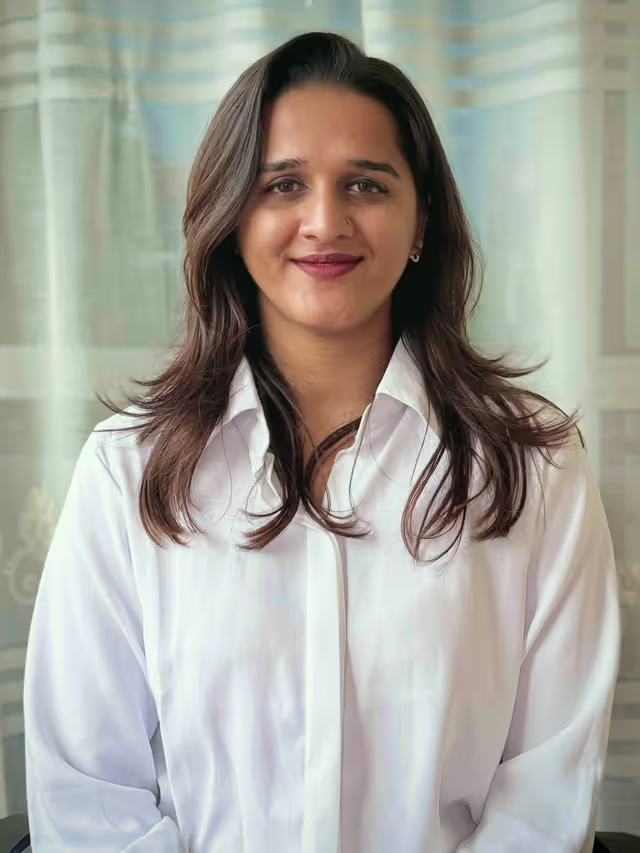
About Smriti Simkhada
Smriti Simkhada is a PTE Academic perfect scorer (90/90) providing structured PTE coaching for Nepali students. She has helped over 1,000 students prepare for Australia PR and Canada immigration through structured, criteria-aligned coaching.
