PTE vs OET for AHPRA Registration: Which Is Better for Nepali Nurses? (2026)
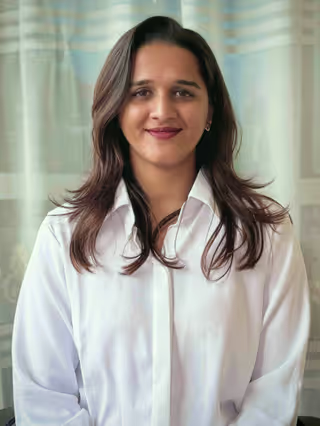
Smriti Simkhada
90/90 Perfect Scorer
Updated September 2026 · Reviewed by Smriti Simkhada (90/90)
Introduction: Why This Question Matters for Nepali Nurses
If you are a Nepali nurse planning to register with AHPRA and work in Australia, one of the first decisions you face is which English test to take. AHPRA accepts five tests, but two dominate the conversation in Nepali nursing circles: PTE Academic and OET (Occupational English Test).
Both are fully accepted by AHPRA. Both test the same four skills. But they are different tests with different cost structures, different result timelines, different availability in Nepal, and different difficulty profiles for Nepali candidates. Choosing the wrong one can cost you months and thousands of rupees. Choosing the right one can get you through AHPRA English requirements in a single attempt.
Stuck below your target? The 79+ Sprint
Private 1-on-1 coaching, from US$99: pick 7 days, 17 days or 1 month, one live session a day on your time zone (Sydney · Melbourne · Toronto · London · Doha), a demo session included, and Coach-Until-Target on the longer plans.
This article gives you a head-to-head PTE vs OET AHPRA comparison built specifically for Nepali nurses — covering every factor that matters: cost, speed, test centre availability, the dreaded Writing component, the two-test combination rule, and a clear recommendation based on your situation. Internal links to the AHPRA PTE requirements (23 April 2026) article and the PTE Speaking 76 guide are included for deeper reading on those specific topics.
What AHPRA Actually Accepts
Under the English Language Skills Registration Standard effective 23 April 2026, AHPRA accepts five English proficiency tests: PTE Academic, OET, IELTS Academic, TOEFL iBT, and Cambridge English (C1 Advanced / CAE). The same standard applies to every AHPRA-regulated profession — nurses, midwives, pharmacists, physiotherapists, dentists, and allied health. This article focuses on the two most commonly chosen by Nepali nursing candidates. Always verify current thresholds on the official AHPRA website before booking.
Verify on the official source: AHPRA's English Language Skills Registration Standard changed on 23 April 2026 and may be updated again. Always confirm current minimum scores, accepted tests, and combining rules on the AHPRA registration standard page and the relevant National Board page (e.g., NMBA for nursing) before booking a test or lodging an application.
PTE Academic for AHPRA — The Current Requirements
Effective 23 April 2026, the PTE Academic minimums for AHPRA registration are:
- Overall: 63
- Listening: 58
- Reading: 59
- Writing: 60
- Speaking: 76
These are floor scores — you must meet all five simultaneously in a valid test result. The lower numbers compared to the prior standard of 66 in each skill (Writing 56, under the March 2025 standard applied to tests taken on or before 22 April 2026) reflect a concordance update by Pearson, not a relaxation of AHPRA's English bar. Speaking 76 still represents near-superior spoken English. For most Nepali nurses, Speaking 76 is the hardest hurdle. See the dedicated AHPRA PTE requirements guide for a full breakdown of what each threshold means in practice.
Key practical points about PTE Academic for AHPRA:
- Two-test combination window: AHPRA allows combining results from a maximum of two PTE Academic sittings within a 12-month period, provided each sitting meets defined per-sitting floor minimums: Listening 53, Reading 54, Writing 60, Speaking 66. No skill in either sitting may fall below these floors for the combination to be valid. This is a significant safety net — if you miss one band by a small margin, you can resit and combine.
- Score validity: PTE Academic results are valid for 2 years from the test date for AHPRA registration purposes — Pearson and AHPRA both apply the same two-year window. Always confirm validity rules on the AHPRA standard before submitting an older result.
- Results speed: typically within 48 hours of sitting.
- Test fee in Nepal: USD 220 list price, roughly NPR 32,000–33,000 at checkout per attempt — confirm the exact amount on the Pearson PTE booking page before scheduling.
OET for AHPRA — What the B Grade Means
OET (Occupational English Test) is a healthcare-specific English test designed for health professionals. Unlike PTE Academic — which uses general academic content — OET tasks are built around medical scenarios: patient case notes, listening to clinical consultations, writing referral letters, and role-playing doctor-patient or nurse-patient interactions.
For AHPRA registration, OET requires a B grade in all four sub-tests: Listening, Reading, Writing, and Speaking. There is no overall score — each sub-test is graded independently from A (highest) to E (lowest), and you need a B in every one.
Key OET facts for Nepali nurses targeting AHPRA:
- No two-test combination: OET does not have an equivalent to PTE's two-sitting combination rule. Each attempt is evaluated independently across all four sub-tests. If you score A in Listening, Reading, and Speaking but C in Writing, you must resit the full test and pass all four sub-tests again — you cannot carry forward your A grades.
- Score validity: OET results are valid for 2 years from the test date.
- Results speed: approximately 16 business days after sitting — significantly slower than PTE.
- Test fee: currently around AUD 587 for international candidates — verify the latest fee on the OET official site. For Nepali nurses sitting in Nepal or a neighbouring country, this translates to a substantially higher outlay than PTE Academic.
- Writing sub-test: OET Writing for nurses involves writing a referral or handover letter based on case notes. It is marked by human assessors and requires professional letter format, accurate clinical content selection, and precise use of medical language.
PTE vs OET: Head-to-Head Comparison
Here is a direct side-by-side look at every factor that matters when choosing between PTE vs OET for AHPRA as a Nepali nurse.
Cost
PTE Academic wins clearly on cost. At USD 220 list price (roughly NPR 32,000–33,000 at checkout) per attempt in Nepal, PTE is still significantly cheaper than OET. OET's international fee is approximately AUD 587 — and for Nepali nurses who must travel to Kathmandu, Delhi, or another centre to sit OET (test centre availability is more limited than PTE), the true cost including travel is considerably higher. If you need multiple attempts, the cost gap widens fast.
Results Speed
PTE Academic wins on speed by a wide margin. PTE delivers results within 48 hours. OET results take approximately 16 business days — roughly three weeks. When you are managing AHPRA deadlines, visa timelines, job offer expiry dates, or nursing board application windows, three weeks is a material delay. Faster results also mean faster identification of which band needs work, and faster rebooking if a resit is needed.
Test Centre Availability in Nepal
PTE Academic wins on availability in Nepal. Pearson-authorised PTE Academic test centres operate in both Kathmandu and Bharatpur, with regular slot availability. OET availability in Nepal is more limited — many Nepali candidates must sit OET in Kathmandu only, or travel to India (Delhi, Bangalore, Mumbai). For nurses based in Chitwan or outside the capital, PTE's Bharatpur centre is a genuine convenience advantage.
Speaking Component
This is closer — depends on your learning style. PTE Speaking is AI-scored, removing human accent bias against Nepali pronunciation. The AHPRA floor is Speaking 76. PTE Speaking tasks (Read Aloud, Repeat Sentence, Describe Image, Retell Lecture, Answer Short Question) are structured and template-learnable. See the PTE Speaking 76 guide for a full 8-week task-specific plan.
OET Speaking is a face-to-face role-play where you conduct a clinical consultation scenario. For nurses already working in English-speaking clinical environments, the format feels natural. For Nepal-based nurses preparing from scratch, OET Speaking requires specific medical role-play preparation that many coaching centres in Nepal do not offer.
Writing Component
OET Writing is generally considered harder for non-native writers. PTE Writing (Summarize Written Text + Essay) has a threshold of 60, which is achievable with a reliable template and focused grammar practice. OET Writing requires producing a professional letter — a referral letter or nursing handover — based on given case notes. It is marked by human assessors against healthcare-specific criteria: appropriate selection of clinical information, accurate professional letter format, appropriate language register, and absence of errors that could cause harm. For Nepali nurses who trained in Nepali-medium institutions or who have limited experience writing formal English letters, OET Writing B grade is a meaningful hurdle.
Two-Test Combination Rule
PTE Academic wins decisively on flexibility. AHPRA allows combining PTE Academic scores from a maximum of two sittings within a 12-month window. If you score Speaking 74 (just below the 76 floor) in your first attempt but clear all other bands, you can resit within 12 months and combine your best sub-skill scores — as long as each test meets the mandatory per-sitting floor scores (for tests taken on or after 23 April 2026: no skill in either sitting below Listening 53, Reading 54, Writing 60, Speaking 66). This rule effectively gives you two shots to nail the hardest band. OET has no equivalent combination rule. Every OET attempt must independently pass all four sub-tests to count. If you score B in three sub-tests and C+ in Writing, you must sit the full OET again with no score carry-forward.
Content Relevance
OET's medical content is a genuine advantage for practising nurses already in clinical settings. OET tasks use clinical consultations, medical journal passages, and ward-based role-play scenarios. PTE Academic uses general academic content (science, social issues, business). For Nepal-based nurses preparing before migrating, the academic content gap in PTE is real but bridgeable with 4–6 weeks of task-specific practice. For nurses already working in healthcare, OET's familiarity may reduce preparation anxiety — but it does not remove the need for structured preparation.
Which Is Better for Nepali Nurses?
Here is a direct recommendation — not a wishy-washy "it depends on you."
Choose PTE Academic if:
- You are based in Nepal and want to keep costs low. PTE is significantly cheaper per attempt and available locally in Kathmandu and Bharatpur.
- You need results quickly. PTE's 48-hour turnaround is far faster than OET's 16 business days.
- You want the safety net of the two-test combination rule. If Speaking 76 is your sticking point, being able to combine two sittings is a major strategic advantage.
- You have not yet started working in healthcare settings (you are preparing from Nepal before migrating). PTE's AI scoring and template-based Speaking preparation is well-suited to this situation.
- Your writing skills in formal English are basic. PTE Writing threshold at 60 is more forgiving than OET Writing B grade, and PTE Writing is template-learnable in 2–3 weeks of focused practice.
Choose OET if:
- You are already working in Australia or another English-speaking country in a healthcare role. The clinical content will feel natural and your Speaking role-play will draw on real experience.
- You have tried PTE Academic twice or more and consistently fail Speaking 76 despite structured practice. For some candidates, the OET role-play format genuinely suits their communication style better than PTE's computer-based tasks.
- Your employer or migration agent specifically recommends OET. Some AHPRA-approved assessment pathways have process nuances — always check with your registered migration agent.
- You have strong formal English writing skills and feel comfortable writing professional letters. If OET Writing B grade is not a concern, the test becomes more competitive.
The bottom line
For the majority of Nepali nurses preparing in Nepal — especially those who are Nepal-based, cost-conscious, and working towards their first AHPRA registration attempt — PTE Academic is the better choice. It is cheaper, faster, locally available, and offers the strategic advantage of the two-test combination window. OET is the right tool for a specific minority: nurses already in clinical English environments who prefer role-play formats and have failed PTE Speaking repeatedly.
Common Mistakes to Avoid
- Assuming nursing experience means OET readiness. Medical content familiarity helps, but OET Writing B and Speaking B require specific skills that most nursing programmes do not build. Do not choose OET simply because the content looks clinical.
- Underestimating PTE Speaking 76. Near-superior spoken English demands real work. Candidates who treat Speaking as easy because it is AI-scored routinely get stuck at 70–74. Start Speaking preparation on day one of your prep plan.
- Overlooking OET's no-combination rule. A strong OET Listening result cannot be carried forward if Writing is below B. Every sub-test must pass independently in each attempt — making a single weak sub-test far more costly than in PTE's combination model.
- Booking OET without checking Nepal availability. OET test slots in Nepal are more limited than PTE. A late booking may force travel to India, adding cost and time pressure to an already tight timeline.
- Treating PTE prep as general English improvement. PTE has a specific AI scoring algorithm. Task-specific template practice for Describe Image, Retell Lecture, and Essay is essential — not just general fluency work.
Tips for Nepali Nurses Choosing Between PTE and OET
- Take a free PTE mock test first. If your Speaking mock score is 72+ and Writing is 58+, PTE is a realistic first-attempt target with 6–8 weeks of structured preparation. If Speaking is below 65, assess whether PTE's computer-based tasks or OET's clinical role-play better suits your communication style — but do not choose OET by default.
- Assess your formal writing honestly. OET Writing B requires professional letter-writing skills. If formal English letters are uncomfortable for you, PTE Writing 60 is the more forgiving path — essay templates are learnable in 2–3 weeks.
- Factor in your timeline. If you have a visa or employer deadline, PTE's 48-hour results give you far more control than OET's 16 business days. Time pressure almost always favours PTE.
- Use 1-on-1 coaching for Speaking. Whether you target PTE Speaking 76 or OET Speaking B, personalised feedback delivers results that group classes cannot. PTE Nepal's 1-on-1 mentorship is designed for AHPRA candidates, with sessions scheduled around your shift roster in Nepal, Sydney, Melbourne, Toronto, London, or Doha.
- Plan two PTE attempts in your budget. Budget and schedule for two sittings within a 12-month window. The combination rule means the second attempt is a precision top-up, not a full restart.
Frequently Asked Questions
Q: Does AHPRA accept both PTE Academic and OET for nursing registration?
A: Yes. AHPRA's English Language Skills Registration Standard (effective 23 April 2026) accepts PTE Academic, OET, IELTS Academic, TOEFL iBT, and Cambridge English (C1 Advanced). Both PTE Academic and OET are fully valid for all AHPRA-regulated health professions, including nursing.
Q: What are the OET score requirements for AHPRA nursing registration?
A: AHPRA requires a B grade in all four OET sub-tests — Listening, Reading, Writing, and Speaking — each achieved in the same test sitting. There is no OET "overall" score requirement; each sub-test is independently graded. Re-confirm the current thresholds on the AHPRA website before booking.
Q: Can I combine OET scores from two sittings like I can with PTE Academic?
A: No. OET does not have a score combination rule. Each OET attempt must independently pass all four sub-tests. If you score B in Listening, Reading, and Speaking but fall short in Writing in one attempt, you must sit the full OET again and pass all four sub-tests — there is no carry-forward for sub-tests already passed. This is a key structural advantage of PTE Academic's two-test combination window for AHPRA purposes.
Q: Is PTE Speaking 76 harder or easier than OET Speaking B grade for Nepali nurses?
A: They are comparable in difficulty but different in format. PTE Speaking 76 is AI-scored across computer-based tasks (Read Aloud, Repeat Sentence, Describe Image, Retell Lecture, Answer Short Question). OET Speaking B requires a face-to-face role-play clinical consultation. Nepali nurses preparing in Nepal typically find PTE Speaking more accessible because it is template-learnable and AI-scored without accent bias. OET Speaking may feel more natural for nurses already working in English-speaking clinical environments.
Q: How much cheaper is PTE Academic compared to OET for Nepali nurses?
A: PTE Academic costs USD 220 list price (roughly NPR 32,000–33,000 at checkout) per attempt in Nepal. OET charges approximately AUD 587 for international candidates — at current exchange rates, considerably more than PTE. If you factor in limited OET test centre availability in Nepal (and the potential need to travel or sit in India), the total cost gap per attempt is substantial. Over two attempts, the savings from choosing PTE can exceed NPR 55,000–60,000.
Q: Is OET Writing harder than PTE Writing for Nepali nurses?
A: For most Nepali nursing candidates, yes. OET Writing requires producing a professionally formatted referral or handover letter based on clinical case notes, marked by human assessors against healthcare-specific criteria. PTE Writing (Summarize Written Text + Essay) has a threshold of 60 and is much more forgiving of individual sentence errors, as long as structure and content are sound. PTE Writing is template-learnable; OET Writing requires developing formal letter-writing skills that are less easily systematised.
Q: How long do PTE Academic results take compared to OET results?
A: PTE Academic delivers results typically within 48 hours of sitting. OET results take approximately 16 business days — roughly three to four weeks. If you have AHPRA, visa, or employer deadlines to manage, PTE's turnaround is a significant practical advantage.
Conclusion
When weighing PTE vs OET AHPRA as a Nepali nurse, the evidence points clearly in one direction for most candidates: PTE Academic. It is cheaper per attempt, results arrive within 48 hours, test centres are available in Kathmandu and Bharatpur, and the two-test combination rule gives you a structured safety net if Speaking 76 requires two attempts. OET remains the right choice for a specific group — nurses already embedded in English-speaking clinical environments who find the role-play format more natural, or those who have persistently failed PTE Speaking despite dedicated preparation.
Whichever test you choose, Speaking is where most Nepali nurses spend the most preparation time. For AHPRA-focused 1-on-1 coaching built around your shift schedule — whether you are in Nepal, Sydney, Melbourne, Toronto, London, or Doha — visit PTE Nepal's 1-on-1 mentorship programme. Sessions are scheduled around your roster, every drill is mapped to AHPRA floor scores, and personalised pronunciation feedback is built into every Speaking session. Start with a free orientation call and choose your test with a clear plan behind you.
Continue on PTE Nepal: AHPRA pathway hub, Speaking 76 8-week plan, and Melbourne 1-on-1 coaching.
Last fact-checked on 2026-05-08 against official sources (Pearson PTE, Australia Department of Home Affairs, AHPRA, IRCC, GOV.UK, INZ). Test fees, score requirements, and visa rules can change at any time — always verify the latest details on the relevant official website before booking or applying.
Update (August 2025): PTE Academic Speaking now also includes Respond to a Situation and Summarize Group Discussion as scored task types (per Pearson plc, 10 July 2025, effective 7 August 2025). Verify the current task list on the official Pearson site before relying on this article for an exhaustive Speaking inventory.
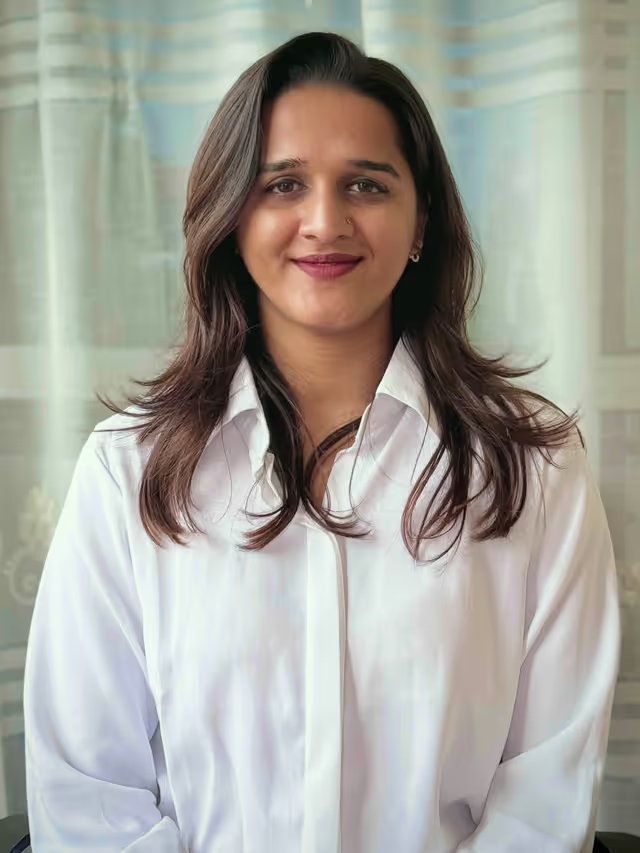
About Smriti Simkhada
Smriti Simkhada is a PTE Academic perfect scorer (90/90) providing structured PTE coaching for Nepali students. She has helped over 1,000 students prepare for Australia PR and Canada immigration through structured, criteria-aligned coaching.
