PTE Predictions July 2026 – Complete Weekly Study Guide (All Skills)
PTE Nepal
Weekly Prediction File
Updated July 2026 · Compiled by PTE Nepal
PTE Predictions July 2026 — All Skills, Weekly Files
Every week in July 2026, PTE Nepal publishes a full prediction file covering all 22 PTE Academic task types — from Read Aloud and Write Essay to Write From Dictation and Summarize Spoken Text. The files are compiled by PTE Nepal, a Nepali PTE coach whose students consistently achieve 79+ across all four communicative skills.
This page is your index. Use it to jump directly to the skill-specific study file you need most. Each linked article contains the full set of predicted questions or passages for that skill, with answers, model responses, or strategy notes where applicable. Files are updated every Monday for the week ahead.
July is one of the busiest months for PTE Academic in Nepal and in the Australian diaspora community. Students targeting Australia PR subclasses 189, 190, and 491 — and those preparing for AHPRA nursing registration or ACS IT assessments — often sit in July to meet September EOI or skills-assessment deadlines. If that is you, use this guide alongside the skill-specific weekly files to make every study session count.
How to Use PTE Predictions Effectively
Predictions work because PTE Academic draws from a stable, repeating pool of questions. The exact item you practise may not appear word-for-word, but the topic, structure, and vocabulary will be very familiar — and familiarity under exam pressure is worth real points.
- Do not memorise responses. Pearson's AI scoring engine detects over-templated, memorised, or off-topic answers and penalises them. Use predictions to build fluency and familiarity, not to script answers.
- Prioritise your weak skills first. If your Listening score is holding back your overall score, start with the Write From Dictation and Listening FIB files — these two tasks together carry the most Listening sub-score weight. If Writing is your bottleneck, the Summarize Written Text and Write Essay files are your entry point.
- Practise under timed conditions. Reading a prediction file is passive. Write two or three full essays from the Essay Predictions file under 20 minutes each; speak every Read Aloud passage aloud before checking your version against the text. Silent review alone does not build the speaking fluency the PTE scoring engine rewards.
- Group topics by theme. Across speaking and writing tasks you will see education, technology, environment, work, and society recurring. Prepare two or three reusable arguments per theme so you can engage confidently with any prompt, even one you have never seen before.
- Check your score report before choosing files. Your most recent PTE Score Report shows per-skill communicative scores — Listening, Reading, Writing, Speaking — and enabling skills. Target the enabling skill that is dragging your communicative skill below your goal, then match it to the task files that feed it.
Week 1 — 1–7 July 2026: All Skill Prediction Files
All task-specific files for the first week of July 2026 are updated on Monday 30 June 2026. Each link below goes to the dedicated prediction article for that skill, which includes the full question set, answer options (where applicable), and scoring notes.
Speaking
Speaking is worth roughly 35% of your PTE Academic score and feeds directly into Oral Fluency and Pronunciation, which also lift your overall communicative skills score. It is the fastest skill to improve with targeted prediction practice because fluency responds quickly to repeated exposure to familiar material. For Nepali students in Australia, Canada, the UK, and the Gulf, timezone flexibility means you can schedule speaking practice sessions any time of day — no classroom required.
-
Read Aloud — Week 1 (1–7 July 2026)
Read Aloud is widely treated by coaches as one of the highest-leverage speaking tasks (Pearson does not publish per-task weightings). It is scored on Content, Oral Fluency, and Pronunciation. You receive 30–40 seconds to read silently, then must read aloud clearly without hesitation. Predicted passages for this week cover academic topics in science, environmental policy, and social science. Practise for smooth pacing and natural stress patterns rather than individual pronunciation perfection — Pearson's AI scores fluency of delivery, not accent. -
Repeat Sentence — Week 1 (1–7 July 2026)
You hear a sentence once (3–9 seconds) and must repeat it exactly. It tests your short-term auditory memory, Listening accuracy, and Speaking fluency simultaneously. High-scorers shadow the sentence immediately rather than trying to recall it word-by-word. This week's predicted sentences focus on academic and workplace themes that recur frequently in the current PTE item pool. -
Describe Image — Week 1 (1–7 July 2026)
You have 25 seconds to prepare and 40 seconds to describe a chart, graph, map, process diagram, or picture. A reliable four-part template — overview, key trend, comparison, conclusion — lets you score well on any visual type. This week's prediction file lists the titles and types of images most likely to appear so you can practise targeted vocabulary in advance. -
Re-tell Lecture — Week 1 (1–7 July 2026)
After listening to an academic lecture of up to 90 seconds (sometimes with an accompanying image), you have 10 seconds to prepare and 40 seconds to re-tell the key points in your own words. Note-taking is allowed and strongly recommended. This week's predicted lecture topics span science, climate policy, and social studies — the file includes the main concepts and vocabulary you need to re-tell each one fluently. -
Answer Short Question — Week 1 (1–7 July 2026)
You hear a short question and must answer in one or two words. The task is not scored for Oral Fluency or Pronunciation — only for whether your answer is correct. These questions draw from world knowledge, vocabulary, and general reasoning. The prediction file lists this week's high-probability questions with the expected one-word or two-word answers, so you can eliminate easy mistakes before exam day. -
Summarize Group Discussion — Week 1 (1–7 July 2026)
Summarize Group Discussion is a speaking task added to PTE Academic in August 2025: you listen to a three-speaker discussion of up to 3 minutes, then have 10 seconds to prepare and 2 minutes to deliver a spoken summary. It is scored on Content, Oral Fluency, and Pronunciation — there is no written component. This week's prediction file provides full Speaker 1, 2, and 3 transcripts for each predicted scenario so you can practise delivering targeted spoken summaries before exam day. -
Respond to a Situation — Week 1 (1–7 July 2026)
You read a real-life scenario and have 40 seconds to give a spoken response addressing the situation naturally. This task rewards conversational fluency over formal academic English — a clear, direct spoken response scores better than a scripted, over-formal one. The prediction file includes this week's high-probability scenarios with response strategy notes.
Writing
Writing is assessed on seven official criteria: Content, Development/Structure/Coherence, Form, General Linguistic Range, Grammar (Usage & Mechanics), Vocabulary Range, and Spelling. The two writing tasks — Summarize Written Text and Write Essay — together contribute significantly to your Writing communicative skill score, and errors in spelling or grammar also suppress your overall score. July test-takers frequently report that essay topics in this window lean heavily toward environment and technology — both well-represented in this week's prediction file.
-
Summarize Written Text — Week 1 (1–7 July 2026)
You read an academic passage (up to 300 words) and must summarise the key ideas in a single grammatically correct sentence of 5–75 words (a response under 5 words scores zero). It is one of the most technically demanding tasks in PTE Academic — a sentence that runs too long, uses a comma splice, or misses the central idea loses most of its marks. This week's predicted passages cover social science, environmental science, and health; the file includes each passage and a model one-sentence summary. -
Write Essay — Week 1 (1–7 July 2026)
You write a 200–300 word academic essay in 20 minutes on a given prompt. PTE Academic scores it across all seven Writing criteria — Content, Development/Structure/Coherence, Form, General Linguistic Range, Grammar, Vocabulary Range, and Spelling. A clean five-paragraph structure — introduction with thesis, two body paragraphs, conclusion — consistently scores well. This week's predicted essay topics span education, technology, work, environment, and society; each entry in the file includes the full prompt and a planning outline to help you practise fast structuring.
Reading
Reading tasks carry no time limit per question — you manage your own time across the entire Reading section. The key challenge is vocabulary breadth and the ability to extract meaning from dense academic prose quickly. Prediction practice with authentic academic passages builds both. For Nepali students who studied in Nepali-medium schools, technical vocabulary in environmental science and economics tends to be the sticking point — the prediction files for Week 1 give you that vocabulary in context.
-
Reading & Writing: Fill in the Blanks — Week 1 (1–7 July 2026)
The highest-value Reading task: it uses partial-credit scoring — each correct blank earns a point and incorrect blanks simply earn zero, with no deduction. A 6-blank passage can swing your Reading score by six points. You choose from a dropdown of 4–5 options per blank; eliminating obviously wrong options (wrong part of speech, wrong register, wrong collocation) leaves you with one or two genuine candidates. This week's predicted passages are academic texts on technology, economics, and environmental policy; answer options are included in the file. -
Re-order Paragraph — Week 1 (1–7 July 2026)
You receive 5–6 sentences from a passage in scrambled order and must drag them into the correct logical sequence. Look for the topic sentence (broad claim, no pronoun reference back), transitional words (however, therefore, in addition), pronoun cohesion (it, they, this must follow the noun they reference), and the conclusion (summary or implication). This week's prediction file includes the scrambled sets and the correct order with a brief explanation of the linking logic. -
Reading: Fill in the Blanks — Week 1 (1–7 July 2026)
Similar to R&W FIB but simpler: you drag words from a word bank into blanks in a passage. Each correct answer earns a point; no negative marking. Read around the blank for grammatical clues (article before a noun, preposition before a verb) and semantic fit. This week's predicted passages are drawn from biology, history, and technology topics — the file lists each passage with word bank and answers.
Listening
Listening is the section where most Nepali students lose 5–10 points unnecessarily — specifically on Write From Dictation and Listening FIB, which together are the most predictable high-weight tasks in the entire exam. If your Listening score is below 79, these two files should be your first stop this week. Students testing in July who are targeting Australian PR points need to note that both the Proficient English band (L58/R59/W69/S76) and the Superior band (L69/R70/W85/S88) require strong Listening — you cannot compensate for a weak Listening sub-score with higher marks in other skills.
-
Summarize Spoken Text — Week 1 (1–7 July 2026)
After listening to a 60–90 second academic lecture, you write a 50–70 word summary in 10 minutes. You are scored on Content, Form, Grammar, Vocabulary, and Spelling. Good note-taking during the audio is the differentiator — jot the main claim plus two or three supporting points, then write your summary from the notes, not from memory. This week's predicted lectures are in environmental science, psychology, and technology; the file includes full transcripts and a model summary for each. -
Listening: Fill in the Blanks — Week 1 (1–7 July 2026)
You listen to a recorded lecture while reading the partial transcript on screen. You type the missing words (one word per blank) as you hear them. Spelling counts — a correctly heard but misspelled word is marked wrong. No negative marking. Speed and accuracy are both needed. This week's prediction file provides the full transcript with answers highlighted so you can listen, fill in, and self-check immediately. -
Write From Dictation — Week 1 (1–7 July 2026)
The final task in PTE Academic and one of the highest-impact items for Listening and Writing scores. You hear a sentence once and must type it exactly — every word, every spelling, every function word. Missing or misspelling even one word in a 12-word sentence drops your score. Many test-takers report that WFD sentences reappear across sittings, which is why coaches treat it as one of the most predictable tasks — though Pearson does not publish an official rotation schedule. This week's file lists each predicted sentence; practise writing them from memory, then check your accuracy against the file.
Week 2 — 8–14 July 2026: Preview
Week 2 files go live on Monday 7 July 2026. Based on the June pool rotation and student exit reports from Kathmandu, Pokhara, and Bharatpur test centres, the most active task categories for Week 2 are expected to be Write From Dictation (high sentence-pool turnover in mid-month windows), Read Aloud (new academic science passages entering the pool), and Write Essay (technology and environmental governance topics prominent in the current Pearson bank).
Bookmark this page — each skill's Week 2 link will activate when the file goes live.
How These Predictions Are Compiled
Smriti Simkhada collects reported questions from students who have tested in the current window — in Kathmandu, Pokhara, Bharatpur, and from the diaspora testing in Sydney, Melbourne, Toronto, and the Gulf. Items that appear multiple times in the same week are promoted to the prediction file. The files are updated every Monday morning before the new exam week begins.
The prediction service is part of the PTE Nepal student membership. Logged-in students access the full question set and answer files for every skill each week. The free preview on each skill page gives you a representative sample so you know exactly what you are getting before you enrol.
July 2026 Study Priorities by Score Target
Not all prediction files carry the same weight for every student. Use the guide below to decide where to spend your limited study hours this month.
Targeting 79+ in all skills (Australia PR — Proficient English, +10 points)
The Proficient English band for Australia's skilled migration points test requires L58/R59/W69/S76 per skill. Speaking 76 is typically the hardest target — spend the most time on Describe Image and Re-tell Lecture, which carry the largest Speaking sub-score. Writing 69 is the second gap for most students; Summarize Written Text (sentence structure) and Write Essay (structure and coherence) are your levers.
Targeting 65+ overall (AHPRA nursing registration)
AHPRA nursing registration requires a minimum overall of 63, with per-skill floors at L58/R59/W60/S76 (for tests taken on or after 23 April 2026). Speaking 76 is the most common stuck point. If you are retaking for AHPRA, the Speaking prediction files — especially Describe Image and Re-tell Lecture — should occupy the majority of your Week 1 practice time.
Targeting 50+ overall (Australian student visa)
The Department of Home Affairs minimum for a higher-education student visa is 47 overall (Competent English, equivalent to IELTS 6.0) for tests taken on or after 7 August 2025, with no per-skill minimum. Most Australian universities set their own higher threshold — typically 58–65 overall. Write From Dictation and Repeat Sentence are the fastest paths to closing a small Listening gap at this level.
Tips for Nepali Students Sitting in July 2026
- Book your test date first, then plan backwards. Bharatpur (Chitwan), Kathmandu, and Pokhara test centres fill up quickly in July, especially around the July 4–6 and July 18–20 windows when diaspora students are visiting Nepal and sitting locally. If you are in Australia or Canada, your nearest Pearson VUE centre should have more availability — check pearsonpte.com for the exact price at your country's centres before booking.
- Practise in your real time zone. If you are in Sydney (AEST), your test may start as early as 7:30 AM — do your morning prediction practice sessions at the same time each day so your brain is warm at that hour on exam day. Students in Doha (AST) and Toronto (EDT) face different peak-alertness windows — calibrate accordingly.
- Address the Nepali accent strategically. Pearson's AI scores pronunciation on clear articulation and appropriate stress, not on matching a native-speaker accent. Predict the phoneme groups that trip up Nepali speakers — the /v/-/w/ distinction, word-final consonant clusters, and unstressed vowel reduction — and drill those specifically with the Read Aloud and Repeat Sentence files.
- Write From Dictation is the fastest win. Many Nepali students underestimate WFD because it looks like a small task. In practice, WFD sentences recur almost identically across test windows. Two weeks of daily WFD prediction practice reliably adds 3–5 points to Listening scores.
- Do not skip the Summarize Group Discussion file. This task type is newer in the PTE Academic bank and still catches many Nepali students off-guard. The structure is fixed — cover all three speakers, speak for the full 2 minutes, and keep your delivery fluent — and the prediction file gives you practice scenarios to master that structure before exam day.
Common Mistakes to Avoid in July
- Treating prediction files as memory lists. Memorising a WFD sentence verbatim is fine — that task rewards exact recall. But memorising a full Describe Image or Essay response and reciting it on a different image or prompt will be flagged by Pearson's AI as off-topic or templated, which drastically reduces your Content score.
- Ignoring the 40-word floor on Summarize Spoken Text. Pearson's official rule: your Summarize Spoken Text response scores zero on all five factors only if it is fewer than 40 words or more than 100 words. The target range is 50–70 words — aim there, but do not be paralysed if you write 47 words. A response of 47 well-chosen words scores on all five factors.
- Skipping the micro-skills in R&W FIB. Many students agonise over R&W FIB blanks they are unsure about. R&W FIB uses partial-credit scoring — an incorrect blank simply earns zero, with no deduction — so there is no penalty for making your best guess. Always fill every blank, and use the process of elimination on the dropdown options before committing.
- Over-preparing on speaking at the cost of writing. Both skills feed into the 79+ overall score. If your Writing is 65 and your Speaking is already 78, spending 80% of your prep time on Speaking prediction files will not get you to 79+ overall — redirect time to Summarize Written Text and Write Essay.
Frequently Asked Questions
Are the same predictions valid for PTE Core?
Some items overlap — particularly Write From Dictation, Repeat Sentence, and Read Aloud — but PTE Core has a different task set, a different scoring scale, and different word-count rules for tasks like Summarize Spoken Text (PTE Core targets 20–30 words, not the 50–70-word PTE Academic target). The prediction files on this page are optimised for PTE Academic. If you are preparing for PTE Core for Canadian immigration, see our PTE Core guide for Nepali students.
How far in advance are predictions published?
Each weekly file is published on Monday of the week it covers. We do not publish predictions more than 7 days in advance because the item pool shifts weekly and early predictions lose accuracy quickly. Bookmark this index page — it is updated each Monday with the new week's active links.
My exam is on 5 July — should I focus only on Week 1 files?
Yes. Use the Week 1 files (1–7 July 2026) exclusively in the days before a 5 July sitting. Do not mix in June files unless you are specifically drilling a task type where you need extra volume — the item pool shifts between monthly windows, and June-heavy practice may prime you for items that have rotated out.
Do I need to practise every skill every day?
Use your most recent PTE Score Report to identify which communicative skills are below your target. Focus your prediction practice on the tasks that feed those skills. If you are unsure which tasks affect which scores, Smriti Simkhada's 1-on-1 coaching sessions include a personalised score analysis and a targeted study plan built around your exact gaps — exactly the kind of focused preparation that closes a 5–10 point deficit in a single retake cycle.
Can I access predictions on mobile?
Yes — the prediction pages are fully mobile-optimised. You can practise Read Aloud passages, review WFD sentences, and check essay topics directly from your phone, which is especially useful for students commuting between shifts in Sydney, Melbourne, or the Gulf.
What if I miss a week's predictions?
Weekly files remain live after the week ends. Missing Week 1 does not block you from accessing it during Week 2 — the full question set stays on the page for the rest of the month. However, WFD and Repeat Sentence files are the most time-sensitive because those items turn over fastest; practise them as close to your exam date as possible.
Ready for Personalised Support?
Predictions give you the material. A coach gives you the feedback on whether you are using it correctly — and that feedback is what separates students who stall at 73 from those who break through to 79+.
Smriti Simkhada works with Nepali students in Australia, Canada, the UK, the Gulf, and Nepal itself — across every time zone, in flexible online sessions. Her flagship programme is the 79+ Sprint: 1-on-1 personalised coaching (Rs. 15,000) with a structured Coach-Until-Target process guarantee. Students targeting Australia PR subclasses 189, 190, and 491, AHPRA nursing registration, and ACS IT skill assessments work with Smriti to close exactly the skill gap standing between them and their visa or PR points.
The group batch (Rs. 2,500) is a lower-commitment way to experience the coaching style before committing to 1-on-1 — many students start there and upgrade when they see how targeted feedback accelerates their scores.
Book a 1-on-1 session or enrol for full access to all prediction files — and walk into your July exam knowing every task type inside out.
You’ve seen the topics — now practice them with a coach
Knowing predictions is half the battle. The other half is drilling them under exam conditions until your score locks in. The 79+ Sprint (from US$99) gives you one private 1-on-1 session a day with your own coach, coach-until-target on 17-day and 1-month plans, and evening slots for Sydney, Melbourne, Toronto, Singapore and Doha.
“The personalized sessions targeted exactly my weak areas, and the feedback improved them fast.”
Get next week's prediction file by email
I decode the new file every week and send you the link the day it goes up — Speaking, Writing, Reading and Listening, all four skills.
Free. One email a week. Unsubscribe in one click. Your country only sets when we send it.
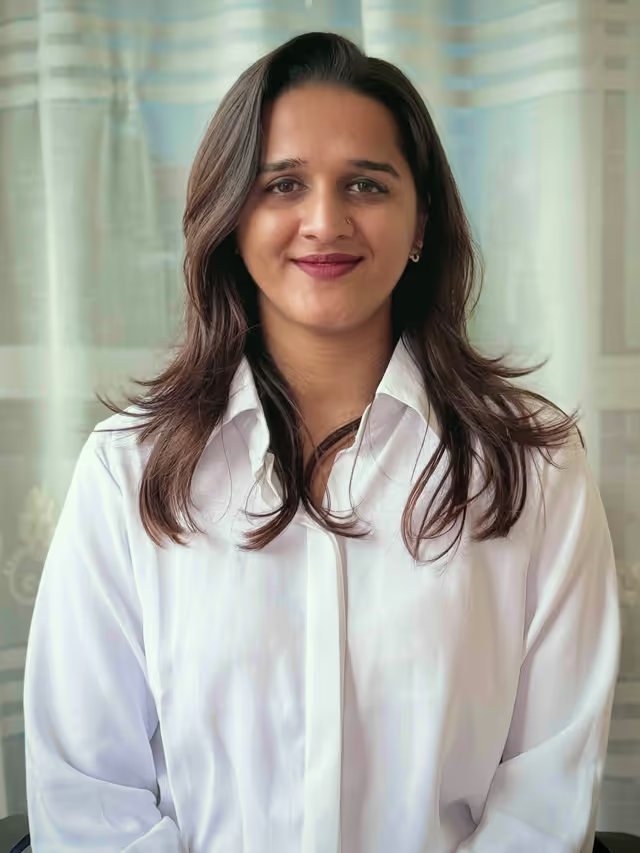
About Smriti Simkhada
Smriti Simkhada is a PTE Academic perfect scorer (90/90) providing structured PTE coaching for Nepali students. She has helped over 1,000 students prepare for Australia PR and Canada immigration through structured, criteria-aligned coaching.
