How I Scored 90/90 in PTE Speaking: Structured Strategies for Nepal (2026)
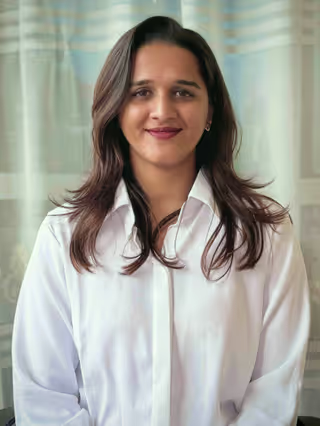
By Smriti Simkhada (90/90) · Updated
I achieved 90/90 in PTE Academic Speaking—a perfect score in every task. I'm sharing exactly how, because most Nepali students I meet are preparing the wrong way and getting stuck between 55 and 72 for months. These strategies helped me achieve this score, though individual results depend on English proficiency and consistent practice.
Why Most PTE Speaking Preparation in Nepal Fails
The standard approach taught at institutes in Kathmandu and Chitwan goes like this: memorise a template, insert keywords, deliver confidently. This worked in 2019. In the current scoring model, it triggers penalty flags.
PTE Academic Speaking is fully automated AI scoring per Pearson's official documentation (pearsonpte.com/pte-academic/scoring/). Individual responses are not human-reviewed. The automated engine detects "rhythmic monotony"—the flat cadence of someone reciting a memorised script—and your content score drops significantly. This is why students who memorise the same template that worked for a senior friend are now scoring lower than that friend did two years ago. Learn more about how PTE Academic is scored.
The solution is not a better template. The solution is understanding what the AI measures.
Stuck below your target? The 79+ Sprint
Private 1-on-1 coaching, from US$99: pick 7 days, 17 days or 1 month, one live session a day at a time that suits you, a demo session included, and Coach-Until-Target on the longer plans.
What the PTE AI Actually Evaluates in Speaking
The Speaking module AI assesses against three scoring criteria. According to Pearson's official scoring guide:
Scoring Criteria
- Oral Fluency—rhythm, pace, reduction of hesitations, connected speech. The AI measures pause length, filler frequency, and speech rate consistency.
- Pronunciation—not accent. The AI evaluates whether phonemes are intelligible. Word stress and consonant accuracy matter; native-accent imitation is not required or rewarded.
- Content—how accurately your response addresses the task. For tasks like Describe Image, this means covering the main trend, key data points, and a conclusion.
Cross-Skill Contributions
Speaking responses also contribute to enabling skills (Grammar, Vocabulary) and to Listening/Reading scores depending on the task. Overuse of the same high-frequency PTE vocabulary (significant, indicate, demonstrate) can be flagged as a template marker.
Section-by-Section Strategy
Read Aloud (highest impact task — item count varies per test version; verify on pearsonpte.com)
Read Aloud contributes to both Speaking and Reading scores. It is the single highest-impact task in the entire test. Most students under-prepare for it because it seems simple.
What the AI rewards:
- No pauses longer than 3 seconds mid-sentence
- Stress on content words (nouns, main verbs, adjectives)—not function words
- Natural linking between words (connected speech): "turn it on" sounds like "tur-ni-ton"
- Consistent pacing—not faster at easy passages, slower at complex ones
My approach: During the 30-40 second reading window before speaking, mark every content word in the text mentally. Deliver the passage at 75% of your normal speaking speed, with deliberate stress on marked words. This feels slow to you. It sounds natural to the AI.
Repeat Sentence (high impact — item count varies per test version; verify on pearsonpte.com)
You hear a sentence once and repeat it exactly. The AI evaluates both accuracy (did you include all words?) and delivery (oral fluency + pronunciation).
The mistake Nepali students make: trying to memorise every word. This creates a delay—you're retrieving from memory, not speaking naturally—and the AI detects the unnatural pause pattern.
My approach: Don't memorise. Chunk. Sentences have 3-5 natural chunks. Retain the first chunk, the middle phrase, and the final chunk. When you speak, speak as if you're telling someone what you just heard—at conversation speed. Partial repetition with high fluency scores better than full repetition with halting delivery.
Describe Image (item count varies per test version; verify on pearsonpte.com)
You see an image (bar chart, line graph, pie chart, process diagram, map), have 25 seconds to study and prepare your response, then 40 seconds to speak.
Content structure the AI rewards:
- Introduce the image type and topic (5 seconds)
- State the main trend or most prominent feature (10 seconds)
- Add one supporting detail or comparison (8 seconds)
- Conclude with an observation or implication (5 seconds)
Do not list every data point. The AI does not reward exhaustive description. It rewards the identification of the main trend, supported by evidence, with a logical conclusion.
Sentence starters that work across image types: "The [chart/graph/diagram] illustrates...", "The most notable feature is...", "In comparison...", "Overall, it is clear that..."
Avoid: "As we can see from the graph..." (overused, flagged), "The graph shows that..." (generic, no content signal).
Re-tell Lecture (item count varies per test version; verify on pearsonpte.com)
You listen to an audio recording of up to 90 seconds and then re-tell the key points in 40 seconds.
Note-taking is essential. Use a 3-column system: Topic | Key Points | Conclusion. You have 10 seconds after the audio ends before recording begins—use this to organise your notes into 3-4 bullet points.
Content formula: "The lecture discusses [topic]. The speaker states that [key point 1]. Furthermore, [key point 2]. In conclusion, [main takeaway]." This structure covers all content requirements and delivers naturally within 40 seconds.
Respond to a Situation (added to PTE Academic on 7 August 2025; also in PTE Core)
You hear a practical scenario (missing a meeting, requesting a favour, apologising) and must respond appropriately. Pearson's published spec is 10 seconds preparation + 40 seconds response. Item count varies per test version; verify on pearsonpte.com/pte-academic.
What this task actually tests: tone-appropriateness and sociolinguistic awareness. The AI evaluates whether your response matches the social context—formal vs informal, apologetic vs assertive, empathetic vs transactional.
Structure: Acknowledge the situation → respond to the specific request → offer a resolution or next step. Keep vocabulary mid-range—neither too formal nor too casual. Avoid starting with "I am deeply sorry for this unfortunate situation" (over-formal) or "No worries, my bad" (too informal).
Algorithm-Aware Speaking Tips — What the AI Actually Measures
| What AI measures | What it does NOT measure | How to optimise |
|---|---|---|
| Phoneme accuracy (sounds recognisable) | Native-speaker accent character | Drill difficult consonants, not accent imitation |
| Oral Fluency (pace, pause, restart patterns) | Confidence or charisma | Steady pacing, no self-correction, even rhythm |
| Word stress on multi-syllable words | Vocabulary "impressiveness" | Stress correctly even simple academic words |
| Content coverage in Describe Image / Retell Lecture | Subjective quality of analysis | Cover topic + 2-3 details + implication |
| Speech recognised against intended words | Accent "cleanliness" | Speak clearly enough for AI to map your speech |
Mistake → Fix: Algorithm-Misaligned Habits
- Mistake: Speaking faster to "show fluency."
Fix: Even pacing scores higher than fast-but-uneven pacing. The AI measures rhythm consistency, not speed. - Mistake: Forcing American "r" sounds in word endings.
Fix: Forced sounds are detected as unnatural. Speak naturally with clear word boundaries. - Mistake: Memorising templates and reciting them word-for-word across attempts.
Fix: Memorise structure; vary content. Repeated phrase patterns trigger AI detection. - Mistake: Stopping mid-Read Aloud to fix a misread.
Fix: Continuous flow scores higher than perfect-but-broken delivery. The AI penalises stops more than minor slips. - Mistake: Practising in long sessions without recording.
Fix: Daily 20-minute recorded sessions are higher-leverage than 90-minute unrecorded sessions.
Step-by-Step Daily Speaking Practice Routine (30 minutes)
- Minutes 0-10 — Read Aloud: Three passages, recorded. Focus on word stress and even pacing.
- Minutes 10-15 — Repeat Sentence: Five items. Speak within 0.5 seconds of the beep, reconstruct from spine.
- Minutes 15-22 — Describe Image or Retell Lecture (alternate days): One full attempt with 5-part structure.
- Minutes 22-27 — Self-review: Listen to recordings. Mark hesitations, mispronunciations, self-corrections.
- Minutes 27-30 — Targeted drill: Practise the specific words or sounds you stumbled on.
The Three Habits That Separate 79 from 90
- Speak on every exhale. Most Nepali students breathe mid-sentence. This creates the exact pause pattern the AI penalises for oral fluency. Train yourself to complete each sentence clause on a single breath.
- Record and review daily. Your ear normalises your own delivery within 3 days. Recording on a phone and listening back the next morning reveals problems you cannot hear in real time.
- Prioritise Read Aloud over every other task. It has the highest item count and the highest cross-skill impact. Students who master Read Aloud raise both their Speaking and Reading scores simultaneously.
Frequently Asked Questions
Does the PTE AI penalise a Nepali accent?
No. The scoring engine measures phoneme accuracy and intelligibility — whether your sounds are recognisable — not accent character. A Nepali accent with clear word boundaries, correct word stress, and even pacing scores well. Accent imitation is wasted preparation effort; drill difficult consonants (v/w, th, p/f) instead.
Are memorised speaking templates detected by the scoring engine?
Word-for-word recitation of the same phrases across responses triggers template detection and hurts your score. Memorise the structure (topic, details, implication) and vary the actual wording in every response. Connector variety — alternating "Furthermore," "Additionally," "Moreover" — keeps delivery natural.
How long should daily Speaking practice be?
A focused 30-minute recorded session daily beats long unrecorded sessions. Recording is the key: your ear normalises your own delivery within days, and only playback reveals hesitations, self-corrections, and stress errors. Follow the step-by-step routine above and review every recording the same day.
Additional Resources
For official practice materials and scored mock tests, visit Pearson's preparation page. Remember that your final score depends on English ability, task performance, and official scoring criteria—not just strategy alone.
Ready to Work On Your PTE Speaking?
The fastest path to 79+ in Speaking is a personalised analysis of where your score is actually being lost—not a generic template you apply to every task.
In my 1-on-1 sessions, Speaking is the first module we cover. I will show you your exact score-loss pattern in the first session.
Or send me your score report on WhatsApp (+977 9825235082) and I'll tell you immediately which tasks to target.
Continue Your PTE Preparation
Related guides for Nepali students preparing for PTE Academic and PTE Core:
- PTE score requirements guide
- PTE Speaking templates by task
- Retell Lecture note-taking
- The flow-over-correction rule
- Stuck at 75-78 in speaking
- Cross-module scoring
Last fact-checked on 2026-05-08 against official sources (Pearson PTE, Australia Department of Home Affairs, AHPRA, IRCC, GOV.UK, INZ). Test fees, score requirements, and visa rules can change at any time — always verify the latest details on the relevant official website before booking or applying.
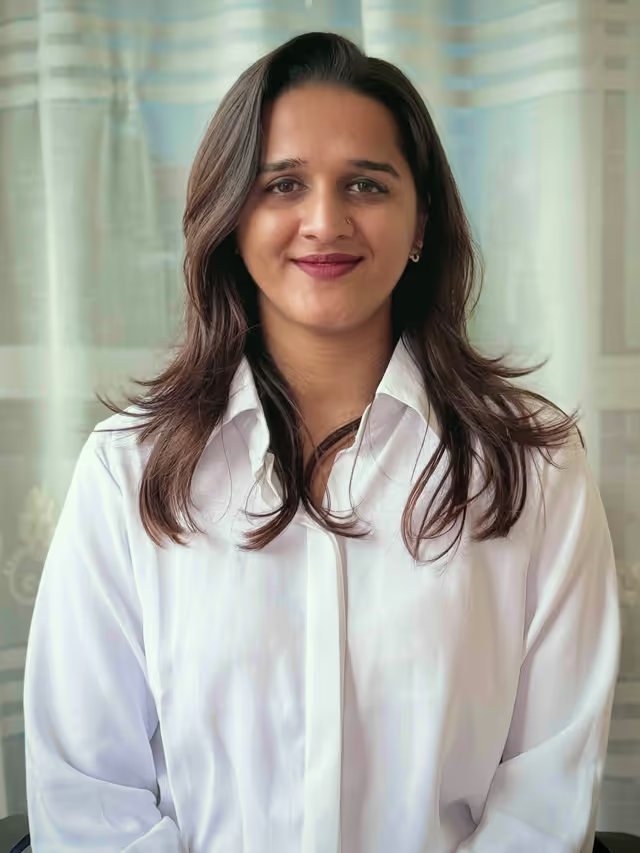
About Smriti Simkhada
Smriti Simkhada is a PTE Academic perfect scorer (90/90) providing structured PTE coaching for Nepali students. She and her team have helped 1,500+ students prepare for Australia PR and Canada immigration through structured, criteria-aligned coaching.