Why Nepali Students Miss PTE 79 for Australia PR Even After Scoring High in Mock Tests (2026)
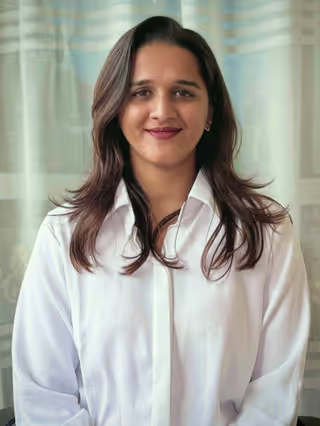
Smriti Simkhada
90/90 Perfect Scorer
Updated October 2026 · Reviewed by Smriti Simkhada (90/90)
Why Your PTE Mock Score Is Higher Than Your Real Exam Score
One of the most frustrating experiences for Nepali PTE Academic students is consistently scoring 80+ on practice tests, then receiving a 73-76 in the actual exam. If this has happened to you, you are not alone — and it is not random. There are specific, predictable reasons why PTE mock scores are higher than real exam scores for Nepali students, and understanding them is the first step to fixing the gap.
Reason 1: Third-Party Mock Tests Overestimate Speaking Scores
This is the single most common cause of the mock-to-real score gap for Nepali students. Most popular third-party PTE mock test platforms (not Pearson's official platform) use simplified AI models or human raters for Speaking tasks. These models are systematically more lenient than Pearson's actual AI scoring engine.
Stuck below your target? The 79+ Sprint
Private 1-on-1 coaching, from US$99: pick 7 days, 17 days or 1 month, one live session a day on your time zone (Sydney · Melbourne · Toronto · London · Doha), a demo session included, and Coach-Until-Target on the longer plans.
Specifically, three things are different:
- Oral Fluency scoring: Third-party platforms often rate hesitations and pauses more leniently. Pearson's actual AI penalises pauses above a certain threshold more severely.
- Pronunciation scoring: Some third-party tools struggle to accurately score non-native accents with the same consistency as Pearson's AI, leading to optimistic Pronunciation scores.
- Describe Image content scoring: Third-party tools may award Content marks for partial coverage; Pearson's system requires more complete coverage of key visual data points.
The fix: Use Pearson's official PTE Practice platform (available at the official PTE Academic website) as your benchmark. Do at least 2 full official practice tests in the 2 weeks before your exam to get an accurate score prediction. Third-party mocks are useful for task volume practice — not for score prediction.
Reason 2: Mock Test Conditions Are Not the Same as Exam Conditions
Most students practise mock tests at home, in their bedroom, without noise-cancelling headphones, at their own pace, and without the psychological pressure of exam day. The actual exam environment is different in several ways:
- Ambient noise: PTE test centres have other candidates speaking aloud simultaneously (for Speaking tasks). This background noise can disrupt concentration during Listening tasks, particularly Write From Dictation.
- Time pressure: In the actual exam, moving between sections and items feels faster. Students who are relaxed during home practice often feel rushed in the exam room.
- Technical unfamiliarity: Students who practise on their own laptop may struggle with the specific headset, microphone sensitivity, or screen layout at the test centre.
The fix: Visit the test centre once before your exam date to familiarise yourself with the layout. During practice, use a similar headset to what test centres provide (usually over-ear). Time your practice tests strictly — do not allow extra time or breaks beyond what the actual exam allows.
Reason 3: The 3-Second Hesitation Rule in Speaking
PTE Academic's Speaking section recordings end automatically if there is an extended pause (commonly documented as around 3 seconds for short tasks). Verify the current threshold in the relevant Speaking task FAQ on support.pearsonpte.com. Many students unknowingly trigger this during Describe Image or Retell Lecture when they are thinking about what to say next. In their home practice, they may pause for 4-5 seconds and continue successfully because the practice platform does not cut them off — but in the real exam, the recording ends and their response is truncated.
A truncated speaking response scores significantly lower in Oral Fluency, which is the primary driver of Speaking scores for students in the 74-78 range.
The fix: Practise Speaking tasks on a platform that enforces the 3-second cutoff exactly as Pearson does. Alternatively, practise filling silence with connecting phrases ("as we can see", "looking at this data", "moving to the next point") to maintain continuous speech without meaningful pauses.
Reason 4: Write From Dictation Is Harder in the Real Exam
Many students practise WFD using the same 200-300 sentences repeatedly until they have memorised them. On mock tests using these familiar sentences, they score perfectly. In the real exam, unfamiliar WFD sentences appear — and the score drops significantly because students have been training recall, not genuine listening-and-transcription skill.
The real exam also uses slightly different audio quality and pacing than many third-party practice platforms. Some candidates report that real-exam audio is faster or uses different accents than what they practised with.
The fix: Practise WFD with a wide variety of sentences — not just memorised lists. Use Pearson's official practice material for WFD, which reflects the actual sentence complexity and pacing. Avoid WFD "prediction lists" as your primary preparation strategy.
Reason 5: Enabling Skills Are Not Evenly Trained
Mock test scores are aggregated and may mask weak enabling skills. A student might score 78 overall in a mock Speaking test — but have Pronunciation at 85 and Oral Fluency at 62. The average looks fine in the mock report; but in the real exam with Pearson's more accurate scoring, the Oral Fluency gap becomes more apparent.
Students who practise for task performance (completing each task type) but not enabling skills (building Oral Fluency, Grammar, Vocabulary, Spelling as foundations) often plateau in mock scores and experience a real-exam shock.
The fix: Review enabling skill scores in your score report after the real exam (not just communicative skill scores). If Oral Fluency is below 70, Read Aloud is your primary practice focus — not Describe Image templates. If Written Discourse is below 70, restructuring your Essay approach matters more than grammar drills.
Reason 6: Exam-Day Performance Anxiety
PTE Speaking tasks require you to speak alone, out loud, into a microphone, with a recording timer running. For Nepali students who have only practised at home, the first time they experience this in a real test environment can produce vocal tension, reduced fluency, and hesitations that do not appear in home practice.
The fix: Simulate exam conditions during practice. Sit upright. Put on headphones. Speak aloud into a microphone. Record yourself. Review the recording. This desensitises you to the physical act of speaking into a recording system in an unfamiliar environment.
The Mock-to-Real Gap Closing Plan
- Stop using third-party mocks as your score benchmark — use only Pearson official practice.
- Complete 2 full official practice tests (one 3 weeks before, one 1 week before your exam date).
- Check the Oral Fluency and Pronunciation enabling skill scores in your official practice result, not just the overall Speaking score.
- Practise WFD with unfamiliar sentences daily — not memorised lists.
- Practise all Speaking tasks under real conditions: upright posture, headphones, speaking aloud, 3-second pause awareness.
Frequently Asked Questions
How much is the typical mock-to-real gap for Nepali PTE students?
Students using third-party mock platforms often see a gap of 4-8 points in Speaking specifically, and 2-5 points in Listening. Reading and Writing gaps are typically smaller because these tasks are less dependent on AI scoring calibration.
Which mock test platform is closest to the real PTE experience?
Pearson's official PTE Practice is the most accurate because it uses the same scoring engine as the real exam. No third-party platform fully replicates Pearson's exact AI scoring, though some come closer than others.
Does retaking PTE without changing preparation improve the score?
Typically not significantly. Students who retake PTE within 2-4 weeks of a previous attempt without changing their preparation approach see average improvements of 1-3 points. Closing a 5-8 point gap requires a deliberate strategy change, not just another attempt.
Get Help Closing the Gap
If you have experienced the mock-to-real gap and are preparing for a retake, the 1-on-1 mentorship starts with a diagnosis of your score report to identify exactly which enabling skills are causing the gap. The shorter 7-day and 17-day plans use structured practice methods that specifically address the common gap-causing issues. Read the complete retake strategy guide or explore the PTE Academic section guide.
People Also Ask
Is 79 PTE easy to score?
PTE Academic Superior English (post-7-Aug-2025: L69 / R70 / W85 / S88; pre-7-Aug-2025: 79 in each skill) is challenging — it corresponds to a strong C1 CEFR level. Most Nepali students need 5-8 weeks of focused preparation on the blocking skill (often Speaking Oral Fluency or Writing Grammar) to push past 79. It is achievable with consistent practice on official Pearson scored mocks, daily Read Aloud, and Write From Dictation drills. Smriti Simkhada has a 90/90 perfect score and coaches the criteria-specific approach that helps Nepali students cross the 79 ceiling.
How much is a 77 score in PTE?
A PTE Academic score of 77 corresponds to C1 on the CEFR scale — strong English proficiency, just below Superior English (post-7-Aug-2025: L69/R70/W85/S88). For Australia PR, 77 in any one skill means you fall short of the +20 Superior English points; you can still claim Proficient English (+10 points) if all four skills meet the Proficient thresholds (Listening 58, Reading 59, Writing 69, Speaking 76). To push from 77 to 79+ in a specific skill, target the enabling skill weak spot in your score report and run a focused 3-4 week prep block.
Is 1 month enough for PTE?
For most Nepali students with conversational English, one month of structured preparation is enough to hit 65+ in each skill. Reaching 79+ for Superior English typically takes 5-8 weeks of focused practice on the blocking skill. The realistic timeline depends on your starting score, target, and the gap in enabling skills. Book a free score assessment to map your specific timeline before committing to an exam date. Verify exam booking availability on the official Pearson PTE website before finalising your schedule.
Need a personal answer for your specific case? Book a free score assessment call or see the three 1-on-1 plans.
Continue Your PTE Preparation
Related guides for Nepali students preparing for PTE Academic and PTE Core:
- How to score 79+ from nepal
- PTE 79+ timeline
- How many attempts most need
- PTE Academic common mistakes
- PTE vs IELTS for PR
More on PTE Nepal: PTE for Australia hub, best PTE coach for Australia PR (listicle), and London 1-on-1 coaching.
Mock-test scores are not Pearson scores: Mock-test platforms use their own AI scoring engines, which are calibrated independently from Pearson. Treat mock results as directional indicators, not score predictions. Real-test scoring can differ in either direction, particularly for Speaking and Writing tasks.
Last fact-checked on 2026-05-08 against official sources (Pearson PTE, Australia Department of Home Affairs, AHPRA, IRCC, GOV.UK, INZ). Test fees, score requirements, and visa rules can change at any time — always verify the latest details on the relevant official website before booking or applying.
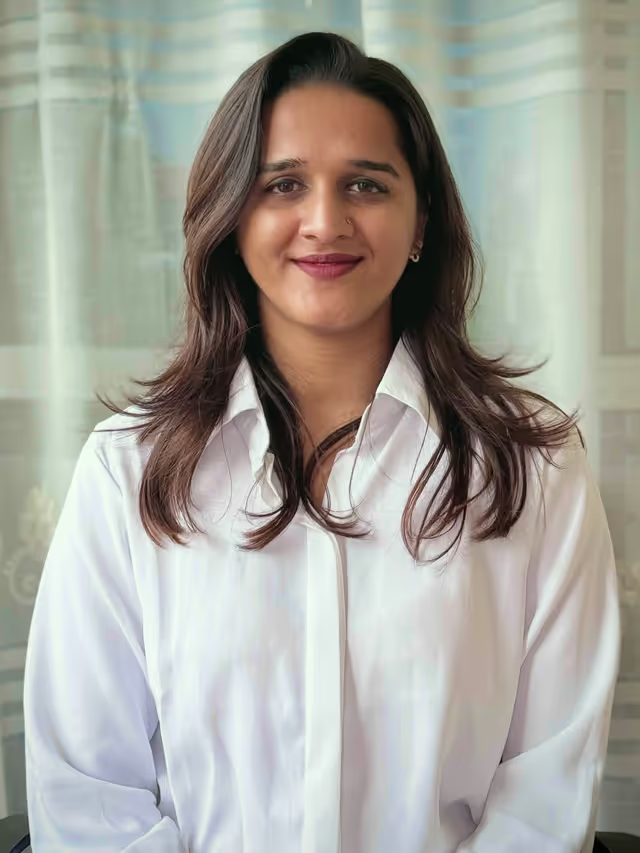
About Smriti Simkhada
Smriti Simkhada is a PTE Academic perfect scorer (90/90) providing structured PTE coaching for Nepali students. She has helped over 1,000 students prepare for Australia PR and Canada immigration through structured, criteria-aligned coaching.
