Australia Moved Nepal, India, Bangladesh and Bhutan to Evidence Level 3
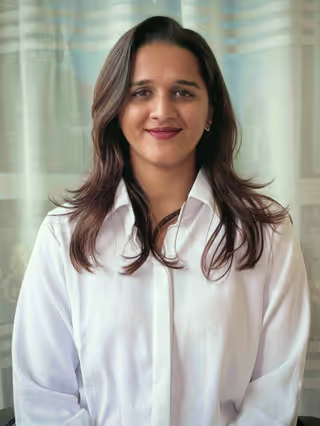
Smriti Simkhada
90/90 Perfect Scorer
Updated October 2026 · Reviewed by Smriti Simkhada (90/90)
Australia Moved Nepal, India, Bangladesh and Bhutan to Evidence Level 3 — What Really Changed
In early January 2026, Australia's Department of Home Affairs raised the evidentiary bar for student visa applicants from four South Asian countries at once: Nepal, India, Bangladesh and Bhutan. Agents and local media in all four markets labelled it "Assessment Level 3" (AL3). The event is real. All four were moved to the highest tier, Evidence Level 3, under the Simplified Student Visa Framework (SSVF), and most applicants holding those passports now face regular, up-front documentary requirements.
But the mechanism behind the label is widely misreported, including on the one point that decides whether it applies to you at all. This guide explains what actually changed, what the framework really is, what PTE Academic score the Australian student visa requires in 2026, and how to prepare.
Stuck below your target? The 79+ Sprint
Private 1-on-1 coaching, from US$99: pick 7 days, 17 days or 1 month, one live session a day on your time zone (Sydney · Melbourne · Toronto · London · Doha), a demo session included, and Coach-Until-Target on the longer plans.
For broader context, see the Australia PR score requirements and the Subclass 189 invitations and Superior English.
Important — PTE Core is NOT accepted in Australia. For Australian visas, only PTE Academic counts. PTE Core is the IRCC-accepted version for Canada. Confirm on the official DHA English language page.
"Assessment Level 3" Is Shorthand — the Formal Assessment Level System Was Abolished in 2016
Precision matters here. Australia's formal Student Visa Assessment Level system (originally AL1–AL5, later simplified to AL1–AL3) was abolished on 1 July 2016, when the Simplified Student Visa Framework (SSVF) replaced it and Streamlined Visa Processing. Since then, there has been a single student visa, Subclass 500, and no official "Assessment Level" attached to any country. Any article telling you Nepal or India "is classified AL3" under a current DHA assessment-level policy is describing a framework that no longer exists.
What exists today is the SSVF's combined immigration-risk model. The Department of Home Affairs assigns an evidence level (1 = lowest immigration risk, 3 = highest) to every country and to every education provider. The combination of your passport's country rating and your provider's rating determines your evidentiary requirements:
- Streamlined evidentiary requirements — you do not normally need to attach financial-capacity or English-test evidence with the visa application (the department can still ask for it later).
- Regular evidentiary requirements — evidence of funds and English must be declared and provided up front, and it is verified closely.
Home Affairs does not publish these ratings publicly. They are communicated to education providers and updated periodically. When agents say a country "moved to AL3", they mean its country evidence level was raised to Level 3. In short: the popular "AL3" label describes a real reclassification, but under the SSVF risk framework and not the pre-2016 Assessment Level system.
The provider half of the matrix is the part almost every write-up drops, and it is the part that decides your own case. Home Affairs states on its evidence framework page that a provider holding the lowest evidence level has streamlined evidence requirements for all countries, while a provider on the highest level gets that benefit only for students from the lowest-level countries. Read that in the direction that matters to you: a Level 3 passport with a Level 1 provider is still streamlined. A Level 3 passport with a Level 2 or Level 3 provider is not.
Neither rating is published, so the way to find out which one you are is the department's Document Checklist Tool, which returns the combined outcome for your provider and your passport. Do that before you assume anything below applies to you.
One more distinction: visa processing priority is a separate mechanism again. Since 14 November 2025 it has been governed by Ministerial Direction 115, which ties offshore Subclass 500 processing speed to each education provider's share of its enrolment allocation, not to your country's evidence level.
What Changed in Early January 2026
Home Affairs does not publish country ratings itself, so what follows comes from consistent reporting by education-industry media and migration lawyers across all four markets:
- In early January 2026, Home Affairs lifted Nepal, India, Bangladesh and Bhutan to Evidence Level 3, the highest-risk tier, in a single change.
- The reported trigger was a spike in fraudulent financial documents and falsified academic credentials detected during the 2025 peak lodgement period.
- Nepal had been at Evidence Level 2 since the end-of-March 2025 update, as reported by education agents at the time, an upgrade that had rewarded improved compliance outcomes among Nepali students. For Nepal the January change was a reversal of that.
A word on the date, because you will see it written two ways. Some sources report the change as effective 8 January 2026 and others as 9 January 2026, and there is no single DHA page that settles it. Treat it as early January 2026. The country list and the Level 3 fact itself are corroborated across several independent sources; the exact day is not. Evidence Level is also applied at the time of lodgement rather than retroactively, so an application already submitted before the change was not reassessed under the new level.
What this means in practice for applicants from any of the four countries:
- Regular evidentiary requirements, unless your provider is Evidence Level 1. With a Level 2 or Level 3 provider, financial evidence and your English test result must be attached at lodgement. With a Level 1 provider you declare your funds and the department can still ask for the documents later. Check the Document Checklist Tool rather than guessing.
- Financial capacity is checked hard. The living-cost component alone is AUD 29,710 for a single applicant, plus tuition and travel, and case officers scrutinise the source of funds. Sudden large deposits and unverifiable income are red flags.
- Genuine Student (GS) answers matter more. Since 23 March 2024 the GS requirement, which replaced the old GTE statement, uses targeted questions. Generic, copied answers invite refusal under heightened scrutiny.
- Applications must be decision-ready. Incomplete files are far more likely to be refused than queried.
One Classification, Four Countries: What Is Identical and What Is Not
Much of the January commentary implied each country got its own new rulebook. It did not happen that way. Evidence Level is a single setting per country in one shared DHA framework, and all four were set to the same value.
Identical Across Nepal, India, Bangladesh and Bhutan
- The evidentiary standard. Level 3 means regular evidentiary requirements with any Level 2 or Level 3 provider, and streamlined with a Level 1 provider. Same rule, whichever of the four passports you hold.
- The English score floor. PTE Academic 47 overall for direct entry, set by legislative instrument for the visa, with no per-skill minimum. The instrument sets one score for every nationality; its only passport rule is a full exemption for five English-speaking countries, none of them South Asian.
- The financial capacity figure. AUD 29,710 per year for a single applicant. Also nationality-independent.
- The Genuine Student requirement. The same targeted questions, assessed the same way.
- Timing. Under regular requirements the evidence must be in the file at lodgement. The department's own guidance is that such an application can be refused without anyone writing to ask you for the missing document.
What Actually Differs
Not the requirement. What differs is the paperwork your own country produces to satisfy it, and that is a practical problem rather than a legal one. A case officer asking "can I verify this bank statement and this transcript" asks it of every applicant; the answer depends on which institutions issued your documents and how easily they can be checked.
Be careful with anything claiming one of the four countries got a lighter or heavier version of Level 3. Home Affairs publishes neither the ratings nor any per-country variation of what Level 3 means, so a claim like that has nothing behind it. January reporting also does not consistently document what level each country sat on beforehand. Nepal's path is the best documented of the four, which is why it appears above and the others do not.
If You Are Applying From India
The rule is the one described above, with no Indian variation. Two practical notes that are specific to India rather than to the classification:
- Test cost. PTE Academic is priced locally at INR 18,900 including GST following Pearson's March 2026 revision. In Nepal the same test is USD 248.60 (Pearson's listed Nepal price), and your bank converts that to rupees at its own rate. Prices move with local Pearson VUE pricing, so confirm at the pearsonpte.com checkout before you budget.
- More advice, not better advice. The Indian market carries far more agent commentary than the other three. Judge any of it by whether it cites the instrument or the DHA page, not by how confident it sounds.
If You Are Applying From Bangladesh or Bhutan
Same classification, same evidentiary standard, and very little country-specific commentary published about either. Bhutan in particular sends a small cohort, and I have not found any credible source describing a Bhutan-specific version of the requirement. That absence is worth stating plainly: if the only difference you can find is that nobody has written about your country, the requirement is the same one everybody else is meeting, and your file should be built to the standard set out below.
What PTE Academic Score Does the Student Visa Require?
Here is the part most "AL3" articles get wrong: the evidence level does not change the visa score floor. Evidence Level 3 changes when you must show your English evidence, at lodgement for anyone whose provider is Level 2 or Level 3, and how closely it is checked. The required score itself is set by a legislative instrument and is the same for every nationality.
Department of Home Affairs Minimums (Subclass 500)
For tests taken on or after 7 August 2025, instrument LIN 25/090 (F2025L00906) sets the PTE Academic requirement as an overall score only, with no per-skill minimum for the student visa:
- Standard (direct entry to your course): PTE Academic overall 47, the equivalent of IELTS 6.0
- Packaged with at least 10 weeks of ELICOS, or a foundation/eligible pathway program: overall 39
- Packaged with at least 20 weeks of ELICOS: overall 31
- Transitional rule: a PTE test taken before 7 August 2025, still within its 24-month validity window, is assessed at the older standard of overall 50 for direct entry
- The test must have been taken no more than 24 months before you apply
Always verify the current numbers on the DHA English language page, and remember your institution's admission requirement is usually higher than the visa floor. You must meet the higher of the two.
University-Set Admission Requirements
These are typical admission ranges. Individual courses vary, so always confirm with your offer letter:
| Provider Type | Typical PTE Academic Requirement |
|---|---|
| Go8 Universities (ANU, Melbourne, Sydney, etc.) | 58–65 overall, 50–58 per skill (depends on course) |
| Regional Universities | 50–58 overall, 42–50 per skill |
| TAFE Colleges | 42–50 overall (lower with ELICOS packaging) |
| Private Colleges (CRICOS registered) | 50–58 overall |
Note: these are institution admission bands. Regardless of how low an institution's own requirement goes, the DHA visa floor is 47 overall for tests on or after 7 August 2025. You must meet both.
Under Evidence Level 3 scrutiny, many agents now advise applicants from all four countries to present comfortably above the floor. PTE 58+ reads as a stronger, lower-risk profile even where 47 would technically suffice.
Why These Four Countries Were Moved to Evidence Level 3
Country evidence levels are driven by measured immigration-risk indicators for each market. The reason attached to the January 2026 change, as reported, was a spike in fraudulent financial documents and falsified academic credentials during the 2025 peak intake. The department has published the shape of its methodology in the past, built on refusal rates, visa cancellations, overstays and subsequent protection-visa applications, with fraud-related refusals carrying the heaviest weight. What it has never published is the resulting score for any country, which is why nobody outside the department can tell you exactly how close Nepal or India was to the line.
Ratings are reviewed periodically, and Nepal's own history proves movement in both directions: it was upgraded to Level 2 in March 2025 before the January 2026 downgrade. No individual applicant can change a country rating. What a genuine, complete, well-documented application with a solid PTE score can do is get approved at any evidence level, which is what most of them still do.
Does This Affect PTE Score Requirements for Skilled Migration Too?
No. Evidence levels apply only to student visa (Subclass 500) evidentiary requirements. For Australia's skilled migration visas (189, 190, 491), the threshold you must clear is Competent English (L47/R48/W51/S54). Proficient English (L58/R59/W69/S76) earns 10 points on top and Superior English (L69/R70/W85/S88) earns 20. All of those are DHA component-specific bands for tests taken on or after 7 August 2025, identical for every country. Your country's student-visa evidence level does not affect your skilled migration English threshold.
PTE Academic vs IELTS for the Australian Student Visa
Both PTE Academic and IELTS are accepted for Australian student visas. PTE Academic has two advantages under Evidence Level 3, and they apply equally in Kathmandu, Delhi, Dhaka and Thimphu:
- Faster results: PTE Academic results usually arrive within two days, though Pearson allows up to five working days. IELTS results take 13 days (paper) or 3–5 days (computer). Under regular evidentiary requirements your English evidence must be ready at lodgement, so faster results protect your timeline.
- Flexible retakes: PTE Academic allows up to 12 sittings in any 12-month period, and you can book the next one as soon as your score is released. That gives you more chances to reach the required score before your application deadline.
How to Prepare for the Higher-Scrutiny PTE Requirement
For most students applying to Go8 universities, the practical target is PTE Academic 58–65 overall with skills above 50. For TAFE or regional universities, admission thresholds are lower, but under Evidence Level 3, scoring well above the visa floor of 47 strengthens your whole application.
Recommended Preparation Timeline
- Target: 47–50 overall (visa floor plus buffer) — 4–6 weeks of structured preparation from a baseline of 40+
- Target: 58 overall — 6–8 weeks of structured preparation from a 45+ baseline
- Target: 65 overall — 8–12 weeks if starting from below 50, or 4–6 weeks from a 55+ baseline
Common Mistakes Applicants Make Under Evidence Level 3
- Believing "AL3" raises the DHA score floor. It does not. The floor is PTE 47 overall for every nationality. What changed is that your evidence is mandatory at lodgement and is verified closely.
- Assuming Level 3 automatically means regular evidentiary requirements. It depends on your provider as well as your passport. A Level 1 provider keeps streamlined requirements for students from every country. Run the Document Checklist Tool before you rearrange your test dates around an assumption.
- Assuming your country got its own version of the rule. One classification was applied to four countries. If a page tells you India's Level 3 is softer than Nepal's, or the reverse, ask it to cite a source.
- Not checking their specific institution's requirement. Requirements vary by university, faculty and course level. Always confirm the exact threshold with your admission offer or the university's English proficiency page.
- Combining scores from different PTE sittings. All skill scores must come from a single PTE Academic sitting. You cannot use reading from one attempt and speaking from another.
- Ignoring the provider's per-skill requirements. The visa floor has no per-skill minimum, but most universities do. If your offer requires 50 per skill and Writing is 48, you have not met the admission condition.
- Submitting an incomplete file. Under regular evidentiary requirements, missing financial or English evidence at lodgement is far more likely to end in refusal than in a polite request for documents.
Tips for Nepali Students, and for Everyone Else Applying Under Evidence Level 3
- Start PTE preparation at least 3 months before your intended offer acceptance deadline. That gives you time for 2 attempts if needed.
- Get a free score assessment call to understand your current level before booking your first exam.
- Use PTE Academic rather than IELTS if your timeline is tight. Under regular evidentiary requirements your test result must be in hand when you lodge.
- If your institution requires 65 overall, treat 68 as your preparation target to build in a buffer.
- Keep your financial documents as clean as your scores. Aged funds, traceable income and consistent paperwork matter as much as English under Evidence Level 3.
- For Nepali applicants specifically: get your academic equivalency in order early. Foreign degree equivalency comes from Tribhuvan University's Curriculum Development Centre and +2 equivalency from the NEB, and neither is quick during peak season.
- Whichever of the four countries you are applying from, assume every document you submit will be checked with the institution that issued it. Prepare the file you would be comfortable having verified.
Frequently Asked Questions
Is "Assessment Level 3" an official Home Affairs classification?
Not under that name. The formal Assessment Level system was abolished on 1 July 2016. What changed in early January 2026 is the country evidence level of Nepal, India, Bangladesh and Bhutan under the SSVF immigration-risk framework, which was raised to Level 3, the highest tier. "AL3" is the shorthand agents and media use for that change. Home Affairs communicates the ratings to education providers rather than publishing them.
Which countries moved to Evidence Level 3 in January 2026?
Four: Nepal, India, Bangladesh and Bhutan. They were moved together, to the same level, under the same reported reason. Sources differ on whether the change took effect on 8 or 9 January 2026, and no official DHA page settles the date, so "early January 2026" is the safe way to describe it.
Does Evidence Level 3 always mean I have to attach my financial and English evidence?
No, and this is the detail most coverage of the January change left out. The evidentiary outcome comes from your country level and your provider's level together. Home Affairs' evidence framework page states that a provider on the lowest evidence level has streamlined evidence requirements for all countries, so a Level 1 provider still gives you streamlined treatment on a Nepali, Indian, Bangladeshi or Bhutanese passport. With a Level 2 or Level 3 provider you are on regular requirements. Neither rating is published, so use the Document Checklist Tool on the Home Affairs site to see which combination applies to you.
Is the requirement different for Indian applicants than for Nepali applicants?
No. Evidence Level 3 has one definition and it applies the same way to all four countries. The visa English floor of PTE 47 overall and the AUD 29,710 financial capacity figure are set independently of nationality. What varies between countries is which local institutions issued your bank statements and transcripts and how easily a case officer can check them, which is a document-quality problem rather than a different rule.
Can I appeal my country's Evidence Level 3 rating?
No. The rating applies at country level, is based on aggregate immigration-risk data, and is not subject to individual appeal. All applicants from the four countries face the same evidentiary requirements. What you control is the quality and completeness of your own application.
Does Evidence Level 3 make my visa application more likely to be refused?
It means greater scrutiny, not automatic refusal. A decision-ready application, with genuine Genuine Student answers, clean and traceable financial evidence, and a PTE score comfortably above the requirement, is still approved. Students from all four countries continue to receive Australian student visas. The ones who struggle are those with incomplete or unverifiable documentation.
My application was lodged before January 2026. Am I affected?
Evidence Level applies at the time of lodgement rather than retroactively, so a reclassification after you lodged does not change the evidentiary requirements your application was assessed against. If you are still preparing to lodge, you are applying under Level 3.
If I get Australian PR later, does the student-visa evidence level affect my PR application?
No. Evidence levels only govern student visa evidentiary requirements. Your skilled migration or partner visa application is assessed independently under its own criteria.
Does the English score requirement change if I study at a regional university vs a metro university?
The visa floor of PTE 47 overall is the same everywhere, but admission requirements differ. Regional universities frequently accept lower English scores than Go8 or other metropolitan universities. If you are close to the Go8 requirement but not quite there, a regional pathway is worth considering. Verify the specific requirement with each institution.
Key Takeaways and Getting Your PTE Score Ready
Four countries, one classification, and no change to the score you actually need. Evidence Level 3 moved the deadline for your English evidence forward to lodgement day and raised how hard everything in your file gets checked. If you need to reach PTE Academic 50–65 for your Australian student visa, a structured preparation approach is more efficient than self-study alone. Coaching is private 1-on-1 mentorship in three plans of 7 days, 17 days or 1 month, one live session a day on your time zone. Each plan starts with a score diagnosis and targets exactly the skills you need to improve. Browse the Australia PTE coaching hub or check PTE score requirements by pathway.
Continue Your PTE Preparation
Related guides for students preparing for PTE Academic and PTE Core:
- PTE score for Australia PR points
- How to score superior english
- Superior English 85-88 for PR
- PTE 79 vs IELTS 8 for Australia
- PTE vs IELTS for Australia and Canada
More on PTE Nepal: PTE for Australia hub and Australia PTE coaching hub.
2025 English-band changes — important context
From 7 August 2025, DHA recalibrated how PTE Academic scores map to its English levels. For the student visa, the requirement is an overall score only: PTE 47 (IELTS 6.0 equivalent) for direct entry, with no per-skill minimum. For skilled migration bands (Vocational, Competent, Proficient, Superior), the thresholds are per communicative skill and now differ by skill. Proficient English, for example, is L58/R59/W69/S76 rather than the old flat "65 in each".
Articles or coaches still quoting the pre-August-2025 uniform numbers, like "50 each" for Competent or "65 each" for Proficient, are out of date. Tests taken before 7 August 2025 are assessed under the earlier scale while they remain valid. Always check the latest DHA English language page before assuming a score level.
Last fact-checked on 2026-09-06 against official sources (legislation.gov.au instrument LIN 25/090, the Department of Home Affairs evidence framework and Document Checklist Tool, Pearson PTE). The Evidence Level 3 status of Nepal, India, Bangladesh and Bhutan is as reported by education-industry media and migration lawyers in January 2026; Home Affairs does not publish country risk ratings, and secondary sources differ on whether the effective date was 8 or 9 January 2026. Score requirements and visa rules can change at any time. Always verify the latest details on the relevant official website before booking or applying.
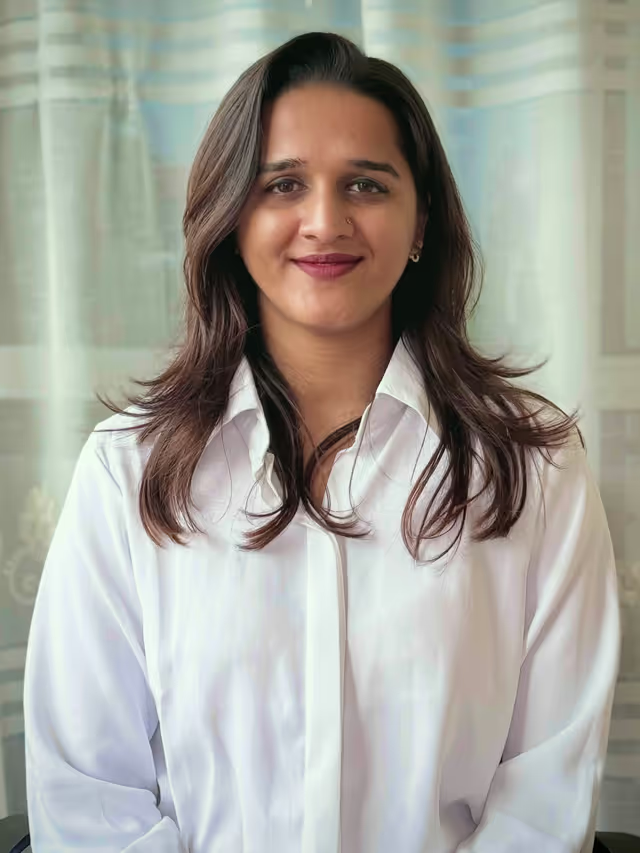
About Smriti Simkhada
Smriti Simkhada is a PTE Academic perfect scorer (90/90) providing structured PTE coaching for Nepali students. She has helped over 1,000 students prepare for Australia PR and Canada immigration through structured, criteria-aligned coaching.
