PTE Core vs Academic: Key Differences in Writing Formats

Smriti Simkhada
90/90 Perfect Scorer
Updated July 2026 · Reviewed by Smriti Simkhada (90/90)
PTE Core (for Canadian immigration) and PTE Academic (for Australian immigration and university admission) share one Writing task and differ on the other. The shared task — Summarise Written Text — appears in both tests, but with different word ranges and sentence rules. The differing task — Essay vs Email — requires fundamentally different writing styles, registers, and templates. Understanding which version of "PTE Writing" applies to your destination is essential before you commit weeks of preparation time. This guide is for Nepali students preparing for one or both pathways.
If you are targeting Canada PR, you need PTE Core is for Canada IRCC only; for Australia skilled migration use PTE Academic, AHPRA, AITSL, or a university, you need PTE Academic Writing. Some Nepali students prepare for both as a hedge — and that is a workable strategy if you understand exactly where the two diverge. The detailed PTE Core vs PTE Academic comparison for Canada PR covers test-level differences; this article focuses on Writing specifically.
Stuck below your target? The 79+ Sprint
Private 1-on-1 mentorship (Rs. 15,000) with Sydney/Melbourne/Toronto/Singapore/Doha-friendly slots — coach-until-target.
Quick Comparison Table
| Feature | PTE Academic Writing | PTE Core Writing |
|---|---|---|
| Shared task | Summarise Written Text (5-75 words, one sentence, zero if <5 or >75) | Summarise Written Text (25-50 words, one or more sentences, zero if <25 or >50) |
| Differing task | Essay (200-300 words, 20 minutes) | Write Email (80-120 words, 9 minutes) |
| Register | Formal academic argument | Formal or informal email based on prompt |
| Score scale | 10–90 communicative skill | 10–90 communicative skill (Pearson maps each score to a CLB level for IRCC reporting; CLB itself ranges 1–12) |
| Primary use case | Australia PR, AHPRA, university admission | Canada PR (Express Entry, PNP), citizenship |
| Audience addressed | Generic academic reader | Specific named recipient (manager, friend, etc.) |
| Tone | Objective, third-person preferred | Personal, second-person addressing recipient |
The Shared Task — Summarise Written Text
Summarise Written Text (SWT) appears in both tests but with different requirements. PTE Academic SWT: one sentence, 5-75 words (zero score if <5 or >75 words). PTE Core SWT: one or more sentences, 25-50 words (zero score if <25 or >50 words). The time limit (10 minutes) is the same, but the word range and sentence-count rules differ. The core reading-and-summarising skill transfers, but preparation must account for these differences.
The scoring on SWT contributes to both Reading and Writing in PTE Academic, and to the equivalent Reading and Writing CLB skills in PTE Core. The cross-module nature is preserved.
The Differing Task — Essay vs Email
PTE Academic Essay
You are given an academic prompt — usually an opinion question ("To what extent do you agree?"), a discussion question ("Discuss both views"), or a problem-solution question. You have 20 minutes to write 200-300 words. The flexible essay framework covers the structural template that handles all four common essay types.
Required structural elements:
- Introduction with topic background and clear thesis statement.
- Two body paragraphs with topic sentences, examples, and mini-conclusions.
- Conclusion that restates the thesis and provides a final implication.
- Connectors throughout (Furthermore, However, Conversely, Consequently).
- Formal register — third person preferred, no contractions, academic vocabulary.
PTE Core Write Email
You are given a real-world scenario — a complaint to a manager, a request to a colleague, an apology, a thank-you message, or an invitation. You have 9 minutes to write 80-120 words. The PTE Core email templates cover formal and informal email structures.
Required structural elements:
- Greeting matching the recipient's relationship (Dear Manager / Hi Sarah).
- Opening sentence stating the reason for writing.
- Body addressing every specific point from the prompt.
- Closing with a call to action or sign-off.
- Register matching the scenario — formal for managers/businesses, informal for friends/colleagues.
Why the Difference Matters for Preparation
Essay and Email are not interchangeable. A student who only practises essays will struggle with Write Email's register flexibility and shorter format. A student who only practises emails will struggle with academic essay structure, formal register, and the longer 200-300 word target. Both tasks require deliberate, format-specific practice.
The shared infrastructure is grammar, vocabulary, and Written Discourse — these enabling skills lift performance on both tasks. Common grammar mistakes matter equally for Essay and Email. Word-limit awareness applies to both, just with different ranges.
Scoring Differences You Should Know
PTE Academic Writing reports as a 10-90 communicative skill score. PTE Core Writing is also reported on the 10–90 scale, and Pearson publishes a CLB conversion table (CLB ranges 1–12) for IRCC reporting. The conversion is not linear, and a "high score" in one system is not directly comparable to the other.
For most Nepali Express Entry candidates, the target is CLB 9 in Writing — which corresponds to a strong, error-light email plus a clean SWT. PTE Core Writing for CLB 9 walks through the bar.
For most Nepali Australia PR candidates, the old flat 79+ benchmark no longer defines the Writing target — for tests taken on or after 7 August 2025, DHA scores each skill separately: Superior English (20 PR points) needs Writing 85, while Proficient (10 points) needs Writing 69. Either way, both the essay and SWT must be grammatically clean with strong content coverage.
If You Are Preparing for Both
The efficient sequence:
- Build SWT skill first — it transfers fully across both tests.
- Build grammar accuracy and Written Discourse — these transfer across both tasks.
- Choose your primary destination test and prepare its differing task fully (Essay or Email).
- Add format-specific practice for the second test only after the first is exam-ready.
Trying to alternate Essay and Email practice from day one usually slows progress on both. Build one to mastery, then transfer the foundation.
Common Mistakes Nepali Students Make
- Using essay register in Write Email — "It is incumbent upon the recipient to address the matter forthwith" sounds artificial in an email. Match the register.
- Using email register in the academic essay — "I think you should know that…" is too informal for the academic essay.
- Memorising rigid templates — Templates are scaffolds. Flexible templates work; rigid memorised content gets penalised.
- Skipping SWT because "it's the same" — Shared task type, but the word ranges differ (5-75 for PTE Academic, 25-50 for PTE Core) — equal preparation requirement. Do not assume your SWT is exam-ready without practice.
- Targeting CLB 9 on PTE Core with PTE Academic-style essays — Wrong test, wrong format. Verify which Pearson test your application requires.
"I had been preparing essays for three months thinking it was the same as PTE Core. The agent caught the mismatch — Canada PR needs Write Email, not Essay. Two extra weeks of email-specific practice fixed the gap." — Manisha B., Pokhara
"For Australia and Canada both, I built SWT first. The shared task gave me a foundation, then I added Essay for PTE Academic and Email for PTE Core." — Pawan K., Bharatpur
Results reflect individual student preparation experience. Scores depend on personal effort, starting ability, and test conditions. No specific outcome is highly likely.
Frequently Asked Questions
Can I practice the Essay for PTE Core too?
Essay practice improves grammar and vocabulary range — which helps PTE Core Writing scores indirectly. But you must also specifically practise Write Email for PTE Core, as the format and register are different.
Which Writing task is harder — Essay or Write Email?
Most students find Write Email more accessible because it is practical English, not academic argument. However, reaching CLB 9 in Writing requires a high Write Email score that demands strong content coverage and natural email language. "Easier to start" is not the same as "easier to score CLB 9 on."
Is SWT really identical between PTE Core and PTE Academic?
No — they are not identical. PTE Academic SWT: 5-75 words, must be a single sentence (zero score if <5 or >75). PTE Core SWT: 25-50 words, one or more sentences allowed (zero score if <25 or >50). The time limit (10 minutes) is the same. The word ranges and sentence rules differ — PTE Core candidates must target 25-50 words, not 5-75.
Does PTE Core have a separate Essay task hidden somewhere?
No. PTE Core Writing consists of Summarise Written Text and Write Email. There is no academic essay in PTE Core.
Plan Your PTE Writing Strategy
Whether you are preparing for PTE Core or PTE Academic, a clear destination-first plan saves weeks of misdirected practice. Book a free score assessment to map your goal to the right test, or join the next 15-day batch (Rs. 2,500) for structured Writing preparation across both formats.
Verify before booking: Pearson does not publish a fixed Nepal NPR price; the test fee shown here is approximate and converted from the local USD price at the booking time. Always confirm the current fee on the official Pearson PTE Core booking page in your Pearson account before payment.
Important: AHPRA does not accept PTE Core for nursing or any other regulated health profession in Australia. Use PTE Academic instead. Verify on AHPRA — English Language Skills Registration Standard.
Not for Australia: PTE Core is approved by IRCC for Canada only. Australia's Department of Home Affairs and AHPRA accept PTE Academic — not PTE Core — for skilled-migration visas (189 / 190 / 491 / 482 / 186) and professional registration. Verify on immi.homeaffairs.gov.au.
Always verify: IRCC scoring tables, CLB-to-PTE Core conversions and program-specific minimums can change. Confirm the latest values on the IRCC Express Entry language test page before submitting any application.
Last fact-checked on 2026-05-08 against official sources (Pearson PTE, Australia Department of Home Affairs, AHPRA, IRCC, GOV.UK, INZ). Test fees, score requirements, and visa rules can change at any time — always verify the latest details on the relevant official website before booking or applying.
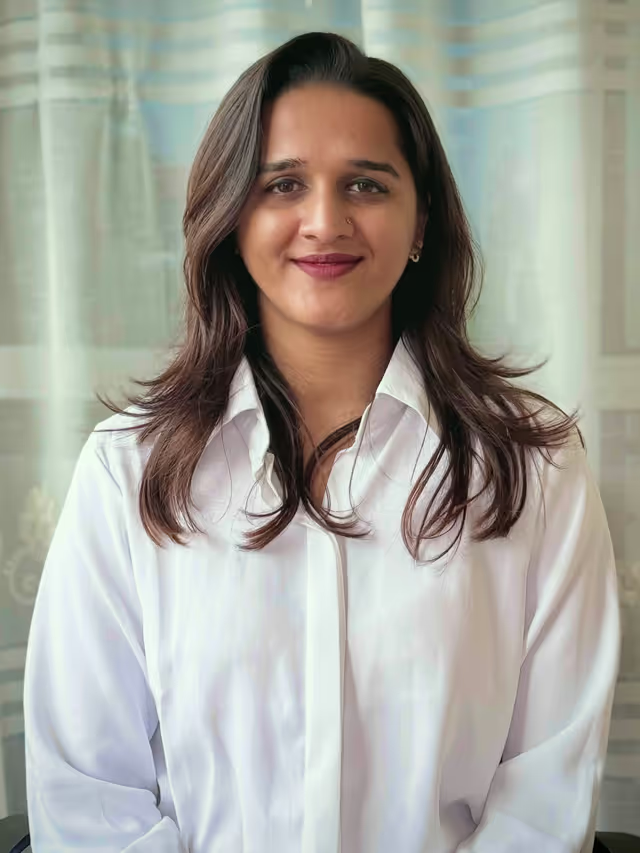
About Smriti Simkhada
Smriti is a PTE Academic perfect scorer (90/90) providing structured PTE coaching for Nepali students. She has helped over 1,000 students prepare for Australia PR and Canada immigration through structured, criteria-aligned coaching.
