PTE Trial 2026: Is There a Summer Trial or a New PTE Format? Wait vs Book
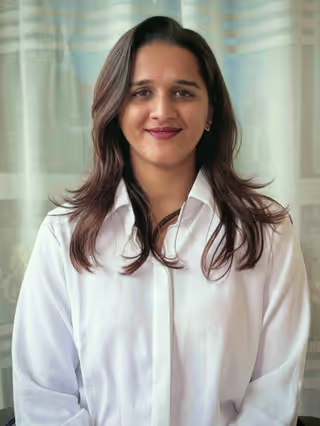
By Smriti Simkhada (90/90) · Updated
Short answer: The PTE Trial 2026 was a private Pearson research (R&D) study run in Spring, around April–May 2026, in Australia and India only — Nepal was never eligible. It used a selection of existing PTE Academic item types, issued no scores or score reports, and was not a new PTE format. As of July 2026, Pearson has announced no Summer 2026 trial, no second window, and no format change.
What this means for you: there is nothing to "wait for" — the current PTE Academic is still the test, and you can book it with confidence. Below: the exact facts straight from pearsonpte.com, plus a calm book-now-or-wait decision framework for Nepali and Australia-bound students.
Introduction
If you have been scrolling PTE groups lately, you have probably seen the panic: "Pearson is changing the PTE again," "the new PTE format is coming," "don't book until the new test launches." Most of that noise traces back to one thing — the PTE Trial 2026, a quiet research study Pearson ran in the spring. The problem is that almost none of the agent blogs spreading the alarm actually read Pearson's own pages about it.
We did. This article reports exactly what the PTE Trial 2026 was, straight from pearsonpte.com, and — just as important — what it does not mean. No fear-mongering, no invented "new format" leaks. If you are a Nepali student deciding whether to book your test now or wait for some rumoured overhaul, you will leave this page with a clear, calm decision framework instead of more anxiety.
Short version: a research trial is not a format change, and right now there is no announced new PTE. Let us walk through the facts so you can plan with confidence.
Stuck below your target? The 79+ Sprint
Private 1-on-1 coaching, from US$99: pick 7 days, 17 days or 1 month, one live session a day at a time that suits you, a demo session included, and Coach-Until-Target on the longer plans.
PTE Trial Summer 2026: Is There One? (Short Answer: Nothing Is Announced)
Because so many people are now searching for a "PTE Trial Summer 2026," here is the direct answer: as of 3 July 2026, Pearson has announced no Summer 2026 trial — no second window, no extension of the spring study. Recruitment for the Spring 2026 trial is closed, and the project wrapped up in June 2026, when the promised gift vouchers were sent to participants. Any blog or agent claiming a "summer trial" is running, or that a new PTE format is imminent because of one, is speculating.
What this means for you is simple: nothing is changing about the test you will sit, so book with confidence. The PTE Academic you schedule today in Kathmandu, Chitwan or Pokhara is the current, fully documented format. If Pearson ever announces another trial, it will appear on pearsonpte.com/news first — we track that page, so this article stays current.
What the PTE Trial Spring 2026 Actually Was
The PTE Trial Spring 2026 was a research and development study run by Pearson — not a relaunch of the test you book for your visa or university application. According to Pearson's own trial pages and FAQ (see pearsonpte.com/pte-trial-spring-2026 and the matching FAQ page), here is what it involved.
The verified parameters
- When: Pearson describes the testing window as running "between April and May 2026," with the wider project ending in June.
- Where: Only in Australia and India. Pearson states participants had to live in, and access a test center in, "either Australia or India." Nepal was not a trial location.
- How long: Pearson's FAQ says the trial test took "a maximum of 1 hour and 50 minutes," and the main trial page describes it as "approximately 2 hours" — so, roughly two hours, shorter than a full live PTE Academic.
- No scores: This is the key point. Pearson is explicit that "you will not receive a PTE score or a Score Report" and the result "cannot be used for any purpose outside of this study."
- Why: Pearson states the trial was "for internal Pearson research and development purposes" — specifically to "gather authentic test taker responses for certain PTE Academic items, in particular speaking and writing items."
- The incentive: Participants were offered "a gift voucher worth the equivalent of $100 USD in your local currency," paid "when the project ends, in June," capped at a maximum of two vouchers per person.
Read those parameters again. A two-hour sitting that issues no score, in two countries Nepal is not part of, with a voucher paid after the project closes, explicitly labelled R&D. That is a controlled experiment to collect real responses on existing item types — not a public launch of a redesigned exam.
What the PTE Trial 2026 Does NOT Mean
Here is where so many competitor posts go wrong. They take "Pearson ran a trial" and leap to "the PTE is changing again, book before it is too late." Let us kill that speculation with what the official pages actually say.
It is not a new announced format
Pearson does not announce any new PTE format anywhere on the trial pages. In fact, the main trial page says the trial test "includes a selection of items that appear in the PTE Academic test." In other words, it used existing question types — the same Read Aloud, Repeat Sentence, Summarize Written Text and essay-style tasks you already prepare for — to gather research data. There is no leaked new task type, no confirmed scoring change, no new test you can book today.
It does not affect your scheduled test
If you book a real PTE Academic at a Kathmandu, Chitwan or Pokhara test center next week, you sit the current, published format and you get a real, valid score report. The trial issued no scores and could not be used for visa, university or AHPRA purposes. So the trial changes nothing about the test you will actually take or the score you will actually use.
"Is PTE changing again?" — the honest answer
The honest answer for mid-2026 is: not based on this trial. Pearson runs research studies regularly to keep its item bank fresh and fair — that is normal quality control for any major exam, including IELTS. A research study is how a test stays reliable, not a signal that the rules are about to flip. If and when Pearson formally announces a change, it publishes it clearly with a lead time, exactly as it did with the updates that already rolled out in 2025-26 (more on those below). A quiet R&D trial in two countries is not that announcement.
The Signals Worth Watching (Analysis, Not Fact)
So is there anything worth watching? Yes — but be careful to separate verified facts from reasonable analysis. The following is our interpretation, clearly labelled as such, not a Pearson statement.
In Pearson's Q1 2026 Trading Update, the company said its English Language Learning sales "increased 2%, driven by Institutional," while "Pearson Test of English (PTE) declined slightly due to a continued tough market backdrop." For the year ahead, Pearson's stated outlook is "higher growth than 2025 driven by market share gains and pricing, with PTE returning to growth" (Pearson Q1 2026 Trading Update, see plc.pearson.com).
That word "pricing" is the one prep agencies should read carefully. Our analysis — and only an analysis — is that "growth driven by pricing" can be a polite way of describing a fee increase somewhere in the product line over time. Prices do change from time to time, which is why we quote Pearson's own current listing rather than older figures. We are not predicting the next increase or quoting any unannounced price. We are simply flagging that the company's own investor language points toward pricing as a growth lever, which is worth keeping an eye on rather than ignoring.
For context, Pearson's listed Nepal price for PTE Academic is USD 248.60. Your bank converts the dollar charge to rupees at its own rate, so always confirm the live figure on pearsonpte.com before you pay. If pricing is genuinely a future lever for Pearson, the practical takeaway is simple: the cost of waiting is unlikely to fall, and may rise. That alone tilts the decision toward acting on a clear plan rather than stalling for a rumour.
Wait vs Book Now: A Decision Framework
Strip away the noise and your decision comes down to a few honest questions. Here is a framework you can actually use.
Book now if any of these are true
- You have a real deadline — a visa lodgement, a university intake, an AHPRA or skills-assessment window, or a points cut-off you are chasing.
- You are already studying and improving; momentum is worth more than a hypothetical future test.
- You want certainty. The current format is fully documented, every task type is known, and there is no announced change to wait for.
You might consider waiting only if
- You have no deadline at all and were not planning to test for many months anyway — in which case you are not really "waiting for the new PTE," you are just not ready yet, which is fine.
- Pearson formally announces a confirmed format change with a published transition date. As of mid-2026, that has not happened.
Notice that "wait for the trial results" is not on either list. The trial gives you nothing to wait for — no public output, no new bookable test, no date. Every month you wait, you are studying for a format that might change instead of locking in your score under the rules that exist today. That is the opposite of strategic.
What Already Changed in 2025-26 (Briefly)
To be clear, the PTE has had real, announced updates recently — and those are the ones that actually matter, not the trial. Rather than restate them here, we have covered each one in depth so you can prepare against the current rules.
For the full picture, read our PTE Academic changes 2026 overview and the specifics in our March 2026 content and format update for Nepal. Those two articles tell you what genuinely changed and how to adapt — the PTE Trial 2026 does not add to that list.
Common Mistakes to Avoid
- Treating the trial as a format announcement. It is an R&D study with no scores and no new test. Do not delay your plan because of it.
- Believing agent-blog "leaks." If a post claims to know the "new PTE format" from the trial, it is speculation. Pearson announced no new format.
- Waiting indefinitely "until things settle." The current format is stable and fully documented. Endless waiting just delays your visa or university timeline.
- Assuming the trial helps your score. It issued no score report and cannot be used for any official purpose. Only a real, booked PTE Academic counts.
- Ignoring the pricing signal entirely. The flip side of not panicking is not being complacent — costs are more likely to rise than fall, so a clear timeline beats drift.
- Confusing score-report access with validity. Your PTE score is generally valid for two years from your test date (see pearsonpte.com) — that is unaffected by any trial.
Step-by-Step: How to Decide and Book
- Write down your real deadline. Visa lodgement date, university intake, or skills-assessment cut-off. If you have one, the decision is essentially made — prepare and book.
- Check the live facts yourself. Open pearsonpte.com and confirm the current PTE Academic format, the Nepal test-center fee, and that no new format is announced. Do not rely on screenshots in WhatsApp groups.
- Set your target score. Decide the exact score you need. For Australian PR points (effective 7 August 2025): Superior English (20 points) requires L69/R70/W85/S88; Proficient English (10 points) requires L58/R59/W69/S76. The old flat "79 each band" threshold was superseded by these component-specific bands — confirm current requirements at pearsonpte.com or immi.homeaffairs.gov.au. Working backward from a number keeps you focused.
- Pick your test date with buffer. Choose a date that leaves room for one retake before your deadline. Read our guide on how to book PTE Academic in Nepal in 2026 for the step-by-step booking flow and centres.
- Build a fixed prep plan. Map your weeks against your weakest skills — usually fluency and pronunciation for Nepali speakers, and templates for Summarize and essay tasks.
- Book and commit. Once the date is set, stop refreshing news about hypothetical formats and put that energy into practice under the known rules.
Tips for Nepali Students
Whether you are studying from Kathmandu, Bharatpur or Pokhara, or already abroad in Sydney, Melbourne, Toronto or Doha, the PTE Trial 2026 changes nothing about how you should prepare. Focus on what is real.
- Nepal was not a trial location — the study ran only in Australia and India, so nothing about your local booking experience changed. Test centers in Kathmandu, Chitwan and the rest of Nepal operate on the current format.
- Prioritise pronunciation and oral fluency. The Nepali accent most often costs marks on Read Aloud and Repeat Sentence through hesitation and intonation, not vocabulary. Steady pacing beats speed.
- Budget for the current fee, not a rumoured one. Plan around USD 248.60, Pearson's listed Nepal price, and confirm the exact figure on pearsonpte.com before paying.
- For the diaspora, use your time-zone reality. If you are working shifts in Australia or the Gulf, build prep around your real schedule rather than waiting for a "better time" that never comes.
- Verify any "PTE changing" claim at the source. One look at pearsonpte.com beats ten alarmed forum posts. Calm, source-checked planning is itself a competitive advantage.
Frequently Asked Questions
Q: Was the PTE Trial 2026 a new PTE format?
A: No. The PTE Trial 2026 was an internal Pearson research and development study, not a format launch. Pearson's own pages say it used "a selection of items that appear in the PTE Academic test" — existing question types — and announced no new format. The test you book today is the current, published PTE Academic.
Q: Could I take the PTE Trial 2026 from Nepal?
A: No. Pearson limited the trial to people living in, and able to access a test center in, Australia or India. Nepal was not a trial location. The study has also closed to new applications, and it ran roughly April to May 2026 with the project ending in June.
Q: Did the trial give a usable score?
A: No. Pearson states clearly that participants "will not receive a PTE score or a Score Report," and the result "cannot be used for any purpose outside of this study." Only a real, booked PTE Academic produces a valid score you can use for a visa, university or AHPRA.
Q: Should I wait to book until the "new PTE" arrives?
A: There is no announced new PTE to wait for as of mid-2026. Waiting just delays your timeline and means studying for a format that may never change. If you have any real deadline, book now and prepare under the current, fully documented rules.
Q: Is the PTE fee in Nepal going up because of the trial?
A: There is no announced fee change tied to the trial. Pearson's Q1 2026 investor language did mention "pricing" as a future growth lever, but nothing Pearson published about the trial links it to a price change. Pearson's listed Nepal price for PTE Academic is USD 248.60 — always confirm the live figure on pearsonpte.com before paying.
Q: How is the PTE Trial 2026 different from the real PTE Academic?
A: The trial was around two hours, issued no score, ran only in Australia and India, and existed purely for research. The real PTE Academic is the full, scored exam you book at a Nepal test center, with a result valid generally for two years from your test date.
Conclusion
The PTE Trial 2026 is a textbook example of how a quiet, ordinary research study gets inflated into panic online. The verified facts are calm and clear: it was a two-hour, no-score Pearson R&D study run only in Australia and India in spring 2026, using existing question types, with no new PTE format announced. It does not change the test you will sit, the score you will use, or your timeline. The only signal genuinely worth watching is Pearson's own talk of "pricing" as a growth lever — which, if anything, argues for acting sooner rather than later, since the cost of waiting is unlikely to drop.
That is exactly why the smartest move during all this noise is to prepare under the rules that exist today. Every month you wait, you risk studying for a format that may change — book now, lock in known rules, and put your energy into a real score. If you want a plan built around your deadline and your time zone, our 1-on-1 PTE mentorship gives you a personalised roadmap, accent-focused speaking practice, and flexible slots that fit whether you are in Bharatpur or already on a shift in Sydney. Skip the rumours. Book your prep, target your score, and let us get you there.
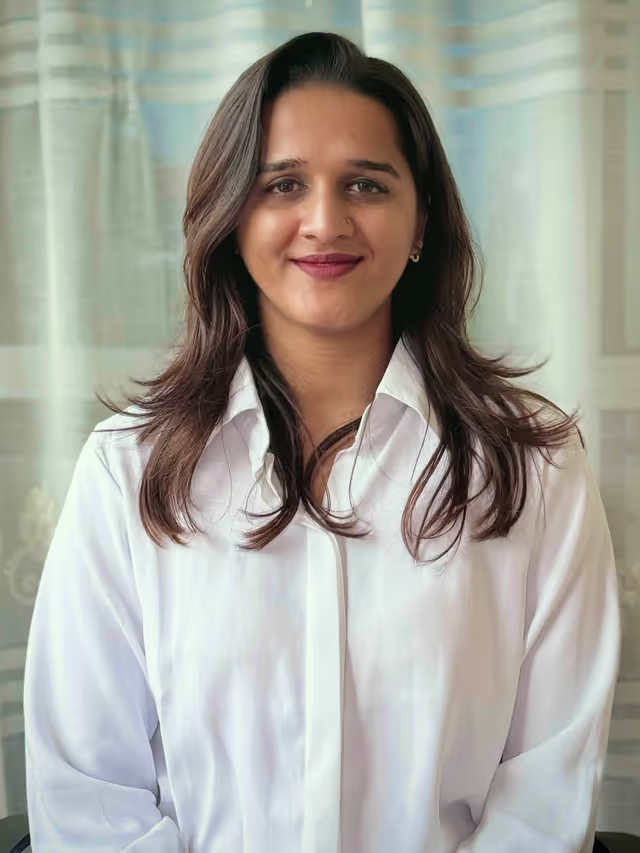
About Smriti Simkhada
Smriti Simkhada is a PTE Academic perfect scorer (90/90) providing structured PTE coaching for Nepali students. She and her team have helped 1,500+ students prepare for Australia PR and Canada immigration through structured, criteria-aligned coaching.