PTE Core Personal Introduction: Template and Tips for High Scores 2026
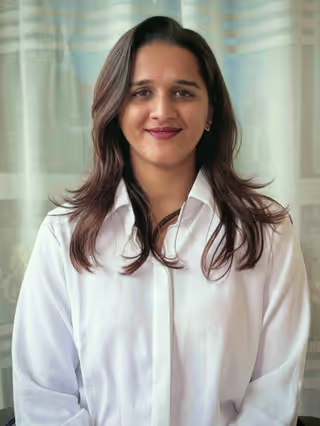
By Smriti Simkhada (90/90) · Updated
Introduction
Whether you're taking PTE Core for Canada PR or PTE Academic for Australia / university admissions, the Personal Introduction is your very first chance to impress the AI scoring system. This task (25 seconds to prepare, 30 seconds to record) doesn't count toward your score in either test, but it sets the tone for your entire Speaking section and helps the AI calibrate to your voice.
Many Nepali students make critical mistakes here that affect their speaking fluency and confidence throughout the rest of the test. In this comprehensive guide, you'll learn the exact Personal Introduction format that works for both tests, along with timing strategies and common mistakes to avoid.
Whether you're targeting CLB 10+ for maximum Express Entry CRS points (CLB 9 is strong but CLB 10+ yields the top 34 pts/skill for single applicants) or CLB 7 for basic eligibility, mastering your personal introduction is the foundation of a strong PTE Core speaking performance.
Stuck below your target? The 79+ Sprint
Private 1-on-1 coaching, from US$99: pick 7 days, 17 days or 1 month, one live session a day at a time that suits you, a demo session included, and Coach-Until-Target on the longer plans.
What is the Personal Introduction Task?
The Personal Introduction is the first task in both PTE Core AND PTE Academic. It is unscored in both tests but is recorded and sent to the institutions and immigration authorities that receive your score report. Here's how it works:
- Timing: 30 seconds to record after 25 seconds preparation
- Recording: Automatically recorded and sent to institutions you apply to
- Scoring: Not scored—doesn't affect your PTE Core or CLB score
- Purpose: Voice calibration for the AI system and introduction for institutions
- Position: First task in the Speaking & Writing section
While this task doesn't count toward your score, it's crucial for two reasons: (1) it helps the AI scoring engine get familiar with your accent, speaking speed, and pronunciation patterns, and (2) universities and immigration officers may listen to this when reviewing your application. Learn more about PTE Core format on the official Pearson website.
How the Personal Introduction Fits Into Both Tests
The Personal Introduction is the very first thing you do in both PTE Core and PTE Academic — before any scored task. Think of it as your audio resume: institutions and immigration officers (IRCC for PTE Core, universities and DHA for PTE Academic) may listen to it to verify your identity and get a sense of your communication style.
For Nepali students with strong accents or those nervous about speaking, this is your chance to settle your nerves and get comfortable with the microphone before the scored tasks begin. The advice in this guide applies whether you are taking PTE Core for Canada PR or PTE Academic for Australia / university admissions.
The Proven Personal Introduction Template
After analyzing hundreds of successful PTE Core test-takers, here's the template that consistently works:
Standard Template (25-28 seconds)
"Good morning/afternoon. My name is [Your Full Name]. I am from [City], Nepal. I am taking PTE Core for [Purpose: Canada PR / study / immigration]. My goal is to [Specific Goal: achieve CLB 9 / pursue graduate studies / immigrate to Canada]. I am confident I will succeed. Thank you."
Template Breakdown by Section
- Greeting (2 seconds): "Good morning" or "Good afternoon"—match the actual time of day
- Name (3 seconds): Clearly state your full name as per passport
- Origin (3 seconds): "I am from Kathmandu, Nepal" (replace with your city)
- Purpose (5 seconds): Why you're taking the test (Canada PR is most common for PTE Core)
- Goal (5 seconds): What you hope to achieve (CLB 9, permanent residency)
- Confidence (3 seconds): Brief positive statement
- Closing (2 seconds): "Thank you"
Example 1: Canada Express Entry Applicant
"Good afternoon. My name is Rajesh Kumar Sharma. I am from Kathmandu, Nepal. I am taking PTE Core for Canada Express Entry. My goal is to achieve CLB 10 in all sections for maximum CRS points. I am confident in my preparation. Thank you."
Example 2: Immigration Applicant
"Good morning. My name is Priya Thapa. I am from Pokhara, Nepal. I am taking PTE Core for Canadian permanent residency. My goal is to successfully immigrate to Canada through Express Entry. I am excited about this opportunity. Thank you."
Example 3: Family Immigration
"Good afternoon. My name is Sanjay Gurung. I am from Bharatpur, Nepal. I am taking PTE Core for family class immigration to Canada. My goal is to reunite with my spouse in Toronto. I have prepared thoroughly for this test. Thank you."
Note: PTE Core is designed for Canadian permanent residency, economic immigration, and citizenship applications. If you're applying for study permits or university admissions in Canada, check PTE Academic requirements as most institutions require PTE Academic for study applications.
Step-by-Step Delivery Strategy
Before You Start Speaking
- Position your microphone correctly: 2-3 fingers away from your mouth, slightly to the side
- Take a deep breath: Calm your nerves during the 25-second preparation time
- Mentally rehearse your template: Visualize saying each section clearly
- Adjust volume: Speak at normal conversation volume (not too loud or soft)
- Smile before speaking: This naturally improves your tone and clarity
During Recording (30 Seconds)
- Start immediately when recording begins: Don't waste the first 2-3 seconds
- Speak clearly and steadily: Not too fast (anxiety trap for Nepali speakers) or too slow
- Maintain consistent volume: Don't trail off at the end of sentences
- Pronounce your name clearly: This is crucial for identity verification
- Fill the 30 seconds: Use the full time—don't finish at 15 seconds
- End with "Thank you": Provides a clean conclusion
Pacing and Timing
The most common mistake Nepali students make is speaking too fast due to nervousness. Here's the ideal pacing:
- Words per minute: 140-160 WPM (conversational pace)
- Total words: 70-80 words fills the 30-second recording window at natural pacing (140-160 WPM)
- Pause strategy: Brief natural pauses after each section (name, origin, purpose, goal)
- No long silences: Avoid gaps longer than 1 second
Common Mistakes to Avoid
Mistake 1: Speaking Too Fast
Nepali students often rush through the introduction due to test anxiety. Speaking at 180+ WPM makes you sound nervous and reduces clarity. The AI system needs time to process your accent.
Solution: Practice with a timer. Record yourself and count words. Aim for 70-80 words in 30 seconds.
Mistake 2: Finishing Too Early
Completing your introduction in 15-18 seconds leaves awkward silence. This wastes the calibration opportunity for the AI system.
Solution: Add a specific goal statement and confidence phrase to fill the full 30 seconds naturally.
Mistake 3: Unclear Name Pronunciation
Mumbling your name or speaking too quickly through it creates identity verification issues. Immigration officers may listen to this recording.
Solution: Say your full name as per passport clearly, with slight pauses between first, middle, and last names.
Mistake 4: Using Complex Vocabulary
Trying to impress with difficult words often backfires with pronunciation errors. This task is about clarity, not vocabulary.
Solution: Keep it simple and natural. Use the template provided—it's proven to work.
Mistake 5: Wrong Microphone Position
Microphone too close creates "popping" sounds on P, T, K sounds. Too far reduces volume and clarity.
Solution: Position microphone 2-3 fingers (about 5cm) from your mouth, slightly angled to the side.
Mistake 6: Reading from Paper
Some test centers have reported students trying to read from notes. This is against test rules and sounds unnatural.
Solution: Memorize your template thoroughly. Practice until it's conversational, not rehearsed.
Mistake 7: Starting Late
Waiting 3-5 seconds after recording starts wastes valuable time and creates a hesitant impression.
Solution: Begin speaking immediately when you see "Recording" status. Use "Good morning/afternoon" as your opening to get started smoothly.
Practice Method for Nepali Students
Week 1: Template Customization
- Write your personal introduction using the template above
- Customize with your actual name, city, and purpose
- Count words—aim for 70-80 words total
- Read it aloud 20 times to memorize
Week 2: Timed Practice
- Set a 30-second timer on your phone
- Record yourself speaking the introduction
- Listen back and check:
- Did you fill the full 30 seconds?
- Was your name clearly pronounced?
- Was the pacing natural (not too fast)?
- Were there awkward pauses?
- Repeat 5 times daily
Week 3: Accent Refinement
- Record your introduction
- Compare with native English speaker samples (YouTube: search "PTE Core personal introduction")
- Focus on problem sounds for Nepali speakers:
- V vs W (very/worry)
- TH sounds (thank you)
- Final consonants (t, d, k)
- Practice these specific sounds in isolation
- Re-record with improvements
Week 4: Confidence Building
- Practice in test-like conditions:
- Sit at a desk with computer
- Use headset with microphone
- Set 25 seconds preparation + 30 seconds recording
- Do 3 full mock recordings daily
- Practice at different times of day (morning and afternoon greetings)
- Get comfortable with starting immediately when recording begins
Tips Specifically for Nepali Students
Addressing Accent Concerns
Many Nepali students worry about their accent affecting the Personal Introduction. Here's the truth: the PTE Core AI system is trained on diverse accents including South Asian English. Your Nepali accent will not hurt you IF you speak clearly and at the right pace.
Focus areas for Nepali speakers:
- V and W distinction: Practice "I will succeed" (not "I vill succeed")
- TH sounds: "Thank you" should have clear TH, not "tank you"
- R sounds: Avoid heavy rolling R—use soft English R
- Sentence stress: Stress important words: "My GOAL is to achieve CLB 9"
Managing Test Day Nerves
PTE Core test centers in Nepal can be busy environments. Here's how to stay calm:
- Arrive 30 minutes early: Familiarize yourself with the test center environment
- Visit the bathroom before starting: Avoid mid-test discomfort
- Use the 25-second preparation time: Take one deep breath and visualize success
- Remember it's not scored: This takes pressure off—it's just a warm-up
- Focus on clarity over perfection: A clear, simple introduction beats a complex but unclear one
Note: Test center availability and locations change regularly. Verify current PTE Core test centers in Nepal through the official Pearson test center finder before booking.
Internet Issues (For Online PTE Core)
If taking PTE Core from home in Nepal, internet stability is crucial:
- Use wired connection: Ethernet cable is more stable than Wi-Fi
- Test beforehand: Do full mock tests online to check bandwidth
- Close other apps: Shut down Viber, Facebook, YouTube to save bandwidth
- Backup connection: Have a mobile hotspot ready as backup
Time Zone and Test Scheduling
Choose your test time strategically:
- Morning tests (8-10 AM): Say "Good morning"—you're fresh and alert
- Afternoon tests (12-5 PM): Say "Good afternoon"—test centers are usually quieter
- Avoid evening tests: You may be tired after work/study
How Personal Introduction Helps Your Speaking Score
While not scored itself, the Personal Introduction affects your scored Speaking tasks in three key ways:
1. AI Voice Calibration
The PTE Core AI system uses your Personal Introduction to:
- Learn your voice characteristics (pitch, tone, accent)
- Calibrate pronunciation expectations
- Set baseline for fluency detection
- Adjust for background noise levels
A clear, confident Personal Introduction helps the AI accurately score your subsequent Speaking tasks. If you mumble or rush through it, the AI may struggle to process your accent in Read Aloud and Repeat Sentence. Learn more about PTE Core scoring.
2. Psychological Confidence Boost
Nailing your Personal Introduction creates momentum:
- Reduces anxiety: Successfully completing the first task calms nerves
- Builds rhythm: Establishes good speaking pace for scored tasks
- Microphone comfort: You're now familiar with how you sound in the headset
Many Nepali students report that a strong Personal Introduction made them feel "in the zone" for the rest of the Speaking section.
3. Institutional Review
Universities and IRCC officers may listen to your Personal Introduction when:
- Reviewing your permanent residency application
- Assessing Express Entry profile
- Verifying test authenticity
- Making immigration decisions
A professional, clear introduction reinforces that you're a serious candidate who prepared thoroughly. For current Canadian immigration requirements, check IRCC's official language requirements page.
Frequently Asked Questions
Q: Does Personal Introduction count toward my CLB score?
A: No, the Personal Introduction is not scored and does not affect your PTE Core or CLB scores. However, it's sent to institutions you apply to and helps the AI calibrate to your voice.
Q: What happens if I make a mistake in my Personal Introduction?
A: Small mistakes (like stumbling over a word) won't hurt you since it's not scored. However, try to complete it smoothly as it affects your confidence and AI calibration for scored tasks.
Q: Should I memorize a script or speak naturally?
A: Memorize the template structure, but deliver it naturally and conversationally. It should sound like you're introducing yourself to a person, not reciting from memory.
Q: Can I use different wording than the template?
A: Yes, you can customize the template to your situation. Just ensure you: (1) use the full 30-second recording window, (2) clearly state your name and origin, (3) mention why you're taking PTE Core, and (4) end professionally.
Q: What if English is not my first language—will my Nepali accent hurt me?
A: No, the PTE Core AI is trained on diverse accents including South Asian English. Focus on clarity and pacing, not eliminating your accent. Many Nepali students achieve CLB 9+ with their natural accent.
Q: Should I say "Good morning" or "Good afternoon" or "Good evening"?
A: Match the actual time of day at your test center. Before 12 PM = "Good morning." After 12 PM = "Good afternoon." Most PTE Core tests don't run late enough for "Good evening."
Q: How many times should I practice my Personal Introduction?
A: Practice until you can deliver it smoothly without thinking—typically 50-100 repetitions over 3-4 weeks. It should feel natural, like introducing yourself at a job interview.
Q: What if I finish speaking before 30 seconds are up?
A: Expand your template with an additional sentence about your goals or background. Avoid awkward silence—use the full 30-second recording window to help the AI calibrate to your voice.
Q: Can test centers or administrators hear my Personal Introduction during the test?
A: No, administrators cannot hear you during the test (unless there's a technical issue requiring assistance). Your recording is only sent to Pearson and any institutions you apply to.
Q: Is Personal Introduction the same in PTE Academic and PTE Core?
A: Yes — the Personal Introduction is the first task in both PTE Academic AND PTE Core. It is unscored in both tests, has the same 30-second response window after 25 seconds of preparation, and is sent to receiving institutions in both. The format and templates in this guide work for both tests. PTE Core is used for Canadian permanent residency and economic immigration; PTE Academic is used for university admissions and Australian immigration / study applications.
Conclusion
The PTE Core Personal Introduction may not be scored, but it's your foundation for a successful Speaking section. By using the commonly used format, practicing your delivery timing, and speaking clearly and confidently, you'll set yourself up for success in the scored tasks that follow.
For Nepali students targeting Canada PR, this is your first impression on both the AI scoring system and the immigration officers who may review your application. Make it count.
Key takeaways:
- Use the 70-80 word template to fill the full 30-second recording window
- Speak at 140-160 words per minute—not too fast
- Clearly pronounce your full name as per passport
- Practice 50-100 times until it's natural
- Focus on clarity and confidence, not perfection
- PTE Core is for Canadian PR/immigration—use PTE Academic for study applications
Ready to master your entire PTE Core test? Our expert coaching at PTE Nepal specializes in helping Nepali students achieve CLB 9+ for Canada Express Entry. With personalized feedback on your speaking tasks, proven templates for every section, and strategies designed for Nepali accent challenges, we've helped hundreds of students secure their Canada PR dreams.
Contact us on WhatsApp at +977 982-523-5082 to book your one-on-one coaching session today.
Continue Your PTE Preparation
Related guides for Nepali students preparing for PTE Academic and PTE Core:
- PTE score requirements guide
- PTE Core complete guide for Nepal
- PTE Core to CLB conversion
- PTE Core vs PTE Academic for Canada PR
- PTE Core vs CELPIP
- PTE Core vs PTE Academic differences
Not for Australia: PTE Core is approved by IRCC for Canada only. Australia's Department of Home Affairs and AHPRA accept PTE Academic — not PTE Core — for skilled-migration visas (189 / 190 / 491 / 482 / 186) and professional registration. Verify on immi.homeaffairs.gov.au.
Always verify: IRCC scoring tables, CLB-to-PTE Core conversions and program-specific minimums can change. Confirm the latest values on the IRCC Express Entry language test page before submitting any application.
Last fact-checked on 2026-05-08 against official sources (Pearson PTE, Australia Department of Home Affairs, AHPRA, IRCC, GOV.UK, INZ). Test fees, score requirements, and visa rules can change at any time — always verify the latest details on the relevant official website before booking or applying.
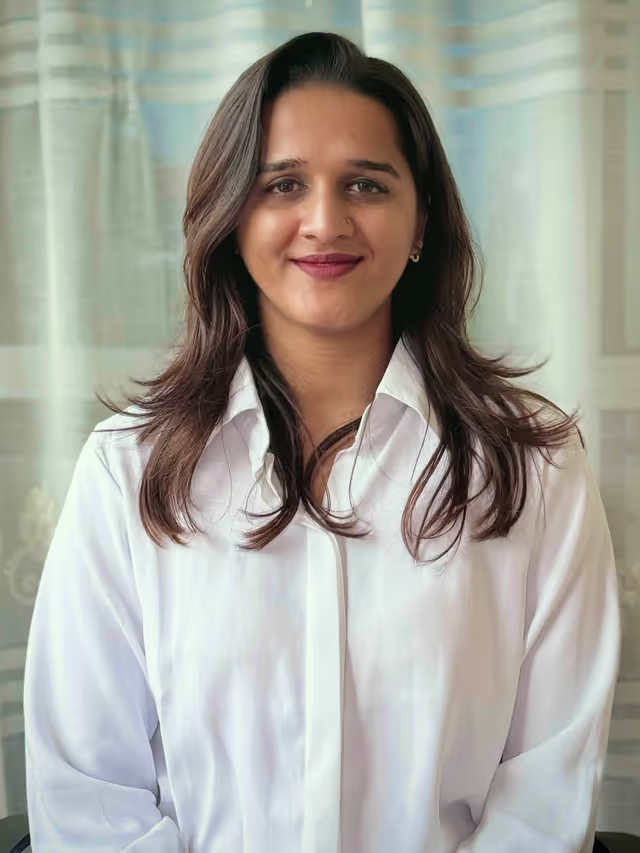
About Smriti Simkhada
Smriti Simkhada is a PTE Academic perfect scorer (90/90) providing structured PTE coaching for Nepali students. She and her team have helped 1,500+ students prepare for Australia PR and Canada immigration through structured, criteria-aligned coaching.