PTE Score for Australian University Admission: 2026 Guide for Nepali Students
By Smriti Simkhada (90/90) · Updated
Introduction
If you are a Nepali student planning to study in Australia, one question decides everything else: what PTE score for Australian university admission do you actually need? PTE Academic is accepted by every Australian university and by the Department of Home Affairs for the student visa, so it is the most practical English test to sit from Nepal. But there is no single magic number — the PTE score an Australian university asks for depends on the university, the course, and whether you are applying for an undergraduate or postgraduate program.
This guide clears up the confusion. You will learn the typical PTE score bands Australian universities expect, how to convert any university's stated IELTS requirement into a PTE Academic score using Pearson's official table, and why the university's English requirement is a separate thing from the student visa English requirement. Every number here is checked against official sources.
Stuck below your target? The 79+ Sprint
Private 1-on-1 coaching, from US$99: pick 7 days, 17 days or 1 month, one live session a day at a time that suits you, a demo session included, and Coach-Until-Target on the longer plans.
What PTE Score Do Australian Universities Require?
Australian universities set their own English entry requirements, and most still publish them in IELTS bands while also accepting PTE Academic. As a rough map, the PTE score for Australian university admission tends to fall into these tiers:
- Undergraduate (Bachelor) programs — usually the entry level, commonly around an IELTS 6.0–6.5 equivalent.
- Postgraduate (Master's) coursework — typically a step higher, often IELTS 6.5.
- Competitive and professional courses — nursing, teaching, law, medicine, social work and some Master's programs demand more, frequently IELTS 7.0 or higher, sometimes with a minimum in each skill.
Because each university and faculty publishes its own figure, the only safe rule is this: find your exact course page on the university's official website and read the English requirement there. Then convert it to a PTE target using the official concordance below.
Convert Your University's IELTS Requirement to PTE
Pearson publishes an official concordance that maps each IELTS Academic overall band to the equivalent PTE Academic score. If your course lists an IELTS requirement, use this to set your PTE goal:
- IELTS 5.5 → PTE 39
- IELTS 6.0 → PTE 47
- IELTS 6.5 → PTE 55
- IELTS 7.0 → PTE 63
- IELTS 7.5 → PTE 71
- IELTS 8.0 → PTE 79
So if your Master's course asks for IELTS 6.5 overall, you are aiming for roughly PTE 55 overall; a course wanting IELTS 7.0 maps to about PTE 63. Remember that a concordance is a comparison tool, not an acceptance guarantee — the university decides which score it accepts, so always confirm that it takes PTE Academic and check any per-skill minimums it lists.
University English Requirement vs Student Visa Requirement
This is where many Nepali applicants get caught out. There are two separate English hurdles for studying in Australia:
1. The University's Academic Requirement
This is the score your university needs before it will issue a Confirmation of Enrolment (CoE). It is usually the higher of the two hurdles and is set by the institution, as described above.
2. The Student Visa (Subclass 500) Requirement
Separately, the Department of Home Affairs sets an English floor for the student visa. For higher education, the PTE Academic visa floor is 47 overall for tests taken on or after 7 August 2025 (an older test still within its two-year validity is assessed at 50), and there is no per-skill minimum at the visa level. In practice, if you already meet your university's higher academic requirement and hold a CoE, you will normally clear the visa floor comfortably. You should still be aware of the other subclass 500 obligations:
- Genuine Student (GS) requirement — since 23 March 2024 the student visa uses the Genuine Student requirement (it replaced the former Genuine Temporary Entrant test). Your application must show you are a genuine applicant whose primary purpose is to study.
- Financial capacity — you must show funds for living costs. For a single student the benchmark is AUD 29,710 per year, on top of course fees and travel.
- Visa application charge — from 1 July 2026 the base student visa fee is AUD 2,500 (it was AUD 2,000 before that date).
If your goal after graduating is permanent residency, it is worth understanding the points system early — our guide to the PTE score for Australia PR points explains how a higher PTE score can add up to 20 points later.
How Australian Universities Use PTE Academic
PTE Academic is a fully computer-based test, so your Speaking answers are scored by Pearson's automated system rather than a human examiner — a genuine advantage for many Nepali students who worry about accent bias in a face-to-face interview. A few things to know:
- Results are fast — typically available within a couple of days, which helps when application deadlines are tight.
- Your score is valid for two years from your test date, so plan your sitting so the score is still valid when you enrol.
- Both admission and visa can run off the same PTE Academic result, so you usually do not need a second English test.
For fully funded study, note that scholarships publish their own minimums — for example, the Masters-level Australia Awards for Nepal require PTE 58 overall with at least 50 in each skill for the 2027 intake. Always cite the scholarship's own page, not a generic figure.
Common Mistakes to Avoid
- Assuming one score fits every university — the PTE score for Australian university admission varies by course; a Bachelor of Arts and a Master of Nursing at the same university can require very different scores.
- Confusing the visa floor with the admission score — the subclass 500 floor (PTE 47) is at or below what most universities ask, so you must meet the higher of the two; do not aim for the visa floor and expect an offer.
- Ignoring per-skill minimums — some courses require a minimum in each of the four skills, so a strong overall score with one weak section can still fail.
- Using outdated conversion tables — old pre-2025 charts give different PTE numbers; use the current official concordance above.
- Letting the score expire — a PTE result older than two years will not be accepted at enrolment.
Step-by-Step: From PTE Target to Offer Letter
- Shortlist your courses and open each one's official admissions page.
- Note the English requirement (usually an IELTS band, sometimes a direct PTE score) and any per-skill minimums.
- Convert it to a PTE target using the official concordance, and set your goal at or slightly above that number to leave a safety margin.
- Prepare and sit PTE Academic at a test centre in Nepal, timing it so the result stays valid through enrolment.
- Submit your application with the PTE score, obtain your CoE, then lodge the subclass 500 student visa with your GS statement and financial evidence.
Tips for Nepali Students
- Test centres are close by — Pearson lists PTE test centres in Kathmandu, Lalitpur, Pokhara, Chitwan (Narayangarh), Tilottama and Itahari, so you do not need to travel abroad to test.
- Budget for the fee — PTE Academic in Nepal costs USD 248.60, Pearson's listed Nepal price, and your bank converts it to rupees at its own rate (see our PTE cost in Nepal breakdown), so aim to pass in as few attempts as possible.
- Turn accent worry into an advantage — because scoring is automated, focus on clear pronunciation, steady pace and fluency rather than sounding "native"; a consistent Nepali-English accent scores well when it is clear.
- Mind your weakest skill — since many courses set per-skill minimums, do not neglect the section you find hardest just to lift your overall.
- Plan around the time zone — if you prepare online with a coach in Australia or elsewhere, evening sessions in Nepal usually line up well with Sydney and Melbourne daytime.
Frequently Asked Questions
Q: What PTE score do I need for an Australian university?
A: It depends on the university and course. Most map to an IELTS 6.0–7.0 requirement, which converts to roughly PTE 47–63 using the official concordance. Check your specific course page and convert its IELTS band to PTE.
Q: Is PTE Academic accepted by all Australian universities?
A: PTE Academic is widely accepted across Australian universities and by the Department of Home Affairs for the student visa. Still confirm acceptance on your course page, as a small number of programs specify particular tests.
Q: Is the university score the same as the student visa score?
A: No. The university sets its own academic requirement (usually higher), while the subclass 500 visa has a separate English floor of PTE 47 overall for higher education. Meeting your university's requirement normally also satisfies the visa floor, since the university score is usually the same or higher.
Q: How long is my PTE Academic score valid?
A: Two years from your test date. Time your sitting so the result is still valid when you enrol.
Q: Do I need a minimum in each skill?
A: Sometimes. Many courses list a per-skill minimum in addition to the overall score, so read the requirement carefully and prepare your weakest skill accordingly.
Conclusion
The PTE score for Australian university admission is not one fixed number — it is whatever your chosen course requires, which you can pin down by reading the official admissions page and converting its IELTS band to PTE with the concordance above. Aim slightly above that target, keep an eye on per-skill minimums, and remember the student visa English floor is a separate, lower hurdle. Get the university score right first, and the visa follows.
If you are targeting a competitive course and need PTE 65+ or a strong result in every skill, structured coaching makes the difference. Our 1-on-1 mentorship (The 79+ Sprint) with Smriti Simkhada (90/90) is built for exactly this — a plan mapped to your target score, with time-zone-friendly evening sessions for students preparing from Nepal or already in Australia. Book a free score assessment to find out how far you are from your university's requirement and how to close the gap.
About Smriti Simkhada
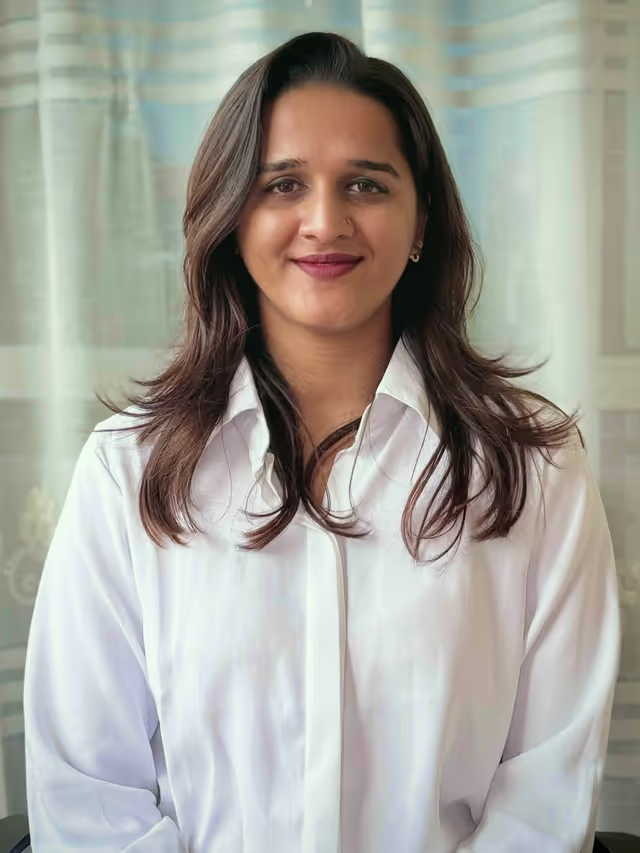
Smriti Simkhada is a PTE Academic perfect scorer (90/90) providing structured PTE coaching for Nepali students. She and her team have helped 1,500+ students prepare for Australia PR and Canada immigration through structured, criteria-aligned coaching.