One More PTE Attempt vs a Refusal: The 2026 Money Math
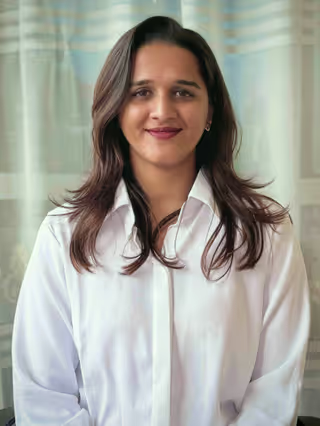
Smriti Simkhada
90/90 Perfect Scorer
Updated October 2026 · Reviewed by Smriti Simkhada (90/90)
If you are sitting in Sydney, Melbourne, Perth or Brisbane with a PTE score report that is almost there, you have probably asked the same question everyone in the Nepali community asks: is retaking PTE worth it in Australia, or should you just lodge with what you have and hope for the best? For years the honest answer was "book another test, it's only a few hundred dollars." After the 1 July 2026 charge rises, that answer no longer survives contact with a calculator.
This article is not about test fees. It is about the economics of failure — what it actually costs when a score falls short and a lodgement goes wrong, versus what it costs to get the score right once. The conclusion is uncomfortable for anyone still self-studying: the cheap-looking path is the expensive one.
Stuck below your target? The 79+ Sprint
Private 1-on-1 coaching, from US$99: pick 7 days, 17 days or 1 month, one live session a day on your time zone (Sydney · Melbourne · Toronto · London · Doha), a demo session included, and Coach-Until-Target on the longer plans.
Why "one more attempt" stopped being the cheap option
The instinct is understandable. A PTE Academic sitting in Australia is AUD 499, Pearson's listed Australia price; in Nepal, Pearson lists it at USD 248.60, and your bank converts that dollar charge to rupees at its own rate. Against a migration dream, that feels like small change. So people book. And rebook. And rebook again.
The problem is that a retake is never just the money. It is another three weeks of evenings, another wave of anxiety before results, and — critically — another cycle in which nothing about your method has changed. If you scored a 65 in Speaking on attempt three using the same approach you used on attempt one, attempt four is not a new roll of the dice. It is the same dice. Meanwhile the thing sitting on the other side of the equation got dramatically more expensive on 1 July 2026, and that is where the real money is.
What a single lodgement now puts on the table
These are the first-instalment visa application charges that took effect for applications lodged on or after 1 July 2026:
- Subclass 189 (Skilled Independent): AUD 6,135 for the main applicant — up from AUD 4,910 before 1 July 2026.
- Subclass 190 (Skilled Nominated) and 491 (Skilled Work Regional): AUD 6,140 for the main applicant.
- Each additional applicant aged 18 or over on any of those three: AUD 3,070.
- Subclass 485 (Temporary Graduate), Post-Higher Education Work stream: AUD 5,750 base — up from AUD 4,600, which itself was already double the earlier AUD 2,300.
- Subclass 500 (Student): AUD 2,500 from 1 July 2026, up from AUD 2,000.
Read the 190 line again with a partner in the picture: AUD 6,140 plus AUD 3,070 for the adult secondary applicant — AUD 9,210 before a single migration agent invoice, skills assessment, or medical. And the charge is paid at lodgement, not at grant. That is the whole point of this article: you hand over the money when you press submit, on the strength of the score you had that day.
English literally has a price tag: the second instalment
Here is the part most people in the community have never heard of, and it is the single clearest proof that Australia prices English in dollars.
If an applicant aged 18 or over does not have functional English, a second visa application charge becomes payable. For subclasses 189, 190 and 191, that second instalment is AUD 4,885 for any adult applicant — main or secondary. For the 491 group it is AUD 4,890. On employer-sponsored permanent visas the primary applicant without functional English owes AUD 9,800, with adult secondary applicants at AUD 4,890.
Note the shape of that. Your spouse's English is not a soft "nice to have" on your application — it is a line item worth thousands of dollars, and families routinely discover it after lodgement, when the invoice arrives and there is nothing left to negotiate. Before you decide another solo attempt is the frugal choice, ask what a properly prepared sitting is worth against a four-figure charge that exists purely because someone's English evidence fell short.
The points angle: what a higher PTE band is actually worth
For skilled migration, PTE does not just pass or fail — it converts directly into points on the points test. Under the component-specific bands that apply to tests taken on or after 7 August 2025:
- Competent English — Listening 47, Reading 48, Writing 51, Speaking 54 — earns 0 points. It only gets you through the door.
- Proficient English — Listening 58, Reading 59, Writing 69, Speaking 76 — earns 10 points.
- Superior English — Listening 69, Reading 70, Writing 85, Speaking 88 — earns 20 points.
Twenty points is an enormous share of a competitive score. The pass mark to be invitable is 65, but 65 is only a floor: in the published 4 June 2026 invitation round, minimum points by occupation ran from 65 up to 100 — Registered Nurses (nec) at 75, Secondary School Teachers at 75, and the most common cut-off across occupations was 80. If your occupation is sitting at 80 or above, the gap between Competent and Superior is very nearly the difference between being invited and never being invited at all.
That is the real cost of a "close enough" score. Not a refusal letter — an EOI that simply sits there, year after year, while your age points quietly tick down. Worth knowing too: the Department accepts English test results for around three years, so a strong score is an asset you hold for years, while a weak one is a receipt you throw away.
The money math, side by side
Path A — keep self-studying and retaking
Three more unguided attempts in Australia at AUD 499 each is roughly AUD 1,500, plus months of delay. From Nepal, three sittings at USD 248.60 each come to USD 745.80, before your bank turns each charge into rupees. And if your method never changed, there is no guarantee you are past Proficient — let alone Superior. Then add the downside branches. At Competent your EOI can sit uninvited for years while your age points quietly tick down — SkillSelect never even lets you lodge, so the cost is time you cannot get back. And if you are invited and lodge on evidence that cannot carry the points you claimed — an English result below the band in your EOI, for example — the AUD 6,135 or AUD 6,140 is paid at lodgement and is not refunded on refusal.
Path B — one properly coached preparation
Structured 1-on-1 mentorship — The 79+ Sprint — comes in 7-day, 17-day and 1-month plans priced for your country, with a Coach-Until-Target guarantee on the 17-day and 1-month plans. Add one test sitting at AUD 499 (or USD 248.60 in Nepal) and that is your total exposure to getting the score right.
Against AUD 6,140 at lodgement, a AUD 4,885 second instalment for missing functional English, and 20 points of skilled-migration scoring, coaching is not really a purchase. It is insurance on a five-figure decision.
Common Mistakes to Avoid
1. Treating the test fee as the cost of failure. It is the smallest number on the page. The visa application charge, the second instalment, and the points you did not earn are the actual cost.
2. Lodging "to get in before the next change." Panic-lodging at a weak score is how people spend AUD 6,135 on an application their points total cannot carry.
3. Forgetting the partner. An adult secondary applicant costs AUD 3,070 on 189/190/491 — and AUD 4,885 more if they cannot show functional English. Plan both people's English, not just yours.
4. Repeating the same preparation. If three attempts produced the same Speaking band, the input is the problem. Buying a fourth test does not change the input.
5. Chasing "overall 79" when the bands are component-specific. Since 7 August 2025 the Department reads Listening, Reading, Writing and Speaking separately. A glorious overall average with one weak component still lands you in the lower band.
6. Booking a remote or at-home test version. Remote-proctored English tests are not accepted for Australian visas.
Your six-step decision plan
- Write down the visa you are actually lodging. 189, 190, 491, 485 or 500 — each carries a different charge, so "the visa fee" is not one number. Put the right one at the top of your page.
- Add every adult on the application. Main applicant charge plus AUD 3,070 per additional adult on 189/190/491. This is your money at stake.
- Check functional English for every adult, including your partner. If anyone cannot evidence it, write AUD 4,885 (or AUD 4,890 on the 491 group) beside their name. That number decides whether they need to sit a test too.
- Map your last score report against the bands. Not the overall — each of Listening 58, Reading 59, Writing 69, Speaking 76 for Proficient, and Listening 69, Reading 70, Writing 85, Speaking 88 for Superior. Circle the components that fell short. Usually it is one or two, not four.
- Do the points arithmetic before you book anything. Take your current total and add the English points you are not yet claiming — moving from Competent to Proficient adds 10, and to Superior adds 20 (10 if you already hold Proficient). Compare that against what your occupation actually needed in the last published invitation round. If Superior is what makes you invitable, an unguided retake is not a strategy.
- Buy the intervention, not another attempt. Fix the two weak components with structured coaching, then sit once. Start with a free assessment so someone experienced tells you which components are genuinely fixable in weeks and which need longer.
Tips for Nepali Students
Your accent is not the problem — your fluency pattern is. The scoring engine does not penalise a Nepali accent. It penalises hesitation, restarts, filler sounds and uneven pacing. Most Nepali test-takers stuck at Speaking 65–75 are losing marks on rhythm and continuity, not pronunciation — exactly the habit a self-study loop cannot see and a coach fixes in a fortnight.
Compare prices in the currency you actually earn in. With the Nepal Rastra Bank selling rate at NPR 107.03 to the Australian dollar (2 October 2026), an AUD 499 sitting in Australia is a very different weight of decision from a USD 248.60 booking in Nepal that your bank converts at its own rate. Put the coaching price for your country next to those numbers before you decide another sitting is the cheap option. See current 1-on-1 plans and prices for your country.
Time zones are solvable, so stop using them as a reason to self-study. Sessions run to fit shift work in Sydney and Melbourne, and equally for people in Toronto, London or Doha.
Talk to your partner about their English now. In a lot of Nepali households the secondary applicant's English is never discussed until the second-instalment invoice appears. A short functional-English conversation today can save a four-figure charge later. And because immigration results stay usable for around three years, sitting early with a strong score is always safer than sitting late with a weak one.
Frequently Asked Questions
Q: Is retaking PTE worth it in Australia if I already meet the minimum?
A: It depends on what "the minimum" is buying you. If your points total already exceeds what your occupation was invited at, a retake may be optional. But Competent earns zero points on the skilled points test, while Proficient earns 10 and Superior earns 20 — so if your occupation's cut-off sits above your current total, retaking with proper preparation is usually the highest-return money in your whole application.
Q: How many times should I retake PTE before getting help?
A: Two. If two sittings with the same preparation method produced roughly the same band pattern, the third will too. At AUD 499 per attempt in Australia, a third and fourth unguided attempt costs more than mentorship that changes the method. We cover the sequencing in detail in our guide to PTE retakes for Nepali students in Australia and the diaspora.
Q: What does it cost my family if my partner doesn't have functional English?
A: On subclasses 189, 190 and 191, an adult applicant without functional English attracts a second visa application charge of AUD 4,885. On the 491 group it is AUD 4,890. That is on top of the AUD 3,070 additional-applicant first instalment on a 189, 190 or 491 lodgement. Partner visas work differently and carry no functional-English second instalment — but for skilled migration, this charge is real and avoidable with a modest English test result.
Q: Should I lodge now at a lower score, or wait and improve my PTE first?
A: A registered migration agent should make that call on your specific case. What we can give you is the arithmetic: the charge is paid at lodgement, the current first instalment is AUD 6,135 for a 189 and AUD 6,140 for 190/491, and points from a stronger English band travel with you for around three years. Spending a few weeks moving from Competent to Proficient or Superior before committing a five-figure sum is a very different risk profile from lodging and hoping.
Q: I'm preparing from Nepal for an Australian pathway. Does this math change?
A: The visa charges are identical wherever you lodge from — AUD 6,135 for a 189, AUD 5,750 for a 485, AUD 2,500 for a student visa. Only your test price changes: Pearson lists it at USD 248.60 in Nepal. If anything the case for getting it right first time is stronger from Nepal, because those charges convert into a far larger number in rupees.
Q: What score should I actually target?
A: Target Superior — Listening 69, Reading 70, Writing 85, Speaking 88 — unless a professional has confirmed you do not need the 20 points. Aiming at the minimum leaves no margin for a bad day, and one weak component drops your whole band. Our 79+ retake strategy guide breaks down how to attack the components in order.
Conclusion: price the failure, not the test
The question was never really "is retaking PTE worth it in Australia." The real question is what a wrong score costs once it is attached to a lodgement. After 1 July 2026 that answer is AUD 6,135 to AUD 6,140 for a skilled application, AUD 3,070 for each adult who comes with you, up to AUD 4,885 more if English evidence is missing, and 10 to 20 points you never earned. Set against that, another AUD 499 self-study attempt is not thrift. It is a slow, expensive way of postponing the same decision.
The alternative is boring and effective: work out which components are short, fix them with someone who has coached hundreds of Nepali test-takers through the same plateau, and sit once. That is what The 79+ Sprint is — 1-on-1 private mentorship with Smriti Simkhada, taught in Nepali, scheduled around your shifts in Sydney, Melbourne, Toronto, London or Doha, in 7-day, 17-day or 1-month plans priced for your country, with a Coach-Until-Target process guarantee on the 17-day and 1-month plans so you are not left alone at 74.
Before you book another test, book the diagnosis. Take the free assessment and find out which two components are holding your band down — or go straight to The 79+ Sprint and make the next sitting your last one. Always confirm current visa charges on the official Home Affairs website and the exact test price at Pearson's checkout before you commit money.
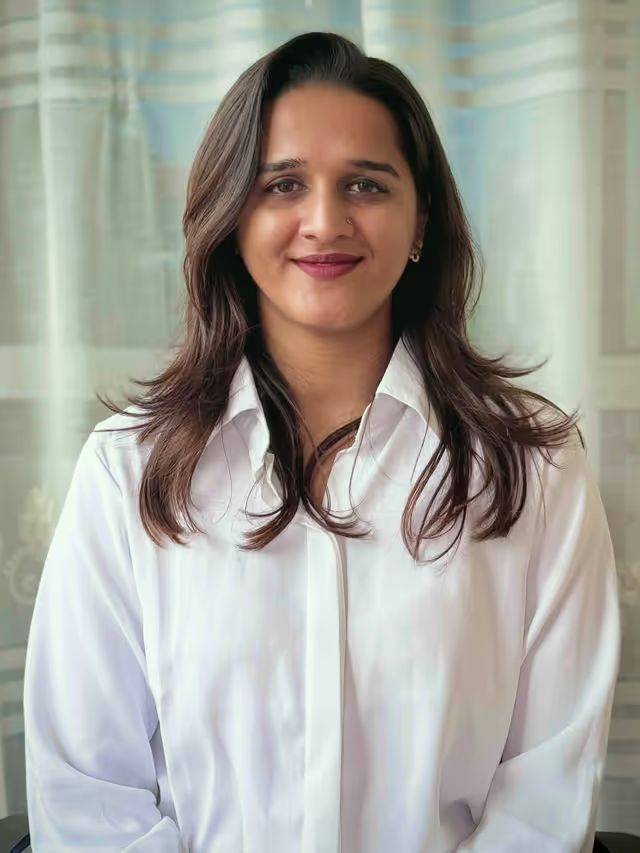
About Smriti Simkhada
Smriti Simkhada is a PTE Academic perfect scorer (90/90) providing structured PTE coaching for Nepali students. She has helped over 1,000 students prepare for Australia PR and Canada immigration through structured, criteria-aligned coaching.
