PTE Summarize Spoken Text Word Limit: The 2026 Form Rule
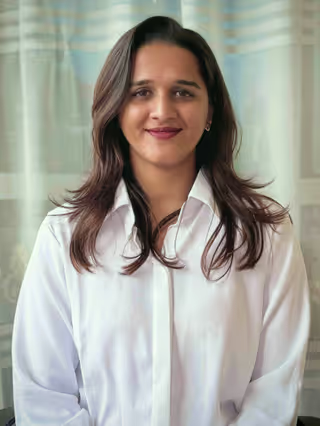
Smriti Simkhada
90/90 Perfect Scorer
Updated October 2026 · Reviewed by Smriti Simkhada (90/90)
PTE Summarise Spoken Text Word Limit 2026 — Complete Guide
Summarise Spoken Text (SST) is the first task in PTE Academic Listening, and it is scored for both Listening and Writing. You hear a 60-90 second lecture once, then type a summary. Pearson's Score Guide lists one SST item per test, so a single response feeds two of your four communicative skill scores.
The word limit is the part students most often get wrong, usually by treating 50 and 70 as the zero line. They are not. This guide sets out what happens at each word count, using Pearson's own wording.
Stuck below your target? The 79+ Sprint
Private 1-on-1 coaching, from US$99: pick 7 days, 17 days or 1 month, one live session a day on your time zone (Sydney · Melbourne · Toronto · London · Doha), a demo session included, and Coach-Until-Target on the longer plans.
For broader context, see the PTE score requirements guide and the Highlight Correct Summary tips.
What Is the SST Word Limit?
PTE Academic Summarize Spoken Text asks for a 50-70 word summary, and only responses under 40 or over 100 words score zero. Pearson's listening format page says: "You will receive full credit if your response is between 50 and 70 words. Writing fewer than 50 words or more than 70 words will decrease your score. If your summary contains fewer than 40 words or more than 100 words, you will not receive any score points for your summary on any of the five factors."
| Word count | Form score (PTE Academic) | What happens to the rest |
|---|---|---|
| Under 40 | 0 | Zero on all five factors |
| 40-49 | 1 of 2 | Content, Grammar, Vocabulary and Spelling still scored |
| 50-70 | 2 of 2 | All five factors scored normally |
| 71-100 | 1 of 2 | Content, Grammar, Vocabulary and Spelling still scored |
| Over 100 | 0 | Zero on all five factors |
Source: Pearson PTE Academic listening format and the PTE Academic Score Guide (2025). Last verified 2026-10-02.
Form is not the only route to zero. Pearson also scores the response zero if it misreads the topic or purpose of the lecture, if it is written in capitals, has no punctuation, or consists only of bullet points or very short sentences. Copied, "unoriginal" text gets no credit either: "You must use your own words."
Because the full-marks band is 50-70, aim for 55-65 words so a late edit never pushes you outside it.
What Does SST Contribute To?
Pearson scores SST on five traits: Content (0-4), Form (0-2), Grammar (0-2), Vocabulary (0-2) and Spelling (0-2). That makes 12 trait points, and Form is 2 of them. The task counts towards Listening and Writing. Your reading skill is used only to read the instructions, and Speaking is not tested.
Content is the biggest single trait, which is why a summary that lands at 62 words but misses the lecture's main point still scores poorly. Pearson adds that a human expert reviews Content before the task score is confirmed.
PTE Academic accepts US, UK, Australian or Canadian spelling, but you must stick to one convention in a response. Spelling scores 2 with no errors, 1 with one error and 0 with more than one, so "organise" and "organize" in the same summary can cost you.
Worked Example: The Same Summary at 48, 62 and 104 Words
Imagine a lecture on urban heat islands. The speaker explains that cities run hotter than surrounding countryside because concrete and asphalt store heat, that this raises energy use and health risks in summer, and that green roofs and street trees can cool neighbourhoods measurably.
48 words: Form 1 of 2
"The lecture explains that cities are hotter than rural areas because concrete and asphalt absorb and store heat. This increases energy demand and health risks during summer. The speaker suggests that green roofs and street trees can reduce temperatures in urban neighbourhoods and improve conditions for local residents."
Every main point is there, so Content can still score well. But 48 words is under 50, so Form drops to 1. Fix: add one detail, such as "especially for elderly people", and you are at 52.
62 words: Form 2 of 2
"The lecture explains that cities are hotter than surrounding rural areas because materials such as concrete and asphalt absorb and store heat during the day. This effect increases energy demand and creates health risks, especially for elderly residents, during summer heatwaves. The speaker argues that practical measures, including green roofs and more street trees, can measurably reduce temperatures in crowded urban neighbourhoods."
Same content, one example added, full Form marks.
104 words: zero
Add a sentence about the history of city planning and another restating the conclusion, and the summary reaches 104 words. Pearson scores it zero on all five factors. The strong content in the first 62 words does not survive.
How to Write 50-70 Words Consistently
Students who write freely drift past 70; cautious writers stop under 50. A fixed structure solves both, because each part has a rough length.
The SST Structure Template
- Topic sentence (8-12 words): "The lecture discusses [main topic] and its impact on [related area]."
- Main point (15-20 words): "The speaker explains that [main argument or finding], noting that [key detail or example]."
- Supporting point (15-18 words): "The speaker also points out [second point], which [explanation or implication]."
- Conclusion (10-15 words): "Overall, the lecture shows [overall significance]."
This structure lands at roughly 48-65 words. Lengthen part 2 or 3 slightly to reach 55-65. Multiple sentences are fine in SST; unlike Summarize Written Text, there is no one-sentence rule. Pearson's own tip is to check that each sentence starts with a capital letter and ends with a full stop.
Note-Taking Strategy During the Audio
Pearson gives you 10 minutes for the whole task: "10 minutes to listen and write your summary." The 60-90 second recording plays automatically, once, inside that time. That leaves a little over eight minutes for writing and checking.
- Note the main topic; it is usually stated in the opening seconds.
- Note two or three key points or examples as nouns and verbs, not full sentences.
- Note the conclusion or implication if the speaker states one.
Pearson's own tip is to write down the supporting points as well as the main idea on the erasable noteboard, then refer briefly to the essential supporting points in your summary.
What to Do When Your Count Is Off
- Under 40: you are in the zero band. Add a full point from your notes before anything else.
- 40-49: add one specific detail or a short closing implication: "...which suggests that [implication]." That is usually 6-9 words.
- 71-80: cut adjective padding first ("very significant" becomes "significant"), then any phrase that repeats the topic sentence.
- 81-100: delete your weakest supporting point outright. Trimming words one at a time will not save enough.
- Over 100: this scores zero, so cut a whole sentence immediately, whatever the time.
- 50-70 with time left: stop editing length and check spelling, subject-verb agreement and full stops.
Common Mistakes With the SST Word Count
- Believing 49 or 71 words means zero. It does not. You lose one Form point; the zero lines are 40 and 100.
- Writing 75 words and assuming "close enough". 71-100 words loses a Form point. Trim before you submit.
- Copying long phrases straight from the lecture. Pearson gives no credit for an unoriginal response. Use the speaker's key terms, but put the summary in your own words.
- Mixing spelling conventions. "Colour" in one sentence and "color" in the next counts against Spelling.
- Counting words by hand. The Word Count at the bottom of the screen is there for this. Trust it.
SST vs SWT Word Limits — Side by Side
- Word range: SST 50-70 for full Form marks (zero under 40 or over 100); SWT one sentence of 5-75 words (zero outside that).
- Sentences: SST allows several; SWT must be exactly one.
- Time: SST 10 minutes including the recording; SWT 10 minutes to write.
- Source: SST is a 60-90 second recording heard once; SWT is a passage of up to 300 words that stays on screen.
- Skills scored: SST counts for Listening and Writing; SWT for Reading and Writing.
The full rules for the written task are in the one-sentence SWT guide, and every writing task's limits are in the PTE writing word limits table.
PTE Core Summarize Spoken Text: Word Limit and Differences
If you are taking PTE Core (the test most Nepali applicants use for Canada PR), its Summarize Spoken Text task has a different limit. PTE Core SST asks for a 20-30 word summary. Writing fewer than 20 or more than 30 words decreases your score, and the response scores zero on all five factors only if it has fewer than 5 words or more than 40 words. Never carry the Academic 50-70 rule into PTE Core, or the Core rule into Academic.
- PTE Academic SST: target 50-70 · reduced Form at 40-49 or 71-100 · zero under 40 or over 100.
- PTE Core SST: target 20-30 · score decreases outside 20-30 · zero under 5 or over 40.
Source: Pearson PTE Core listening format — verified 2026-06-10.
Tips for Nepali Students
- Practise with accents you find hard. SST lectures use a range of English accents. If you have only practised with one accent, spend a week on lectures in others before your test.
- Learn to drop articles in notes, not in the summary. Nepali has no "a" or "the", and notes without them are fine. The typed summary needs them, and missing articles cost Grammar.
- Pick one spelling convention and keep it. If you studied with British spelling in Nepal and now read Australian news, both are UK-style; just do not switch to "-ize" mid-summary.
- Time your note review. Two minutes of looking at notes, five of writing, the rest for checking.
Frequently Asked Questions
What happens if I submit exactly 50 words vs exactly 70 words?
Both receive full Form marks. After that, Content, Grammar, Vocabulary and Spelling decide the score. Seventy words of good content does not beat fifty words of equally good content on Form.
Can I write in bullet points for SST?
No. Pearson's Score Guide gives Form 0 to a summary that consists only of bullet points or very short sentences, and a Form of 0 means the response scores zero overall.
Is it better to cover more points briefly or fewer points in depth?
Cover the main point and two or three supporting points. Pearson's Content criterion asks whether all key points are addressed without misrepresenting the topic, so a short list of every detail scores worse than a clear summary of the main ideas.
Conclusion: Improve Your SST Score
For PTE Academic SST, the numbers to remember are 50-70 for full marks and 40 and 100 for the zero lines. Aim for 55-65, use your own words, and keep one spelling convention.
SST is covered in the Writing module of every 1-on-1 plan. If Writing is the skill blocking your 79+, the team of Smriti Simkhada gives feedback on your actual SST responses in the 1-on-1 coaching program. Aiming for Australia PR? Explore free study materials or read the PTE Academic guide.
Continue Your PTE Preparation
Related guides for Nepali students preparing for PTE Academic and PTE Core:
- SST and Writing score
- Listening tips and dictation patterns
- Negative marking on multiple choice and Highlight Incorrect Words
- Write From Dictation list
- Free score assessment
Source: Pearson, PTE Academic test format: Listening and the PTE Academic Score Guide (Test Taker, 2025) linked from pearsonpte.com/pte-academic/scoring. Last verified: 2026-10-02. Pearson can change word-count rules; check the official page before your test.
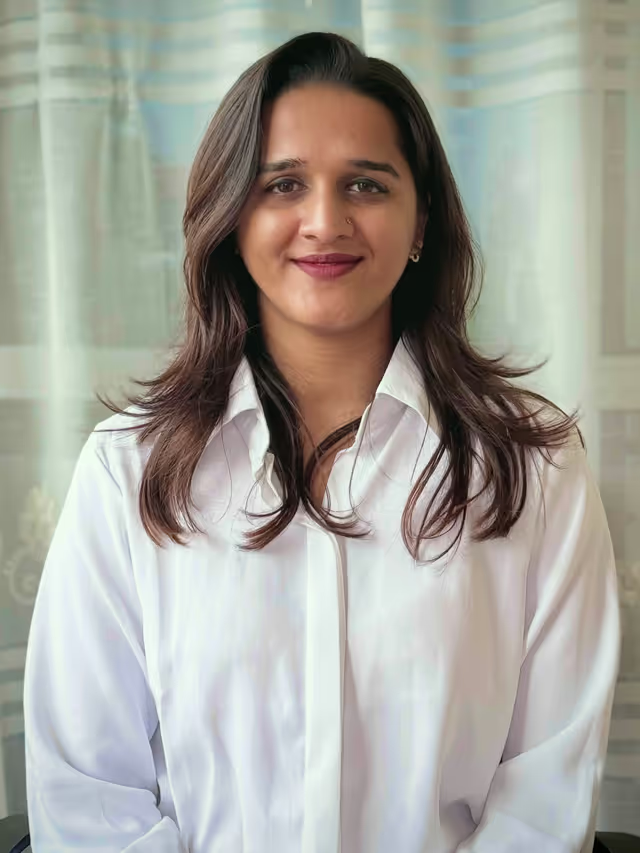
About Smriti Simkhada
Smriti Simkhada is a PTE Academic perfect scorer (90/90) providing structured PTE coaching for Nepali students. She has helped over 1,000 students prepare for Australia PR and Canada immigration through structured, criteria-aligned coaching.
