PTE vs TOEFL: Which Is Easier for Nepali Students in 2026?
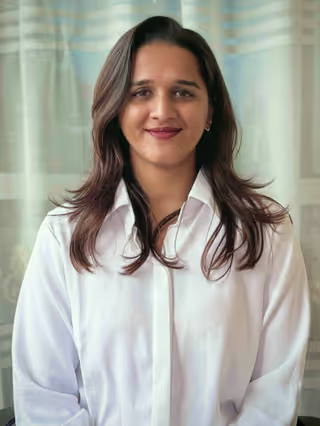
By Smriti Simkhada (90/90) · Updated
Introduction
Choosing between PTE and TOEFL is one of the biggest decisions Nepali students face when planning to study abroad or apply for permanent residency. Both tests measure English proficiency for non-native speakers, but they work very differently. In 2026, more Nepali students are shifting from TOEFL to PTE Academic, especially those targeting Australia and Canada for PR. But is PTE actually easier than TOEFL?
The answer depends on your goals, learning style, accent confidence, and timeline. This comprehensive guide compares PTE and TOEFL across every dimension that matters to Nepali students—from test format and scoring to costs in Nepal, acceptance by universities and immigration authorities, and which test gives you better odds of hitting your target score.
By the end of this article, you'll know exactly which test fits your situation, how to prepare efficiently, and what mistakes to avoid when making this critical choice.
Stuck below your target? The 79+ Sprint
Private 1-on-1 coaching, from US$99: pick 7 days, 17 days or 1 month, one live session a day at a time that suits you, a demo session included, and Coach-Until-Target on the longer plans.
Quick Comparison Table: PTE vs TOEFL
| Feature | PTE Academic | TOEFL iBT |
|---|---|---|
| Test Duration | 2 hours (approximately) | About 3 hours |
| Test Format | 100% computer-based | Computer-based (4 sections) |
| Scoring | Primarily AI-scored; since the 2025 update, some responses may also be part-scored or reviewed by human experts (pronunciation and oral fluency are not assessed by human examiners) | AI + Human raters (hybrid) |
| Score Range | 10–90 for each skill | 0–120 total score (30 per section) |
| Results Time | Pearson says results usually arrive within two days, up to five working days | 4–8 days (usually 6 days) |
| Cost in Nepal | USD 248.60 (Pearson's listed Nepal price) — confirm current fee at pearsonpte.com | USD 205 (ETS's listed Nepal fee, before taxes) — confirm current fee at ets.org |
| Score Validity | 2 years | 2 years |
| Test Centers Nepal | Kathmandu, Lalitpur, Pokhara, Chitwan (Narayangarh), Tilottama, Itahari (verify current availability at pearsonpte.com) | Kathmandu, Pokhara (verify current availability at ets.org) |
| Best For | Australia/Canada PR, fast results, accent concerns | US universities, traditional test-takers |
Fees and test-center seat availability change frequently. Confirm current pricing and availability in your myPTE or Pearson account before making payment. For TOEFL, verify at ets.org/toefl.
Test Format Differences: How PTE and TOEFL Are Structured
The biggest difference between PTE and TOEFL is how the test is delivered and scored. Understanding these format differences is crucial because your comfort level with each format directly affects your score potential.
PTE Academic Test Format
Duration: Approximately 2 hours total
Structure: Three main parts with 20 different question types (section timings per Pearson's official guide):
- Part 1: Speaking & Writing (76–84 minutes) — 7 question types combined: Speaking tasks include Read Aloud, Repeat Sentence, Describe Image, Re-tell Lecture, and Answer Short Question; Writing tasks include Summarize Written Text and Essay
- Part 2: Reading (22–30 minutes) — 5 question types including Fill in the Blanks (two types), Multiple Choice, and Re-order Paragraphs
- Part 3: Listening (31–39 minutes) — 8 question types including Summarize Spoken Text, Multiple Choice, Fill in the Blanks, and Write from Dictation
Key Features:
- 100% computer-delivered with no human interaction during the test
- AI microphone records your speaking responses
- Type all written responses (no handwriting)
- Cross-module scoring: some questions affect multiple skill scores
- One-time playback for most listening items (no replay button)
Scoring note: PTE Academic is primarily scored by Pearson's AI system. Since the 2025 update, some response types may also be part-scored or reviewed by human experts, though pronunciation and oral fluency are not assessed by human examiners. See Pearson's scoring page for the latest details.
TOEFL iBT Test Format
Duration: About 3 hours (with 10-minute break after Reading and Listening)
Structure: Four separate sections tested independently
- Reading (54–72 minutes) — 3–4 passages with 10 questions each, multiple choice format
- Listening (41–57 minutes) — 3–4 lectures and 2–3 conversations, multiple choice and matching questions
- Speaking (17 minutes) — 4 tasks: 1 independent (personal opinion), 3 integrated (read/listen then speak)
- Writing (50 minutes) — 2 tasks: 1 integrated (read/listen then write), 1 independent essay
Key Features:
- Computer-based but with separate timed sections
- Can take notes during all sections (provided notepad)
- Multiple choice dominates Reading and Listening
- Speaking scored by human raters reviewing your recordings
- Writing scored by AI (e-rater) + human rater combination
Which Is Easier for Nepali Students? Section-by-Section Breakdown
The honest answer: it depends on your strengths. But there are clear patterns in which test favors Nepali students in specific ways.
Speaking: Advantage PTE
Why PTE is easier for most Nepali students:
- Accent tolerance: PTE's AI scoring focuses on pronunciation clarity and fluency, not on matching British or American accents. Nepali students with distinct accents consistently score higher on PTE than TOEFL
- Template-friendly: You can use proven speaking templates for Describe Image and Retell Lecture without penalty
- No human judgment during test: No pressure from a human examiner present in the room. Just speak into the microphone following the pattern
- Shorter responses: Most speaking items are 30–40 seconds (vs TOEFL's 45–60 second responses)
Why TOEFL might be easier if you:
- Are comfortable with conversational, opinion-based speaking
- Prefer human evaluation over AI algorithms
- Have strong critical thinking and can synthesize information quickly
Verdict: PTE wins for most Nepali students, especially those worried about accent or preferring structured templates.
Writing: Slight Advantage TOEFL
Why TOEFL is easier for writing:
- Only 2 tasks: 1 integrated, 1 independent essay (vs PTE's Essay + Summarize Written Text)
- More time per task: 20 minutes for integrated, 30 minutes for essay (vs PTE's 20 minutes total for essay)
- Familiar essay format: Traditional 5-paragraph structure works well
- Word count flexibility: No strict penalties for slightly exceeding limits
Why PTE might be easier if you:
- Are good at summarizing (SWT is 1 sentence, very formula-driven)
- Prefer shorter essay (200–300 words vs TOEFL's 300+ word expectation)
- Want AI scoring consistency (no subjective human judgment)
Verdict: Balanced, but TOEFL has slight edge for students with solid essay-writing foundations. PTE wins if you master the SWT formula.
Reading: Advantage TOEFL
Why TOEFL is easier for reading:
- Multiple choice only: You can eliminate wrong answers and guess strategically
- Academic passages with clear structure: Similar to what you've seen in school/college
- More time per passage: About 18 minutes per passage (vs PTE's 22–30 minutes for all reading tasks combined)
- No spelling required: All answers are click-based selections
Why PTE might be easier if you:
- Have strong grammar and collocation knowledge (Fill in the Blanks rewards this)
- Are good at logical sequencing (Re-order Paragraphs is pure logic)
- Read fast and can skim effectively
Verdict: TOEFL wins for most students. PTE Reading is time-pressured and requires precise grammar knowledge.
Listening: Advantage PTE
Why PTE is easier for listening:
- Shorter audio clips: Most recordings are 30–60 seconds (vs TOEFL's 3–6 minute lectures)
- Clear accents: PTE uses neutral or clear professional accents
- Fill-in-the-blanks format: Tests exact word recognition, not interpretation
- Write from Dictation: If you can spell what you hear, you score points (contributes to all four skills!)
Why TOEFL might be easier if you:
- Are good at note-taking during long lectures
- Prefer multiple choice over typing exact words
- Can remember details from longer conversations
Verdict: PTE wins for Nepali students with good spelling and short-term memory. TOEFL demands sustained concentration for long audio.
Cost Comparison: What You'll Actually Pay in Nepal
Both tests are expensive, but there's more to cost than just the test fee.
Test Fees (as of 2026 — verify current fees before booking)
- PTE Academic: USD 248.60, Pearson's listed Nepal price; your bank converts the USD charge to rupees at its own rate — confirm at pearsonpte.com
- TOEFL iBT: USD 205, ETS's listed Nepal fee before taxes — confirm at ets.org
Fees and seat availability change frequently. Always confirm the current price in your myPTE or Pearson account, and on the ETS website, before making payment.
On paper: both fees are charged in US dollars, so compare the two USD figures directly once you have confirmed each on the official site.
Hidden Cost: Retake Probability
Here's where the calculation changes. Based on our coaching experience with Nepali students (anecdotal, not a verified industry study):
- PTE: Most students reach their target score in 2–3 attempts when they move from unguided study to a structured plan.
- TOEFL: Retake counts vary widely by starting score and preparation approach; we do not have a verified industry average to cite.
Two attempts at either test means paying its fee twice. For PTE, that is USD 248.60 each time at Pearson's listed Nepal price. Which route costs less overall comes down to how many attempts you end up needing, and we have no verified retake data for either test in Nepal.
Preparation Costs
- PTE coaching in Nepal: Rs. 15,000–25,000 for group classes, Rs. 40,000–60,000 for one-on-one
- TOEFL coaching in Nepal: Rs. 12,000–20,000 for group classes, Rs. 35,000–50,000 for one-on-one
- Mock tests: PTE scored mock tests (Rs. 3,000–4,000 each), TOEFL official practice tests (free but limited)
Time Cost: Opportunity Cost of Waiting
PTE Academic results: Pearson says PTE Academic results usually arrive within two days, up to five working days; for PTE Core, Pearson says most results arrive within two business days and some take up to five.
TOEFL results: 4–8 days (average 6 days)
If you're applying for a university intake with a tight deadline, waiting an extra week for TOEFL results can mean missing your application window. For PR applications with point cutoffs that change monthly (like Australia's SkillSelect), getting scores 5 days faster can make a meaningful difference.
Real cost: it depends on how many attempts you need and how much a faster result is worth to your application timeline.
University and Immigration Acceptance: Where Each Test Works
Global University Acceptance
TOEFL iBT: Accepted by 11,500+ institutions worldwide
PTE Academic: Accepted by 3,300+ institutions worldwide
Reality check: These numbers are based on publicly reported figures and change over time. What matters is whether your specific target institutions accept your chosen test.
Top Study Destinations for Nepali Students
United States:
- TOEFL is still the gold standard for top-tier universities
- PTE is rapidly gaining acceptance—now accepted by the majority of US universities
- Ivy League and top 50 schools: Both tests widely accepted, but TOEFL has longer history
- Verdict: TOEFL slight edge for prestige schools, PTE perfectly fine for most others
Australia:
- All Australian universities accept both PTE and TOEFL equally
- For student visa: Department of Home Affairs accepts both
- For PR: Only PTE Academic is accepted for points-tested skilled migration (TOEFL not accepted) — always confirm the latest requirements on the official DHA website
- Verdict: PTE dominates if you plan to transition from study to PR
Canada:
- Universities: Both tests widely accepted for study admissions and study permits
- For permanent residency (Express Entry, PNP, citizenship): IRCC accepts only IELTS and PTE Core (not TOEFL, and not PTE Academic). PTE Academic is suitable for university study applications in Canada; PTE Core is the required test for Canadian PR pathways.
- Student visa: Both tests accepted
- Verdict: If targeting a Canadian PR pathway, you will need PTE Core specifically (TOEFL does not qualify)
Always confirm the latest Canadian immigration requirements on the official IRCC website before lodging your application.
United Kingdom:
- Student visa: Must take TOEFL iBT at an approved SELT center, or PTE Academic UKVI
- Universities: Both accepted for academic admissions
- Verdict: Tied, but verify SELT approval for your test center
Immigration & PR Pathways
| Country | PTE | TOEFL |
|---|---|---|
| Australia PR | ✅ PTE Academic accepted | ❌ Not accepted |
| Canada PR | ✅ PTE Core accepted (not PTE Academic) | ❌ Not accepted |
| UK Skilled Worker | ✅ PTE Academic UKVI | ✅ TOEFL iBT SELT |
| New Zealand PR | ✅ PTE Academic accepted | ✅ TOEFL iBT accepted |
Clear winner for PR pathways: PTE Academic (Australia) and PTE Core (Canada). TOEFL is essentially irrelevant for the two most popular PR destinations for Nepali students. Always confirm the latest requirements directly on the relevant immigration authority website before lodging any application.
Score Reporting and Validity
How Fast You Get Results
PTE Academic:
- Pearson says results usually arrive within two days, up to five working days
- Instant score sending to unlimited institutions (free)
- Can send scores before receiving them (useful for urgent deadlines)
TOEFL iBT:
- Results in 4–8 days (typically 6 days)
- Free score reports to 4 institutions (selected before test day)
- Additional score reports: USD 20 each (~Rs. 2,700)
Score Validity Period
Both tests: Valid for 2 years from test date
This is standard across all major English tests. Plan your test timing so scores are valid when you need them for applications.
Score Cancellation and Enhancement
PTE: Cannot cancel scores. If you score badly, you must retake. MyPTE score account shows all attempts.
TOEFL: Can cancel scores within 72 hours of test (but you lose the test fee). ETS offers "MyBest Scores" feature—combines your best section scores from multiple tests within 2 years.
Winner for flexibility: TOEFL, due to MyBest Scores option (though not all universities accept this).
Which Test Should You Choose? Decision Framework for Nepali Students
Answer these 6 questions to identify your best fit:
1. What's Your Primary Goal?
- Australia PR (189, 190, 491 visa): Choose PTE Academic (TOEFL not accepted)
- Canada PR (Express Entry, PNP): Choose PTE Core (TOEFL not accepted; note PTE Academic is also not accepted for Canadian PR)
- US university (top 50 schools): TOEFL slight preference, but PTE fine too
- US university (other schools): Either test works—choose based on ease
- UK student visa: Either works, verify SELT approval
- Study in Canada + later PR: Use PTE Academic for study admissions; plan to take PTE Core separately for the PR pathway
- Study + PR pathway in Australia: PTE Academic (one test for both)
2. How Confident Are You About Your Accent?
- Concerned about Nepali accent: Choose PTE (AI more tolerant)
- Have neutral/American accent from coaching: Either test works
- Prefer human judgment over AI: Choose TOEFL
3. What's Your Application Deadline?
- Less than 3 weeks away: PTE (results usually within 2 business days)
- More than 1 month away: Either test works
- Need to send scores quickly to multiple universities: PTE (unlimited free score sending)
4. What's Your Budget for Test + Retakes?
- Limited budget (one shot only): PTE (statistically easier for Nepali students to score high on first attempt)
- Can afford 2–3 attempts: Either test works
- Need cheapest single test: compare the current USD fees on both official sites before you decide
5. Which Test Format Suits Your Learning Style?
- Prefer structured templates and patterns: PTE (formula-driven)
- Comfortable with essay writing and opinions: TOEFL
- Good at short-term memory and spelling: PTE Listening
- Good at note-taking from long lectures: TOEFL Listening
- Prefer multiple choice: TOEFL Reading
6. What Preparation Resources Are Available to You?
- In Kathmandu with access to coaching centers: Both tests have good coaching options
- Outside Kathmandu (Bharatpur, Pokhara): PTE has growing presence; TOEFL slightly more established
- Self-study only: PTE has more scored practice tests available; TOEFL has more free preparation materials but limited scored mocks
Common Mistakes Nepali Students Make When Choosing
- Choosing based on what friends took: Your friend's experience doesn't predict yours. Evaluate based on YOUR goals and strengths, not peer pressure
- Not checking specific university requirements first: Always verify that your target universities accept your chosen test. Some programs have preferences
- Ignoring PR pathway planning: If you plan to study abroad and then apply for PR, choose the test that works for BOTH stages. For Australia, PTE Academic works for both study and PR. For Canada, PTE Academic works for study admissions, but you will need PTE Core specifically for the PR pathway.
- Underestimating accent impact on TOEFL Speaking: Human raters on TOEFL can be less forgiving of Nepali accent patterns than PTE's AI
- Choosing TOEFL for "brand name" without checking immigration acceptance: TOEFL is not accepted for Australia or Canada PR—this catches many students by surprise after spending on the test
- Not taking a diagnostic test before deciding: Take one mock test of each format before committing. Your actual performance matters more than general advice
- Waiting too long to take the test: Both tests need preparation. Start at least 2–3 months before your application deadlines
Step-by-Step Decision Guide: Choose Your Test in 10 Minutes
Follow this flowchart logic to make your decision:
- Check your target institutions' English test requirements — Visit university websites or immigration department pages. List all accepted tests.
- If Australia PR is your goal: Stop here. Choose PTE Academic. TOEFL is not accepted.
- If Canada PR is your goal: Stop here. Choose PTE Core. TOEFL is not accepted, and neither is PTE Academic for Canadian PR.
- If targeting US universities only: Go to step 5.
- Take one free mock test of each format: PTE (scored mock available on official site), TOEFL (free practice test on ETS website).
- Compare your Speaking scores in both mocks: Whichever test gives you a higher speaking score is likely your better option.
- Check your application timeline: If deadline is less than 3 weeks away, choose PTE for faster results.
- Consider your budget: If you can afford only one attempt, choose PTE (easier for most Nepali students).
- Verify test center availability in Nepal: Check Pearson's website and ETS's website for test dates in Kathmandu, Chitwan, or Pokhara.
- Make your decision and book immediately: Test slots fill up fast, especially during peak application seasons (August–November).
Tips for Nepali Students: Preparing for Either Test
Test Center Availability in Nepal
Test center availability and locations change. Always verify current test center details and book at pearsonpte.com (PTE) or ets.org/toefl (TOEFL).
PTE Academic Test Centers (verify current availability at pearsonpte.com):
- Kathmandu area
- Pokhara, Chitwan (Narayangarh), Tilottama and Itahari
TOEFL iBT Test Centers (verify current availability at ets.org):
- Kathmandu area
- Pokhara area
Book your test slot at least 3–4 weeks in advance, especially during peak seasons.
Preparation Resources Available in Nepal
For PTE Academic:
- PTE Nepal coaching centers in Kathmandu (New Baneshwor, Putalisadak areas)
- Online coaching from Nepali instructors (affordable options: Rs. 15,000–25,000)
- Official Pearson scored practice tests (highly recommended—best predictor of actual score)
- YouTube channels by Nepali PTE trainers (free templates and strategies)
For TOEFL iBT:
- TOEFL coaching centers in Kathmandu (Kamalpokhari, Putalisadak)
- ETS official guide book (available at Mandala Book Point, Pilgrim's Book House)
- ETS free practice tests (4 full-length tests online)
- Magoosh TOEFL prep (online, affordable subscription)
Accent Training Specific to Nepali Students
Both tests require clear pronunciation, but PTE is more forgiving:
- For PTE: Focus on oral fluency and pronunciation consistency. Templates help standardize your delivery. Practice Read Aloud daily (impacts all four skills).
- For TOEFL: Work on content delivery and natural pausing. Human raters assess your ability to communicate ideas clearly, not accent-free English.
- Common Nepali accent issues: /v/ vs /w/ confusion (e.g., "very" sounds like "wery"), retroflex sounds affecting /t/ and /d/, aspiration in /p/, /t/, /k/ sounds
- Solution: Spend 15 minutes daily practicing minimal pairs and recording yourself. Both tests reward intelligible speech, not native-like accents.
Time Management During Preparation
- PTE preparation timeline: 6–8 weeks for most students (4 weeks if you have strong English base)
- TOEFL preparation timeline: 8–10 weeks recommended (more content-heavy)
- Daily study time: 2–3 hours minimum for either test
- Mock test schedule: Take 1 full mock test every week in final 4 weeks
Frequently Asked Questions
Q: Which test is easier to target high scores equivalent?
A: For most Nepali students, PTE Academic is easier to target high scores (equivalent to TOEFL 90–100 or IELTS 7.0–7.5). PTE's AI scoring is more consistent, and the test format favors template-based preparation. Speaking section in PTE is significantly easier for students with Nepali accents. However, individual results vary—take a diagnostic mock of both tests to confirm which gives you better baseline scores.
Q: Do US universities prefer TOEFL over PTE?
A: Top-tier US universities (Ivy League, top 50) have historically preferred TOEFL because it's been around longer (since 1964 vs PTE's 2009 launch). However, the majority of US universities now accept PTE Academic as of 2026. For undergraduate and graduate admissions at most schools, both tests are treated equally. Check your specific program's requirements—if both are listed, choose based on ease rather than perceived preference.
Q: Can I take both tests and submit the better score?
A: Yes, you can take both tests and submit whichever score is higher. However, this means paying both test fees (PTE alone is USD 248.60 at Pearson's listed Nepal price) and it is time-consuming. Better strategy: Take one diagnostic mock of each test, identify which format suits you better, then focus all preparation on that single test. Exception: If you're applying to multiple pathways (e.g., US universities + Australia PR), you may need both anyway.
Q: Is PTE easier because it's computer-scored?
A: PTE's AI-primary scoring makes it different, not necessarily easier. PTE Academic is primarily scored by Pearson's AI system, though since the 2025 update some responses may also be part-scored or reviewed by human experts. The advantage is generally consistent scoring—the AI follows defined criteria without subjective bias. This helps students with non-standard accents (like Nepali). However, PTE's scoring is very strict about timing, pronunciation, and spelling. It's easier if you follow patterns; harder if you make careless errors.
Q: How long should I prepare for PTE vs TOEFL?
A: Most Nepali students need 6–8 weeks for PTE Academic and 8–10 weeks for TOEFL iBT, assuming 2–3 hours of daily study. PTE preparation is faster because the test format is more predictable and template-based. TOEFL requires more content knowledge and critical thinking practice. If you have strong English fundamentals (academic IELTS 6.5+), you can reduce these timelines by 2 weeks.
Q: Which test has better re-score or review options?
A: TOEFL offers a "Score Review" service where human raters re-evaluate your Speaking and Writing sections (costs USD 80 per section). PTE does offer a rescore. You request it by phone within 14 calendar days of your score being released, it costs USD 160 (refunded if your overall or communicative-skills scores change), and a human expert rescores your entire test. The new score can go down as well as up. If you suspect a technical problem such as a microphone fault, Pearson's separate technical review costs USD 50. It never changes scores, but if a technical issue is found, both the test fee and the review fee are refunded.
Q: Can I use PTE Academic for both university admission and PR?
A: Yes, if your target country is Australia. PTE Academic is accepted for both Australian university admissions and skilled migration (PR) applications. This is a major advantage—you take one test and use the same scores for multiple purposes. For Canada, however, the situation is different: PTE Academic is accepted for Canadian university study admissions, but you will need PTE Core separately for Canadian PR (Express Entry, PNP) pathways. Always confirm the latest requirements on the IRCC website.
Q: Is TOEFL accepted for Australia PR?
A: No. The Australian Department of Home Affairs accepts only specific English tests for skilled migration points, including IELTS and PTE Academic. TOEFL iBT is NOT accepted for Australian PR applications. Always confirm the latest accepted tests on the official DHA website before making your choice.
Q: Which test is better if I have only 2 weeks to prepare?
A: Neither test is ideal with only 2 weeks of preparation, but PTE Academic is more manageable in a short timeframe. Focus on these high-impact tasks: Read Aloud (practice 2 hours daily—affects Speaking, Reading, and even Listening/Writing scores), Repeat Sentence (pure memory drill), Write from Dictation (practice spelling accuracy). With 2 weeks of intensive preparation on these three task types, you may achieve a passing score (50–58 range). TOEFL requires broader preparation and doesn't have the same cross-module scoring advantages.
Q: Do test centers in Nepal follow the same standards as international centers?
A: Yes. Both PTE and TOEFL test centers in Nepal are authorized by Pearson and ETS respectively, and must meet the same technical and security standards as centers worldwide. Your scores from Nepal test centers are equally valid internationally. However, test center experiences can vary—read recent Google reviews for each center to check current quality (computer speed, microphone clarity, noise levels). Book morning slots when possible (less external noise from traffic).
Conclusion
The PTE vs TOEFL decision for Nepali students ultimately comes down to your specific goals and context. Here's the bottom line:
Choose PTE Academic if:
- You're targeting Australia for study + PR pathway
- You're concerned about your Nepali accent affecting speaking scores
- You need results fast (university deadlines, visa timelines)
- You prefer structured, template-based test formats
- You want to send scores to unlimited institutions for free
Choose PTE Core if:
- You're applying for Canadian permanent residency (Express Entry, PNP, or citizenship)
- Note: PTE Core is specifically designed for Canadian immigration, not for general university admissions
Choose TOEFL iBT if:
- You're applying primarily to top-tier US universities
- You prefer traditional test formats with multiple choice questions
- You're more comfortable with essay writing and opinion-based responses
- Your English proficiency is strong across all skills (can leverage MyBest Scores)
- TOEFL's current fee, checked on ets.org, comes in below PTE's USD 248.60
For most Nepali students planning to study abroad and eventually apply for PR in Australia or Canada, PTE Academic and PTE Core are the clear strategic choices. The combination of AI-primary scoring (accent-friendly), fast results, and acceptance for immigration purposes makes PTE the more practical option in 2026.
Whichever test you choose, commit to proper preparation. Take at least one scored mock test before your actual exam, practice daily for 6–8 weeks, and focus on your weak sections first. Both tests are achievable with the right strategy.
Ready to start your PTE preparation? Connect with our expert PTE coaching team in Nepal for personalized guidance, proven templates, and support to hit your target score on the first attempt. We offer both group classes and one-on-one coaching specifically designed for Nepali students targeting Australia and Canada.
People Also Ask
Is PTE harder than IELTS?
PTE and IELTS test similar English skills but in very different formats. Many Nepali students find PTE Academic easier on Speaking because the AI does not penalise non-native accents (only intelligibility matters), and PTE Reading and Listening are computer-based with no human examiner. IELTS may suit students who prefer handwritten essays and a face-to-face Speaking interview. PTE Academic results are typically delivered within 2 business days versus IELTS's 3-13 days.
Is 79 PTE easy to score?
PTE Academic Superior English (post-7-Aug-2025: L69 / R70 / W85 / S88) is challenging — it corresponds to upper C1/lower C2 on CEFR (concordant with IELTS 8.0). Most Nepali students need 5-8 weeks of focused preparation on the blocking skill (often Speaking Oral Fluency or Writing Grammar) to reach Superior thresholds. It is achievable with consistent practice on official Pearson scored mocks, daily Read Aloud, and Write From Dictation drills. Smriti Simkhada has a 90/90 perfect score and coaches the criteria-specific approach that helps Nepali students reach the Superior band.
How much does PTE cost in Nepal?
PTE Academic in Nepal costs USD 248.60, Pearson's listed Nepal price, and your bank converts the USD charge to rupees at its own rate — verify the latest fee on the official Pearson PTE website before booking. Pearson occasionally offers discount vouchers; check the official site for current promotions. Pearson lists test centres in Kathmandu, Lalitpur, Pokhara, Chitwan (Narayangarh), Tilottama and Itahari, with appointment availability varying by season.
Need a personal answer for your specific case? Book a free score assessment call or see the three 1-on-1 plans.
Continue Your PTE Preparation
Related guides for Nepali students preparing for PTE Academic and PTE Core:
- PTE score requirements guide
- What is pte academic
- How to score 79+ from nepal
- PTE vs IELTS for PR
- PTE cost in Nepal
- PTE Academic 2026 overview
Verify current fees and concordances
Two things in this comparison change frequently and should be re-verified before you act on the recommendation:
- PTE fee — Pearson lists the PTE fee in Nepal in USD, so the rupee amount depends on your bank's rate. The USD price itself can also change when Pearson updates its prices. Confirm on the official Pearson PTE booking page and the official ETS TOEFL page.
- PTE↔TOEFL/IELTS concordance — Pearson last updated its official concordance to IELTS in July 2025. Older blog comparisons may use stale band mappings; rely on the official Pearson concordance.
Last fact-checked 2026-05-08 against official sources (Pearson PTE, Department of Home Affairs, AHPRA, IRCC, AITSL). Test fees, score thresholds, and immigration rules can change at any time — always confirm the latest details on the relevant official website before booking or applying.
Last fact-checked on 2026-05-08 against official sources (Pearson PTE, Australia Department of Home Affairs, AHPRA, IRCC, GOV.UK, INZ). Test fees, score requirements, and visa rules can change at any time — always verify the latest details on the relevant official website before booking or applying.
Update (August 2025): PTE Academic Speaking now also includes Respond to a Situation and Summarize Group Discussion as scored task types (per Pearson plc, 10 July 2025, effective 7 August 2025). Verify the current task list on the official Pearson site before relying on this article for an exhaustive Speaking inventory.
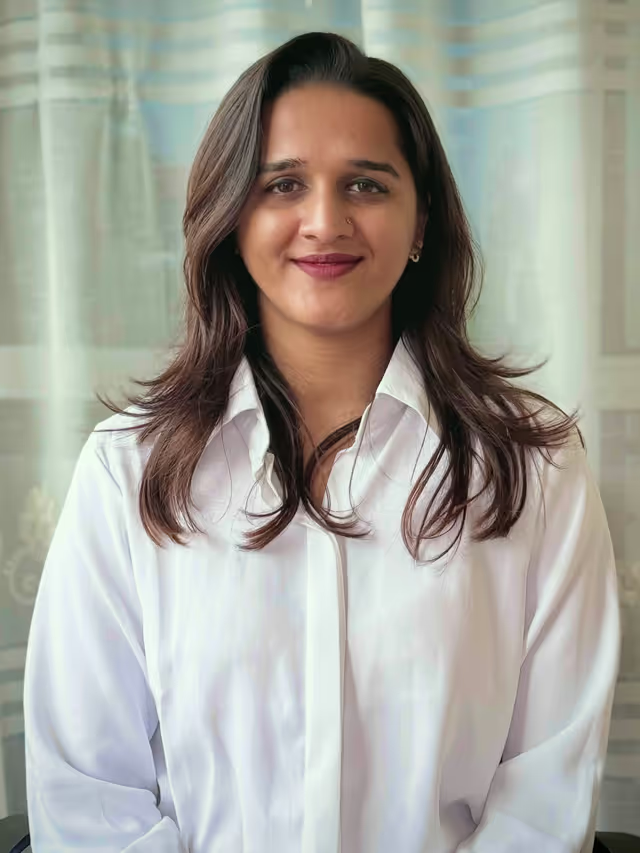
About Smriti Simkhada
Smriti Simkhada is a PTE Academic perfect scorer (90/90) providing structured PTE coaching for Nepali students. She and her team have helped 1,500+ students prepare for Australia PR and Canada immigration through structured, criteria-aligned coaching.