How PTE Academic Scoring Works for Beginners Nepal 2026
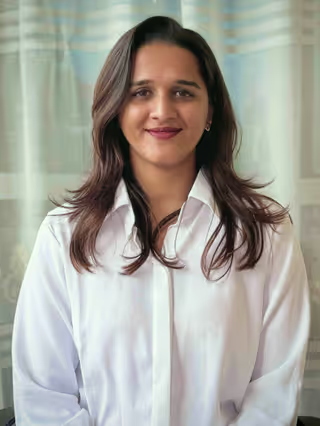
By Smriti Simkhada (90/90) · Updated
⚡ Quick answer
PTE Academic is scored by Pearson's AI on a 10-90 scale across four communicative skills: Listening, Reading, Speaking and Writing. Your overall score is their average: (Listening + Reading + Speaking + Writing) ÷ 4. Your performance also feeds six enabling skills (Grammar, Oral Fluency, Pronunciation, Spelling, Vocabulary, Written Discourse). Results arrive in about 2 business days and stay valid 2 years.
— Verified by Smriti Simkhada, PTE Academic 90/90 (PTE Nepal).
PTE Academic Scoring Can Feel Like a Black Box — Here Is How It Actually Works
One of the most common frustrations Nepali students experience when starting PTE Academic preparation is that the scoring system feels mysterious. You speak into a microphone, type some answers, and a number between 10 and 90 appears a couple of days later. But what happens in between? How does your Read Aloud performance become a Speaking score? Why did your Writing score drop even though your essay seemed fine? Why do scores sometimes increase or decrease unexpectedly between attempts?
This guide explains PTE Academic scoring from the ground up in plain language for beginners. You will understand exactly how your answers generate your final scores, what the AI evaluates, and which scores actually matter for your visa or university application in Nepal.
Stuck below your target? The 79+ Sprint
Private 1-on-1 coaching, from US$99: pick 7 days, 17 days or 1 month, one live session a day at a time that suits you, a demo session included, and Coach-Until-Target on the longer plans.
The Core Idea: PTE Academic Is Primarily AI-Scored
PTE Academic is primarily scored by Pearson's AI scoring system. Since the 2025 update, some response types may also be part-scored or reviewed by human experts, though pronunciation and oral fluency are not assessed by human examiners. This is one of the most important things to understand about how PTE scores work. When you speak in Read Aloud or Describe Image, the AI analyses your recording. When you write an essay, automated scoring evaluates your grammar, vocabulary, and structure.
This has important implications for Nepali students:
- Your Nepali or Indian accent does not automatically lower your score — the AI is designed to understand a wide range of English accents
- Scores are highly consistent across test attempts because examiner variability is minimised
- The AI rewards specific patterns — knowing what the AI looks for is essential to scoring well
- Pearson says results usually arrive within two days, up to five working days. Check Pearson's official site for the latest guidance.
The PTE Score Scale: 10 to 90
Every score in PTE Academic uses the same 10–90 scale. This applies to:
- Your overall score (the average of all four section scores)
- Your four communicative skills scores (Listening, Reading, Speaking, Writing)
- Your six enabling skills scores (Grammar, Oral Fluency, Pronunciation, Spelling, Vocabulary, Written Discourse)
A score of 10 means very limited English ability. A score of 90 means native-level English proficiency. Most Nepali students targeting Australian skilled migration, Canadian immigration, or UK visas need scores in the 50–79 range, depending on their specific visa category.
Common Score Benchmarks for Nepal Students (Tests Taken On or After 7 August 2025)
Pearson and the Australian Department of Home Affairs (DHA) updated English proficiency thresholds for PTE Academic tests taken on or after 7 August 2025. Always confirm the latest requirements on the official DHA English language page for your specific visa subclass, as transition rules and subclass requirements vary.
- Competent English (post-7 Aug 2025): Listening 47, Reading 48, Writing 51, Speaking 54. (Tests taken on or before 6 Aug 2025 used a uniform 50 per skill threshold — those results may still be accepted under transition rules depending on visa subclass and validity.)
- Proficient English (post-7 Aug 2025): Listening 58, Reading 59, Writing 69, Speaking 76. Always check the DHA English-language page for your visa subclass before booking or lodging. (Tests taken on or before 6 Aug 2025 used a uniform 65 per skill threshold.)
- Superior English (post-7 Aug 2025): Listening 69, Reading 70, Writing 85, Speaking 88 — required for Australia PR points boost (10 extra points). These thresholds apply to tests taken on or after 7 August 2025. (Tests taken on or before 6 Aug 2025 used a uniform 79 per skill threshold.)
- PTE 90 overall: Maximum score — effectively native-level proficiency
Sources: DHA Superior English; PTE updates 2025 summary
How Individual Task Answers Become Scores
Your score does not come from a single calculation. It is built up from hundreds of micro-evaluations across every task you complete. Here is how it works for each type of response:
Speaking Tasks — How the AI Scores Your Voice
For tasks like Read Aloud, Repeat Sentence, Describe Image, and Re-tell Lecture, the AI evaluates your recording along several dimensions:
- Content: Did you include the relevant words, ideas, or information? For Read Aloud, content means reading the correct words from the text.
- Pronunciation: Were your spoken words recognisable as standard English words? The AI compares your phonemes (sound units) against a pronunciation model.
- Oral Fluency: Did you speak smoothly without unnatural pauses, false starts, or repetitions? The AI analyses speech rhythm and the distribution of pauses.
Each of these dimensions generates a sub-score, and these sub-scores combine to create your Speaking communicative score and your Oral Fluency and Pronunciation enabling scores.
Writing Tasks — How the AI Evaluates Your Writing
For tasks like Write Essay and Summarize Written Text, the AI evaluates:
- Content: Did you address the essay prompt? Did your SWT capture the main idea of the passage?
- Form: Did you meet the word count and format requirements? (Essay: 200–300 words; SWT: single sentence 5–75 words)
- Grammar: Are your sentences grammatically correct? Subject-verb agreement, tense consistency, article usage, and clause structure are all analysed.
- Vocabulary: Did you use a range of appropriate vocabulary? Did you repeat the same words excessively?
- Spelling: Are all words spelled correctly? Each misspelling deducts points.
- Written Discourse: Is your essay logically structured with a clear introduction, body, and conclusion? Do your paragraphs flow with appropriate connectors?
Reading Tasks — How Right or Wrong Answers Score
Reading tasks generally use correct/incorrect scoring with partial credit available on some task types. The key variations:
- Reorder Paragraphs: Partial credit — each adjacent pair of correctly ordered boxes earns a point. You do not need a perfect order to score partial points.
- Fill in the Blanks: Each correct word earns a point independently. Getting one blank wrong does not affect your other blanks.
- Multiple Choice Multiple Answer: Negative marking — selecting a wrong answer deducts a point. Selecting a correct answer adds a point. This is the most misunderstood scoring rule in PTE Academic.
- Multiple Choice Single Answer: No negative marking — one point for the correct answer, zero for incorrect.
Listening Tasks — Partial Credit and Negative Marking
Listening tasks follow similar rules to Reading but with one critical difference: Write from Dictation uses word-level scoring where each correctly spelled word earns a separate point. This makes it the most fine-grained scoring task in the entire test — and the one with the most room for partial credit improvement.
Communicative Skills vs. Enabling Skills: The Two Layers of Your Score
Your PTE Academic score report has two distinct groups of scores. Understanding the difference is essential for knowing which scores matter for your application and which scores to use for improving your performance.
Layer 1: Communicative Skills (What Visa Authorities and Universities Use)
These are your four section scores: Listening, Reading, Speaking, Writing. Every immigration authority and university in the world that accepts PTE Academic uses only these four scores — not the enabling skills scores below them.
Communicative skills scores are calculated from your combined performance across all tasks in that skill area. For example, your Speaking communicative score incorporates your scores from Read Aloud, Repeat Sentence, Describe Image, Re-tell Lecture, and Answer Short Question.
Layer 2: Enabling Skills (Your Diagnostic Improvement Map)
Below your communicative skills on the score report are six enabling skills: Grammar, Oral Fluency, Pronunciation, Spelling, Vocabulary, and Written Discourse. These are diagnostic sub-scores that show you which specific language ability is limiting your communicative score.
If your Speaking communicative score is 58 but your target is 65, looking at your Oral Fluency enabling score tells you whether the problem is speech rhythm (low Oral Fluency) or accent intelligibility (low Pronunciation). This helps you target the right practice instead of working on everything at once.
How Your Overall Score Is Calculated
Your PTE Academic overall score is the average of your four communicative skills scores:
Overall Score = (Listening + Reading + Speaking + Writing) ÷ 4
So if you score Listening 72, Reading 68, Speaking 65, Writing 70, your overall score is (72+68+65+70) ÷ 4 = 68.75, rounded to 69.
This averaging means that one weak section can significantly pull down your overall score even if the others are strong. A Nepali student scoring 79 in Listening, Reading, and Writing, but only 60 in Speaking, gets an overall score of 74 — not 79. This is why consistent performance across all four skills is the goal, not maximising one section.
Why Your Score Can Change Between Attempts
PTE Academic uses a large item bank — different students on the same day see different questions from the same pool. Your score changes between attempts for these common reasons:
- Different question difficulty: Some Read Aloud texts are shorter and simpler; others are longer and more complex. The scoring system adjusts for difficulty, but some variability is natural.
- Performance improvement: If you have been practising correctly, your actual English ability has improved and your score reflects this.
- Test day conditions: Speaking task scores can be affected by background noise, microphone sensitivity, and test day concentration.
- Score estimation variability: The AI scoring model has a small margin of error, typically ±3 to 5 points on individual section scores.
Common Scoring Misconceptions for Nepali Students
- Myth: Writing more in my essay always increases my score — Going over 300 words in the PTE Academic essay triggers a score penalty. The target range is 200–300 words, and exceeding it hurts your Form score.
- Myth: My accent will lower my Pronunciation score — PTE Academic's AI is trained on a diverse range of English accents worldwide. A consistent Nepali or Indian accent does not automatically hurt your Pronunciation score. What hurts the score is mispronounced consonants, incorrect word stress, or unintelligible speech.
- Myth: Skipping a question and leaving it blank is safe — Many PTE Academic tasks award partial credit. A blank answer guarantees zero. A partially correct answer (even one correct word in a WFD sentence) earns points. Always attempt every question — these strategies can improve consistency, but your score ultimately depends on your English ability, task performance, and the official scoring criteria.
- Myth: My overall score is what the university checks — Most universities and immigration authorities check per-skill minimums, not just the overall score. A 79 overall with a 45 in Speaking fails the per-skill requirement of many Australian and UK visa categories.
Tips for Nepali Students Starting PTE Academic
- Take an official scored practice test first — Before you start preparing, take one full Pearson-scored PTE Academic practice test. This gives you a real baseline score with enabling skill breakdowns so you know exactly where to focus your preparation.
- The AI rewards pattern and rhythm, not perfection — For speaking tasks, a steady, rhythmic reading of the text scores better than a careful but slow and paused reading. Speed your reading practice as you improve accuracy.
- Check negative marking task types before exam day — The tasks with negative marking are Multiple Choice Multiple Answer (Reading and Listening) and Highlight Incorrect Words. Memorise these task types. Never guess on them during your exam.
- Results arrive by email — Pearson says PTE Academic results usually arrive within two days, up to five working days; for PTE Core, Pearson says most results arrive within two business days and some take up to five. Plan your visa or university application timeline accordingly.
- Use your score report as a guide, not just a result — Your score report from each attempt tells you your enabling skills breakdown. Read this carefully. If your Oral Fluency enabling score is 38 but your Pronunciation is 72, your speaking problem is rhythm and flow, not accent. Target the right weakness.
Frequently Asked Questions
Q: How fast do PTE Academic results come in Nepal?
A: Pearson says PTE Academic results usually arrive within two days, up to five working days. For PTE Core, Pearson says most results arrive within two business days and some take up to five. You will receive an email notification when your scores are available in your Pearson account. Check Pearson's official website for the most current guidance.
Q: Does PTE Academic use the same scoring for all countries?
A: Yes. PTE Academic scoring is standardised globally. Your score from a Kathmandu test centre is directly comparable to a score from a Sydney or London test centre. The scoring system does not vary by country or location. Fees and test-centre availability can change; confirm in your Pearson account before payment at pearsonpte.com.
Q: Can the AI scoring system make errors?
A: Pearson's scoring system is highly reliable. If you believe your score does not reflect your performance, Pearson offers a formal re-score service for an additional fee. However, score changes following a re-score are uncommon. The re-score service is most useful if there were technical issues during your test (audio problems, microphone failures) that you reported at the test centre.
Q: Is a high PTE overall score enough, or do I need per-skill minimums?
A: Almost all immigration and university requirements specify per-skill minimums, not just an overall score. For example, the standard Australia skilled migration requirement specifies minimum per-skill thresholds — not just an overall figure. You could score well overall and still fail if one skill is below the required threshold. Always check the per-skill requirements for your specific visa or university programme on the official DHA English language page.
Q: What is the minimum passing score for PTE Academic?
A: There is no universal "passing score" for PTE Academic because the required score depends entirely on your purpose. Requirements vary by visa subclass and institution. For Australian PR pathways, required thresholds changed for tests taken on or after 7 August 2025 — check the official DHA page for your specific visa category and ensure your results fall within the required validity period.
Conclusion
PTE Academic scoring is logical, consistent, and learnable once you understand the system. The AI evaluates your answers across multiple dimensions for each task type, generating enabling skills scores that feed into your four communicative skills scores. Your visa or university application uses only the communicative skills scores — but your enabling skills scores are your diagnostic tool for improving them. As a Nepali student beginning PTE Academic preparation, the most valuable first step is taking a full scored practice test, reviewing your enabling skills breakdown, and targeting the one or two skills that are furthest from your goal. For personalised guidance on understanding your PTE score and building a preparation plan tailored to your target score, contact expert PTE coach Smriti Simkhada via WhatsApp for a free consultation.
Continue Your PTE Preparation
Related guides for Nepali students preparing for PTE Academic and PTE Core:
- PTE Academic 2026 changes overview
- PTE AI scoring explained
- How pte academic scoring works
- Enabling skills explained
- Common mistakes that cost marks
- Free score assessment
PTE has no pass/fail: PTE Academic reports a score on the 10–90 scale; whether that score is sufficient depends on the program (university, AHPRA, visa points, employer requirement). Check the threshold the receiving institution actually requires.
Last fact-checked on 2026-05-08 against official sources (Pearson PTE, Australia Department of Home Affairs, AHPRA, IRCC, GOV.UK, INZ). Test fees, score requirements, and visa rules can change at any time — always verify the latest details on the relevant official website before booking or applying.
Update (August 2025): PTE Academic Speaking now also includes Respond to a Situation and Summarize Group Discussion as scored task types (per Pearson plc, 10 July 2025, effective 7 August 2025). Verify the current task list on the official Pearson site before relying on this article for an exhaustive Speaking inventory.
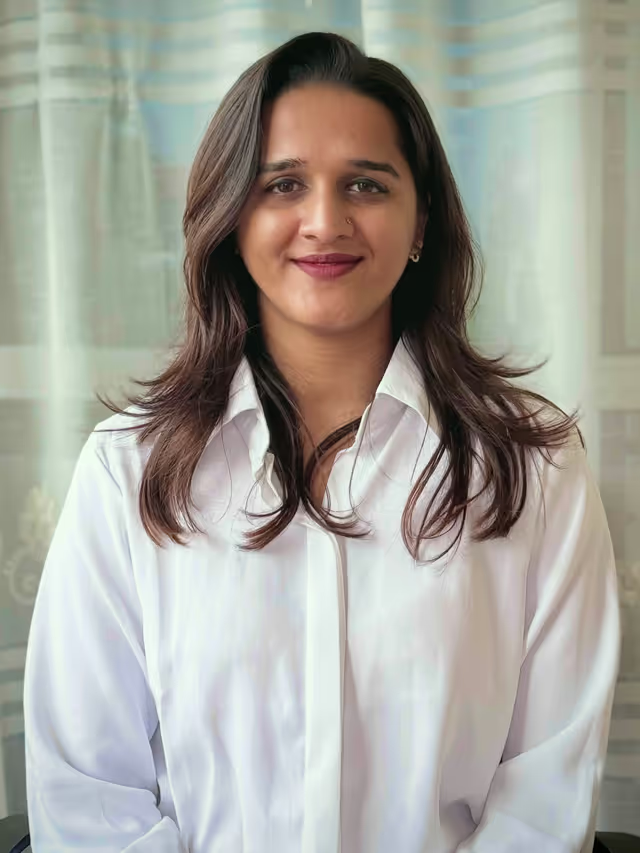
About Smriti Simkhada
Smriti Simkhada is a PTE Academic perfect scorer (90/90) providing structured PTE coaching for Nepali students. She and her team have helped 1,500+ students prepare for Australia PR and Canada immigration through structured, criteria-aligned coaching.